|
Raising of the Regiment
|
|
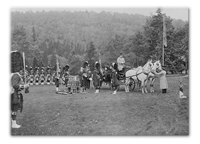
On 17 August 1793 Alan Cameron of Erracht was granted the Letter of Service authorising him to raise the 79th Regiment of Foot, or Cameronian Volunteers. This was after repeated efforts by Cameron to be allowed to raise a regiment of men from Clan Cameron in the region of Lochaber in the Western Highlands, and after his lobbying to repeal the Act that prohibited the wearing of Highland dress, one of the draconian measures enforced during the infamous Clearances. A Highland regiment had already been raised in the 1730s, the 42nd Black Watch, from Scotsmen loyal to King George, but ex-Jacobite supporters were still not trusted to be recruited, that was until the French Revolutionary War started in 1793. Major Alan Cameron had financial backing from his rich father-in-law, and his mother (or grandmother) designed the special Cameron tartan sett that has distinguished the 79th from other kilted regiments ever since.
Cameron had always intended that the 79th should be the Clan Cameron regiment, and the main source of recruits was therefore Lochaber, Appin, Mull and North Argyll. His brother, Captain Ewen Cameron raised a complete company from Lochaber which assembled at Fort William in November 1793. But competition for recruits was fierce at the time as there were many Fencible regiments being raised, and the Duke of Gordon, a feudal superior of much of Lochaber, was also hoping to be allowed to raise a regiment (later the 92nd, raised in Feb 1794). Cameron had to send his recruiting parties to draw men from all over the Highlands, and from the main cities such as Edinburgh, Glasgow, Aberdeen and Perth, also the industrial towns where many Highlanders had sought work.
In selecting a base for his Headquarters, and accommodation for nearly 700 men, he was left with little choice. The coastal towns were full of Fencible regiments protecting the country from invasion by the French, and the only large barracks, at Fort George, were occupied by the 78th Highlanders who were being raised by Colonel MacKenzie of Seaforth. The only available town, with a small military barracks and enough inns to accommodate the recruits, was Stirling; and so it became the first HQ of the 79th.
|
|
French and Revolutionary Wars
|
|
Flanders 1794
The regiment was brought up to a strength of 1000 men in 1794 and received their first Colours. They were sent to Belfast until June but then sailed to England where they were ordered to prepare for service abroad. They were to sail to Flanders to join the allied army in what turned out to be a disastrous expedition to expel the French from the occupied Low Countries. The regiment landed at Gorcum near Flushing on 26 Aug 1794 and marched to Arnhem. They were then sent to Nijmegen but were soon retreating eastwards to the sea via Westphalia. In the spring of 1795 they were at Bremen having lost 200 men from cold and hunger.
Martinique 1795 - 97
The next posting was even more disastrous than the botched Flanders campaign. The 79th returned to England and were quartered at Newport where Lt-Colonel Cameron was informed that the regiment was to be broken up and drafted into other regiments. The infuriated colonel sought out the Duke of York, who happened to be in the Isle of Wight, to remonstrate with him, but the Duke was unsympathetic and said that the King, his father, would certainly send the 79th to the West Indies, a posting known to the army as a graveyard. Cameron intemperately retorted “You may tell the King, your father, from me, that he may send us to hell if he likes, and I’ll go at the head of them, but he daurna draft us!” Accordingly the regiment sailed from Cowes in July 1795 and arrived on Martinique on 20 September. They were given onerous duties on board infectious prison ships, a task that lasted until June 1797. The regiment was by this time greatly reduced in numbers, and faced the ultimate humiliation of being drafted after all. It is recorded that the commander of Martinique, Sir Ralph Abercromby had no liking for Colonel Cameron and ordered him home with just a skeleton of the regiment consisting of officers, sergeants and drummers, while the survivors of the 79th, which amounted to 229 men, were drafted, mostly into the 42nd Highlanders.Egmont-op-Zee, 2 Oct 1799
The remnants of the regiment returned to England in August 1797 and marched to Inverness to recruit Highlanders. By June 1798 they had a strength of 780. After a short spell in Guernsey, they were sent to the Helder in North Holland for a further attempt to drive the French out of the Low Countries. The 79th were brigaded with the 2nd Bn Royal Scots, 25th, 49th, and 92nd Regiments under the command of Sir John Moore. The 4th Division, commanded by Sir Ralph Abercromby, advanced in column along the beach and encountered the enemy positioned at the village of Egmont-op-Zee. Moore’s brigade formed line to the left of the brigade, and despite the difficulties of running on soft sand hills, carried out a brilliant bayonet charge. The enemy troops were pursued for a considerable distance until darkness put an end to the fighting. The other brigades under Dundas, Pulteney and the Russians under Count D’Essen, attacked the centre of the enemy line with similar success.
The French and Dutch were able to reform their defence between Beverwyck and Wyck-op-Zee as the allies were too exhausted to pursue further. The casualties were Captain Campbell of the Grenadier company and Lt Stair Rose killed, along with 13 men. The list of wounded included Lt-Col Alan Cameron who was shot through the arm and had a severe wound to the wrist which caused him permanent loss of the use of his hand. Two lieutenants, 4 sergeants and 54 men were also wounded. The regiment did not take part in the next battle at Alkmaar on 6 Oct. An armistice was concluded on 7 Oct and the allies left Holland. The 79th sailed to Yarmouth and were stationed at Chelmsford barracks. It was not until 2 Oct 1818, the 19th anniversary of the battle that they were awarded the battle honour EGMONT-OP-ZEE.
Ferrol, 26 Aug 1800
An Expedition to destroy the arsenals and ships of the Spanish was sent to Ferrol and Cadiz in August 1800. The 79th had been stationed on the Isle of Wight but joined the army at Southampton and sailed on 16 Aug 1800. They arrived at Ferrol on 25 Aug and disembarked a few miles north of the objective. The Rifle Corps made an initial attack on outlying Spanish troops, followed the next day by an attack by the 52nd Regiment. This was supported by Maj-Gen Morshead’s brigade consisting of the 2nd , 27th and 79th Regiments. The result of this battle was the defeat of the Spanish outposts and the occupation of the heights overlooking the town of Ferrol.
It was at this point that the commander of the expedition, Lt-General Sir James Pulteney made the unpopular decision to abandon the enterprise, and retreat back to the ships. This decision was met with disbelief and many senior officers made their objections very clear. The regiment had suffered relatively light casualties; one officer, two sergeants and two rank-and-file wounded. The staff of the Regimental Colour was struck by a musket ball whilst being carried by Ensign Cooksey. The regiment could have suffered much worse when a storm struck and the Transport ‘Minerva’, carrying 3 Companies of the 79th, narrowly escaped destruction.
Cadiz, 4 Oct 1800
Pulteney was replaced by Sir Ralph Abercromby and the force sailed south to Cadiz which was reached on 4 Oct. The Spanish refused to surrender and a plan of attack was put in motion. The 79th were loaded onto boats suitable for landing but then the order was given to abort the attack. The reason given was that bad weather was approaching and there was said to be plague in the town. The men re-embarked on the Transport and the fleet sailed to Gibraltar bay, arriving on 23 October.
Aboukir Bay, 8 Mar 1801
The fleet was then diverted for an attack on the French in Egypt. In November 1800 they sailed to Malta where the regiment spent 20 days encamped, and were reinforced with a draft from the Highland Fencibles of 279 men. In January 1801 they rendezvoused at Marmorice Bay in Turkey where training took place for the landing in Egypt. This was made in March 1801; the landing being delayed a week by bad weather. On 8 March the army invaded the coast at Aboukir Bay and fought off stiff opposition from the French defence. The next few days were spent unloading stores and artillery.
Lake Maadie, 13 Mar 1801
The French retreated toward Alexandria and the army moved forward on 12 March in a long line stretching from the sea to Lake Mareotis. The French picquets were driven in, but the enemy had established themselves on sand-hills extending from Lake Maadie to the sea, blocking the approach to Alexandria. The attack was led by the 90th and 92nd Highlanders, the 90th repulsing a cavalry charge. The 79th, brigaded with the 2nd and 50th Regiments, was ordered to attack the French right flank. They drove the enemy from the hills with a bayonet charge and the pursuit lasted for several miles. The losses to the regiment were; 5 men killed and 63 wounded, including the commanding officer, Lieutenant-Colonel Patrick McDowall. who later died of his wounds at Rosetta.
Alexandria, 21 Mar 1801
Abercromby withdrew his army two miles and entrenched them on some high ground between Cleopatra’s Palace and a canal on their left. A week was spent building batteries and redoubts, but on the night of the 20th March there was a false alarm that caused the army to stand to arms. Colonel Alan Cameron, who was part of the expedition but not actually commanding the regiment, took charge after Lt-Col McDowall had died. Cameron ordered the regiment to remain under arms for the rest of the night and so they were well prepared when the French launched an attack on an advanced battery on the left. However this was a feint to divert attention from the real attack that came towards the British right. Daylight revealed enemy artillery and cavalry in position on the plain outside the city of Alexandria.
The fighting on the right continued without either side gaining ground. Then a close column of infantry advanced on the British centre but were fought off by the Guards. The fighting was brought to a close soon after and the French withdrew. The casualties of the 79th were one sergeant killed and 21 men wounded. One of the wounded was Lieutenant Patrick Ross who had to have his arm amputated, but he was made of tough stuff because within 3 weeks he was back on duty and served in an outlying picquet.
Rhamanich, 9 may 1801
The 79th were moved to Maj-Gen Craddock’s brigade, which, along with a division of Turks was sent on an arduous march of many days along the Nile, until they reached the village of Rhamanich where a French force was encountered. The light companies were engaged in this battle so that the 79th’s casualties were not heavy, only one officer and one private were wounded. The regiment then proceeded to Cairo where the French finally capitulated. The 79th were given the honour of taking possession of the advanced gate, termed the Gate of the Pyramids, in the Fortress of Ghiza. However, the French garrison in the city of Alexandria were still holding out, but after a short siege they surrendered. The regiment left Egypt in October and were stationed for a few months on the island of Minorca, from Dec 1801 to June 1802.
2nd Battalion Raised 1804 A letter of Service was received by Colonel Alan Cameron, written by Charles Bragge, Secretary at War, on 19 April 1804, approving the addition of a 2nd Battalion to the 79th Regiment. The battalion was never sent on active service but was a source of supply to fill vacancies caused by casualties or discharged men in the 1st Battalion. The letter stipulated 10 companies made up of 950 privates, 50 corporals, 50 sergeants and one sergeant-major. The officers consisted of one lieutenant-colonel, 2 majors, 10 captains, 12 lieutenants and 8 ensigns. There was to be an adjutant, and specialists which included 20 drummers and 2 pipers. Also a paymaster, a paymaster-sergeant, a quartermaster, a quartermaster-sergeant, an armourer-sergeant, a surgeon and 2 assistant surgeons.
Officers were tasked with recruiting a quota of men, which if approved ensured their promotion. Men were to be enlisted ‘without limitation as to time and place of service’. No man above the age of 35 as to be enlisted. They had to be taller than 5’ 4”. The greatest care had to be taken ‘that no man enlisted who is not stout and well made, and that the lads are perfectly well limbed and open chested.’ They were not permitted to take apprentices. Colonel Cameron was allowed only 6 months to raise the battalion but managed it within a few months.
Proposal to Abolish the Kilt 1804
While engaged in the task of raising the 2nd Battalion, Cameron received a letter from Horse Guards in October 1804 asking his opinion ‘ as to the expediency of abolishing the kilt’ The proposal was to replace them with trews. This prompted a very passionate response in which the colonel explained that the kilt was very popular with the Highlanders and inspired terror and confusion in the enemy. It would also be the death warrant to recruitment. As to the trews, he accused the authorities of ‘stripping us of our native garb and stuffing us in a harlequin tartan pantaloon’. The kilt was easily dried after getting wet ‘whilst the buffoon tartan pantaloon, with its fringed frippery…sticking wet and dirty to the skin, is not so easily pulled off and less so to get on again in case of alarm or any other hurry.’ The proposal was dropped.
Catastrophe off Landguard, 8 April 1807
The 1st Battalion served in Ireland from 1803 to 1805 and then sailed to Ramsgate, staying at Ospringe Barracks. They attended the funeral of Lord Nelson in January 1806 and afterwards were stationed at Colchester. In May they moved to Weeley Barracks, midway between Colchester and Frinton-on-Sea, and then in February 1807 moved again to Harwich barracks. In April 1807 there was a catastrophe when 60 members of the regiment lost their lives in a storm (the history calls it a sudden squall). Captain John Dawson, 3 sergeants and 56 men drowned when they made the short crossing between Landguard Fort and Harwich at the mouth of the Stour and Orwell estuary on 8 April. Copenhagen, Sep 1807
The 79th embarked at Harwich on 26 July for an expedition against Denmark, commanded by The Earl of Cathcart. The objective was to destroy the Scandanavian fleet which was pledged to Napoleon. They landed at Zealand on 16 August and marched with other troops to Frederickswerk in the vicinity of Copenhagen. The British bombarded the city between 2 and 7 September. When the defenders capitulated, Colonel Alan Cameron was ordered to take possession of the citadel with a force composed of various flank companies. In October the regiment returned to Weeley barracks having sustained only four wounded casualties. |
|
The Peninsula War 1809 - 1814
|
|
Corunna 16 Jan 1809
Due to a treaty between Britain and Sweden, a force of 10,000 men was sent to assist the King of Sweden, under the command of Sir John Moore. They embarked at Harwich in May 1808 but after dropping anchor at Göteborg, the men were required to stay on board while Sir John visited the King in Stockholm. His trip proved fruitless and he returned the fleet to Spithead where they were redirected to Portugal. The regiment finally disembarked at Maceira Bay on 26 Aug 1808. Colonel Alan Cameron was promoted and appointed Commandant of Lisbon, so command of the 79th passed to his son, Lt-Col Philips Cameron. The army marched into Spain and linked up with a division under Sir David Baird. But the Spanish army had dispersed and the two divisions were not enough to fight the three French Corps d’Armée, one of which was commanded by Napoleon himself. They had no choice but to retreat towards Corunna in the northwest corner of the Peninsula. The rigours of the long cold journey through the mountains of Galicia are well known but the regimental history gives little information other than ‘the Cameron Highlanders were not exceeded in discipline and efficiency by any other corps’. However the suffering of the long hard march cost the regiment almost 100 men. The casualties were 40 officers and men killed or captured. Five officers, 4 sergeants and 45 men had to be abandoned due to injury or illness.
The regiment was not involved in the battle at Corunna to hold off the French army on 16 Jan 1809, although the light company, along with other light troops, were engaged in skirmishing near the village of Elvina. The regiment had no casualties from the action and the regiment embarked successfully for England. But the state of the regiment can only be imagined because, on arrival at Weeley barracks, there were 700 down with fever, brought on by the harsh conditions in Galicia. It took a few weeks for the men to regain good health. The losses from disease can only be estimated by the fact that the battalion had to be brought up to strength with a draft of 258 men from the 2nd Battalion.
Flushing, August 1809
An expedition was sent to the Netherlands in the summer of 1809 to destroy French arsenals and shipping on the Scheldt. This was known as the Walcheren Campaign. The 79th embarked at Harwich on 15 July. They were brigaded with the 11th and 50th Regiments and landed at Veer on 2 Aug. They marched to Flushing where they bivouacked and watched the bombardment which lasted from the 13th to the 15th Aug. The unhealthy climate caused the death of Paymaster Baldock and one other man. After the surrender of Flushing the army was sent up the Scheldt to attack Antwerp, but the expedition was aborted due to widespread fever, and the regiment was returned to England. Two officers and 42 men succumbed to sickness and had to be left in Britain when the regiment sailed back to Portugal.
Talavera 27- 28 July 1809
The battle of Talavera was the first major victory of the Peninsula War, where British and Spanish troops repulsed repeated French attacks and forced them to withdraw. Men of the 79th fought at this battle but not as a complete battalion which was at that moment sailing to the Netherlands. A detachment of the 79th was formed from sick men who had remained in Lisbon in August 1808 after the first voyage to Portugal. To these were added the men who had fallen ill on the retreat to Corunna and been left behind. They, together with men from other regiments, were placed under the command of Lt-Colonel Bunbury. They fought bravely in the battle of Talavera on 27 and 28 July 1809 and lost 14 men of the 79th killed and 28 wounded. Lt John Campbell Cameron was taken prisoner by the French but escaped during the night. No battle honour was granted to the Cameron Highlanders for this engagement. Cadiz 16 Mar 1810 The regiment was ordered to Portugal to join Wellesley’s army. They embarked at Portsmouth in Jan 1810 and reached Lisbon on 31 Jan. However, they were redirected to Cadiz to reinforce the defenders blockaded by the French under Marshal Victor. They landed on 12 Feb and quartered at La Isla de Leon, an advanced position. The commander of the division planned to attack the French on the Trocadero isthmus. He sent a company of the 79th to create a diversion across a small river, but the main attack was abandoned and the company recalled. However, Lieutenants Patrick McCrummen and Donald Cameron had been wounded along with 25 other ranks, before they were pulled out. The regiment stayed in Cadiz until 16 Aug and were then sent back to Lisbon.
Busaco 27 Sep 1810
The 79th were brigaded with the 7th and 61st Regiments, under the command of their former CO, Major-General Alan Cameron. Wellington positioned his army in a favourable place for battle to resist the advance of Massena. The brigade was on the extreme right of the line along the Sierra de Busaco. Advanced posts were sent forward down a steep and rugged slope but on the morning of the 27 Sep they came under attack when the French concentrated their effort against the right wing. Enemy skirmishers drove in the isolated troops. The picquet of the 79th was surrounded and Captain Neil Douglas volunteered to take his company forward to help them. They opened fire on the French and this enabled the picquet to retire in good order. However, Captain Alexander Cameron, the commander of the advanced post was seen fending off several French soldiers, refusing to surrender. He was killed and later found with seven bayonet wounds.
Massena redirected his army to attack the centre and left of Wellington’s army so that the pressure was off for the 79th and they were able to attend to their wounded. Captain Cameron’s picquet also lost 7 men killed. Captain Douglas was wounded in the shoulder and had the musket ball removed on the battlefield. Also wounded were 41 men. Six men had been captured or were missing.
Foz d’Aronce 15 Mar 1811
After Busaco, Wellington withdrew his army to the lines of Torres Vedras. Massena followed but his lines of communication had been stretched too far and in November he retreated to Santarem. The British followed and at Santarem it looked as if another battle would take place, but the French resumed the retreat with skirmishes occurring at various places where they caught up with the French rearguard. There was a serious battle at Foz d’Aronce in which the Light Division was engaged from 4pm until nightfall. The Light Company of the 79th fought in this action and distinguished themselves when their officer Lt Kenneth Cameron captured the commanding officer of the French 39th Infantry. Two men were killed and seven wounded.
Fuentes d’Onor 3 - 5 May 1811
The French entered Spain in April 1811 and battle lines were drawn up near Fuentes d’Onor. Wellington’s army extended beyond the brook of Onoro, on the hill of Fort Conception. The right of the line was at Nave d’Aver and the centre at Villa Formosa. In the afternoon of 3 May, Massena directed his attack on the British right where the village of Feuntes d’Onor was situated. It was here that the 79th were posted, together with the 71st Highlanders and the 24th Regiment. Lt-Col Philips Cameron commanded this brigade, with some light companies in support. The French managed to capture parts of the village but desperate hand-to-hand fighting took place, and by nightfall the enemy had been driven back. The brigade remained in control of the village but the light companies were moved elsewhere.
There was a lull in the fighting on the 4th May but the next day the French attack was renewed, with the most intense fighting taking place at Fuentes d’Onor. The whole VI French Corps d’Armée was sent in but only captured the lower part of the village. Two companies of the 79th were surrounded and captured. The remainder of the brigade was caught up in a violent melee where soldiers had to resort to clubbing the enemy with their rifle butts as there was no room to use the bayonet. The brigade was reinforced by the 88th and the 74th Highlanders. Grenadiers of the Imperial Guard were at the forefront of the French assault, and one of their soldiers was seen to step up into a doorway and aim his musket at Colonel Philips Cameron. The shot hit him and he fell from his horse mortally wounded. The cry went up that their CO had been shot, and the enraged Highlanders doubled their efforts. The Highlanders expressed their rage in Gaelic so that the other regiments understood that the colonel was the son of the well-respected Alan Cameron. The whole force defending Fuentes d’Onor were now more determined than ever and the French were driven back with heavy casualties.
The incident inspired Sir Walter Scott to write about Cameron’s death in his poem ‘Vision of Don Roderick’. Scott also wrote:
“The gallant Colonel Cameron was wounded mortally during the desperate contest in the streets of the village called Fuentes d’Onor. He fell at the head of his native Highlanders, the 71st and 79th, who raised a dreadful shriek of grief and rage. They charged with irresistible fury the finest body of French Grenadiers ever seen, being a part of Buonaparte’s selected guard. The officer who led the French, a man remarkable for stature and symmetry, was killed on the spot. The Frenchman who stepped out of his rank to take aim at Colonel Cameron was also bayoneted, pierced with a thousand wounds, and almost torn to pieces by the furious Highlanders, who, under the command of Colonel Cadogan, bore the enemy out of the contested ground at the point of the bayonet.’
The casualties of the 79th in this battle were; Killed: Lt-Col Philips Cameron, Captain Willam Imlach, one sergeant and 30 men. Wounded: 10 officers, 6 sergeants and 138 men. Missing: 2 sergeants and 92 men. Most of the missing were later discovered to have been killed. Captain Sinclair Davidson and 13 men died of their wounds on the following day. The regiment was awarded the battle honour FUENTES D’ONOR seven years later on 16 April 1818.
Salamanca 22 July 1812
The regiment suffered from fever and dysentery when they went into cantonments at Bemquerenca in August 1811, so that 300 men were hospitalised. They moved to Valledes in October where they were reinforced by a draft of 231 men and five sergeants from the 2nd Battalion, together with Lt-Col Robert Fulton who took over command of the 1st Battalion. However, by the end of 1811 they were still suffering from widespread sickness and spent the early part of 1812 in Vizen, a healthier location. They were involved in a forced march of 12 leagues (36 miles) to Llerena in March 1812 and in May they were further reinforced by 113 men and five sergeants under Captain Peter Innes. When the army met the French at Salamanca on 22 July the 79th were in the reserve with Major-General Campbell’s Division on the extreme left of the line. They remained inactive until the end of the day when they were brought into action to follow up Wellington’s important victory, with the loss of only two men wounded. However, the 79th were granted the battle honour SALAMANCA.
Siege of Burgos Sep 1812
The Allied Army entered Madrid on 12 August and the 79th was quartered in El Escorial. At the beginning of September Wellington marched the army 250 kilometres to Burgos in the North of Spain, where the castle was defended by a strong French garrison. They arrived on the 18th and set about preparing to lay siege. On 19 September an assault was organised, comprising the light companies of the 24th, 42nd, 58th, 60th and the 79th, commanded by Major Hon. E C Cocks. The objective was the San Miguel horn-work, a small defensive redoubt just beyond the slope leading up to the wall of the castle. The men of the 42nd and 79th led the assault but some men of the 79th were pinned down by fire from the defenders. The 79th’s light company officer, Lt Hugh Grant used a wounded soldier’s musket to fire back and encouraged his men to maintain the firefight long enough to be relieved by the other light troops. Grant was badly wounded and died a few days later.
 |
|
|
The 42nd and the 79th were unable to make any progress or to retreat. All they could do was wait for the rest of the light companies to storm the horn-work, which they did at 11pm. The 42nd were ordered to make a direct frontal attack while a detachment of 42nd and Portuguese troops was to attempt using ladders to storm the bastions. The light troops were to wait for the 42nd’s attack as their signal to go in, but when they did they were subjected to heavy fire which killed and wounded many men. But with a determined effort they managed to lift men up over the palisade. The first man to enter the horn-work was Sergeant John McKenzie of the 79th who was wounded as soon as he got in. He was lifted up by Sergeant Masterton McIntosh also of the 79th who soon followed, with Major Cocks and others. The rest of the Highlanders used ladders and within minutes the horn-work was captured. McKenzie, who had borrowed Major Cocks’s sword, together with 12 men was detailed to guard the gate leading to the castle to cut off the defenders’ escape. It was here that fierce fighting took place in which McKenzie was severely wounded and Bugler Charles Bogle of the 79th was bayoneted and killed.
Meanwhile, the frontal attack had failed, with great loss of life, and the storming party came under fire from muskets and guns but were later relieved by troops who spent the night building a defence to allow access to and from the horn-work. The two sergeants were recommended for commissions. There were subsequent efforts to storm the castle in which one assault by Guards and German troops was led by Major Andrew Lawrie of the 79th. His valiant efforts resulted in his death, and Major Cocks also was killed in another assault. Lawrie’s death and the death of Lt Hugh Grant were added to the regimental casualty figures which were: one sergeant and 27 men killed, three officers, five sergeants, one drummer and 79 men wounded. Wellington’s army lost 550 killed, 1,550 wounded, and 3 guns. By 21 October it was clear that the siege was too difficult and too costly so Wellington was forced to abandon the siege and vacate Madrid, leading the army on a disastrous and costly retreat towards Portugal, pursued by French cavalry.
Battle of the Pyrenees 28 July 1813
The 79th wintered at Vodra in Portugal, and on 20 Feb 1813 had a change of commanding officer when Lt-Colonel Neil Douglas joined the 1st Battalion, and by April had been reinforced by 80 men, sergeants and 2 officers. Active operations were resumed in May. The 79th were in the 6th Division, commanded by Major-General Pakenham, which did not take part in the battle of Vittoria on 21 June. They were instead employed covering the convoys of ammunition and stores, and later attempted to prevent Marshal Chauzel’s French Corps from joining the defeated French. But Chauzel outwitted Packenham and the 6th Division was recalled to join Wellington in North East Spain.
Soult’s French Armée d’Espagne confronted the allied army at Sorauren on 28 July. Packenham’s Division was positioned across the valley of the Lanz in the Pyrenees with its right resting on the village of Oricain and its left on the heights on the opposite side. An advanced brigade picquet under Major Andrew Brown was attacked and fought a fierce action. The battalion faced superior enemy numbers but fought at close quarters with the bayonet and, together with other divisions deployed on the mountains, successfully repulsed Soult’s army. This was an important victory for the British-Portuguese army and earned the 79th the battle honour PYRENEES, awarded 5 years later on 16 April 1818. Their casualties were 16 men and one sergeant killed, one officer, two sergeants, one drummer and 37 rank-and-file wounded. Lt-Col Douglas had his horse shot from under him, but was not seriously hurt.
Nivelle 10 Nov 1813
The 6th Division followed the retreating French and camped near the Mayo Pass. At this time the sieges of San Sebastien and Pamplona were concluded, so by November Wellington’s army was able to move into France, crossing the frontier on 10 November. The enemy were strongly entrenched on the River Nivelle and the 79th formed line to move up the hill to meet the enemy, in such an impressive manner that Sir Roland Hill remarked on their steady advance under fire. The French were forced to retreat causing the battalion few casualties: one man killed, an officer and five men wounded. The 79th Cameron Highlanders earned the battle honour NIVELLE, awarded on 16 April 1818.
Nive 10 - 15 Dec 1813
On 16 Nov the regiment set up camp at Ustaritz where it was reinforced by an officer, four sergeants and 46 men. On 9 Dec they advanced towards Bayonne where Soult’s army was entrenched on both sides of the flooded River Nive. On 10 Dec 1813 Wellington attacked the enemy defences on the flank, an operation that took 5 days. In this battle the 79th lost 5 men killed, and one officer, two sergeants and 24 men wounded. The French retreated to Gave d’Oleron and the 79th spent the rest of the winter at St Pierre d’Yurbe. They were in dire need of new clothing and this was issued at St Jean de Luz on 20 Feb 1814. The regiment was awarded the battle honour NIVE on 16 April 1818.
Toulouse 10 April 1814
The regiment took no part in the battle of Orthes on 25 Feb 1814, but on Sunday, 10 April they distinguished themselves to a high degree at the battle of Toulouse. This battle might never have happened if Soult and Wellington had been made aware that Napoleon had abdicated on 30 March. As it was, the French Troops were entrenched in fortified positions on the 600ft high plateau outside the city, between the Languedoc canal and the River Ers. The 79th marched out at daybreak on 10 April and approached the redoubts of de l’Est and de l’Ouest which had been unsuccessfully assaulted by Spanish troops.
 |
|
|
The Highland Brigade, led by Sir Denis Pack, consisted of the 42nd, the 79th and the 91st Regiments as well as a Portuguese regiment. As they moved into position they came under fire from French guns which killed and wounded several men. An attack was made by the flank companies which drove the enemy from the redoubts. Meanwhile the rest of the brigade prepared for an attack on the more difficult objectives of the central redoubts, La Colombette and Le Tour des Augustins. The 42nd were directed to assault La Colombette and the 79th, 91st and Portuguese were sent against Augustins. Both redoubts were captured but not without the Highlanders suffering heavy casualties. Several officers took 100 men of the 79th to attack more of the enemy on the ridge of the plateau, but while this was happening there was trouble at La Colombette where the French, having been reinforced, counter-attacked, driving the 42nd from the redoubt. The route of their retreat came past Augustins and the 79th joined them so that both redoubts were then abandoned.
Lt-Colonel Douglas then reformed the 79th and they made a heroic charge which resulted in the recapture of both Colombette and Augustins redoubts. The 42nd had been all but wiped out and could not offer much assistance in this part of the action. There were two more enemy positions to be attacked but as the brigade was preparing to do this the French were seen to be retreating and it was clear that the allied army had won the battle. The casualty figures reflected the heavy fighting, four officers and 40 men killed, 13 officers, 12 sergeants, 2 drummers and 159 men wounded. The regiment went into action with 36 officers, 31 sergeants, 13 drummers and 414 rank-and-file. It came out with 18 officers, 19 sergeants, 11 drummers and 215 rank-and-file. The battle honour TOULOUSE was awarded on 9 July 1816. |
|
Return to Britain, July 1814
|
|
The day after the battle of Toulouse, news came through of Napoleon’s abdication and the regiment was quartered in villages in the South of France. The regimental history states that the 79th had lost 650 men, NCOs and officers during the Peninsula War, either in action or through dying of wounds or disease. The battle honour PENINSULA was granted on 6 April 1815 in recognition of the Cameron Highlanders' service and sacrifice throughout the war from 1808 to 1814. On 3 July the battalion embarked at Pauillac and sailed to England, but within weeks they were redirected to Ireland where they were put into barracks in Cork. There were two attempts, in February and March 1815 to ship them off to North America but bad weather forced them to return to Ireland. In May they marched from Belfast to Dublin to embark for England, and from there they crossed the Channel.
Quatre Bras 16 June 1815
The 79th was brigaded with the 28th and 32nd Regiments under Major-General Sir James Kempt, in the 5th Division (Picton’s). They landed at Ostend and were conveyed along the canal to Ghent from where they marched to join the Duke of Wellington’s army in Brussels. News of Napoleon's rapid progress was given to the Duke and the order to get ready to march was given at 10 pm on the night of 15 June. They were held in readiness and rations were issued, but they did not set off until 4am. At 8am they halted at the Forest of Soignés and began to cook breakfast but this was interrupted by the order to continue on to Quatre Bras. The French were half a mile off but advancing, driving a battalion of Belgians before them and exchanging fire. Riflemen were sent to support the Belgians and the Division was placed to line the Namur road, with the 79th on the extreme left of the British Army.
 |
|
|
At around 3pm enemy sharpshooters were close enough to cause many casualties, so light companies were sent forward to repel them. The artillery was being rendered useless because the gunners had been picked off by enemy marksmen. Wellington ordered Piction to send a regiment forward to drive them off, and the Cameron Highlanders were chosen for the task. The Highlanders fired a volley and continued to advance with the bayonet. They succeeded in driving the French skirmishers back 100 yards to a hedge. The pursuit carried on until their ammunition was expended and they were joined by support troops. They were ordered to retire under fire and form a line in front of the Division where they had to lie down for an hour to reduce casualties. In the early evening French cavalry threatened Picton’s Division and the regiments formed squares which were repeatedly attacked. Mounted field officers were especially vulnerable and the COs of the 42nd and 92nd Regiments, Sir Robert Macara and Cameron of Fassiefern were killed.
By this time, British artillery was coming into action and the French were forced to retreat. By 9pm the firing came to an end and the men bivouacked in advance of the Namur road. The 79th had lost 28 men killed as well as Captain John Sinclair and Adjutant John Kynoch. The wounded included Lt-Colonel Neil Douglas, 16 other officers, 10 sergeants and 248 rank-and-file. Douglas and two of the officers were mounted and had their horses killed.
|
|
Waterloo 18 June 1815
|
|
After Quatre Bras the battle did not continue on 17 June, and at 1pm they were ordered to retreat under cover of the light companies. A thunderstorm broke and it rained heavily for the rest of the day and all night so that by the morning of the 18th everyone was soaked. The Division had bivouacked in corn fields near La Haye Sainte. The battle was slow to start but by late morning the French columns approached, accompanied by a barrage from their artillery. Kempt’s brigade deployed into line and advanced towards their own artillery, at the same time the light companies and Rifles went down into the valley and exchanged fire with enemy skirmishers.
A heavy column of French infantry advanced towards Picton’s Division so that the light companies were driven back. When the column was quite close, the brigade opened up a volley, then the 79th and 28th charged at the enemy with Picton at the front. This bayonet charge drove the column back down the hill and Picton shouted to his ADC, “Thornton, rally the Highlanders!” his last words just before being hit by a bullet in the head. At this moment, the Union Brigade of cavalry came up and passed through the gaps in the 5th Division. The Scots Greys passed through the 92nd Gordon Highlanders, shouting “Scotland forever!” both units charged at the retreating Frenchmen, the Gordon’s hanging onto the Greys’ stirrups.
But the Cuirassiers, dragoons, chasseurs and lancers advanced, prompting the regiments of Kempt’s brigade, the 79th, 28th and 32nd, to form squares. Piper Kenneth MacKay stepped outside the square of the 79th and walked around in front of the bayonets, playing ‘Cogadh na Sith’. Not long after this episode the regiment retired to its position on the Namur road near the Royal Artillery but it was exposed to enemy gun-fire and sniper fire. At around 6pm more cavalry and large masses of infantry threatened the British centre. Kempt’s brigade was now exhausted and without ammunition, but they were supported by Pack’s brigade and a supply of balls and powder. They were able to repulse the latest enemy attack, but Napoleon sent in his Old Imperial Guard. However, even these ‘invincibles’ were forced to retreat, and the order for a general advance was given.
The 79th had held its position for most of the day, and now, with loud cheers, they pressed forward, under the command of Lieutenant Alexander Cameron, a Grenadier Company officer who had taken over as the most senior unwounded officer. The casualties of the 79th on 18 June were; 4 officers, 2 sergeants and 27 men. Wounded were; 9 officers, 7 sergeants, 4 drummers and 121 men. The strength of the regiment before 16 June was 41 officers, 40 sergeants, 11 drummers and 684 men. The figures for unwounded personnel on the evening of the 18th June were 9 officers, 21 sergeants, 7 drummers and 260 men. The numbers of wounded from both battles included 3 officers and 48 men who died of their wounds soon afterwards.
|
|
Postings 1815 - 1825
|
|
The depleted battalion pursued the French army after Waterloo, until 8 July when Napoleon surrendered and the 79th camped at Clichy. On 5 Aug the battalion was augmented with a draft of 88 men, 4 sergeants and one captain who came from the 2nd Battalion which comprised the depot. The 2nd Battalion was disbanded at Dundee in December 1815. The Cameron Highlanders remained in Paris for 3 years, returning to England on 29 Oct 1818. Their postings after that were:
Chichester Nov 1818 - Mar 1819
Jersey June 1819 - Mar 1820
Plymouth Mar 1820 - May 1820
Fermoy May 1820 - June 1821
Limerick June 1821 - May 1822
Templemore May 1822 - Apr 1823
Naas Apr 1823 - Oct 1823
Dublin Oct 1823 - May 1825
|
|
Canada 1825 - 1836
|
|
The 79th was increased from eight companies to ten in April 1825, bringing its strength up to 740 rank-and-file, in preparation for foreign service in Canada. Six service companies sailed on three ships from the 25th, 26th and 27th August 1825, leaving four companies in the depot firstly at Cork, then Glasgow, and from 1826 to 1828 they were back in various parts of Ireland. The 6 service companies arrived in Quebec in October 1825 where they remained until June 1828 when they moved to Montreal with detachments at St Johns, Coteau-du-lac and Isle Aux Noix. In May 1829 they moved to Kingston, on Lake Ontario, providing detachments at Fort Henry, Point Frederick and Prescott. In May 1831 they were moved to Toronto from where they sent detachments to Amhurstburgh, Fort George, and Penitanguishine.
Whilst in Kingston and Toronto a corporal and 11 men died. In the summer of 1832 there was an outbreak of cholera which caused several more men to die. In November the flank companies were detached to Montreal under Lt-Colonel McDougall who had temporarily replaced Sir Neil Douglas as CO. The companies were employed in riot control in the city. The detachment at Amhurstburgh under Captain Riach was recalled in May 1833, but as they were being conveyed by steamer on Lake Erie the boiler exploded, killing two crewmen and injuring several Highlanders. On 23 Jan 1834, the old Chateau de St Louis at Quebec caught fire and men of the 79th were involved in trying to put the fire out but the water was frozen and the chateau burned to the ground. The Highlanders were stationed in Quebec until Sep 1836 when they returned to Scotland.
|
|
Gibraltar 1841 - 1847
|
|
The regiment left Britain at the end of December 1840 on two ships and arrived in Gibraltar on 25 and 26 Jan 1841. The service companies were commanded by Major the Hon. Lauderdale Maule who was promoted to lieutenant-colonel on 14 June 1842. The regiment was not on active service, and Lauderdale Maule took the opportunity to make changes and improvements to the uniforms and equipment of his men. New badges, accoutrements, sporrans, skean dhus, and dirks were introduced. Among his innovations, which were followed by other regiments, were the glengarry bonnet, green tunics for the pipers, and red and green hose which replaced the universal red and white.
There was an incident involving the capsizing of a boat in the harbour that put the lives of two soldiers in peril. They were saved by Corporal John Ross and eight privates of the 79th and four other soldiers. All 13 men received the thanks of the Governor of Gibraltar. While the regiment were on the rock for 6 years 28 men died; their names and the date of their death were inscribed on a marble tablet in the Wesleyan Chapel which was attended by Presbyterian soldiers. On 7 June 1848 the regiment embarked for Canada, arriving at Quebec on 27 July.
|
|
Chobham Camp 14 Jul - 20 Aug 1853
|
|
The posting to Canada lasted only 3 years and they sailed back to Scotland on 4 Aug 1851, arriving in Leith Roads on 30 Aug and joining the depot companies at Stirling Castle, later moving to Edinburgh. In 1852 a detachment was sent to London to attend the funeral of the Duke of Wellington on 18 Nov 1852. In April 1853 the regiment were taken by train to Lancashire where detachments were stationed in various places including the Isle of Man. On 14 July they travelled south by train to Staines and marched to Chobham Camp to be brigaded with the 19th and 97th Regiments. They remained under canvas and took part in manoeuvres with two other brigades, artillery and cavalry, the whole Division commanded by General Lord Seaton. There were also reviews attended by Queen Victoria and Prince Albert. The Camp was broken up on 20 Aug, and the 79th marched to Farnborough Station, taking the train to Portsmouth to stay in the Cambridge and Colewort barracks.
|
|
The Crimean War 1854 - 56
|
|
Scutari and Varna
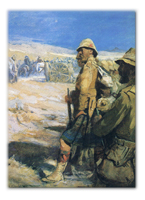
On 1st March 1854 The 79th were ordered to prepare for the coming war in the East and accordingly increased their strength with volunteers from other regiments. They received new Colours on 21 April and embarked at Portsmouth on 4 May under the command of Lt-Colonel Edmund Elliot. They arrived at Scutari on 20 May. The modern name for Scutari is Üsküdar on the Asiatic side of the Bosporus, opposite Istanbul. The 79th was brigaded with the 93rd (Sutherland Highlanders) and the 42nd (Black Watch) under the command of Sir Colin Campbell. This Brigade, together with the Guards formed the 1st Division which moved to Varna. The 79th sailed on the ‘Cambria’ on 13 June and encamped firstly at Lake Devno then moved to Aladyn. But after 3 weeks Aladyn proved to be unhealthy with men suffering from cholera. They then moved to Givrakla, but it was here that their CO and second-in-command both died of fever. At around the same time the 79th was saddened to hear that their previous CO, Colonel the Hon. Lauderdale Maule, also died. He had been appointed Assistant Adjutant General to the 2nd Division.
Invasion of the Crimea
The 79th, now under the command of Lieutenant-Colonel John Douglas, embarked on 29 August to sail up the coast to Balschik Bay where the combined armies of Britain and France assembled. On 7 Sep the fleet set sail for the Crimea, each steamer towing two sailing transports, and arrived at Kalamita Bay on 13 Sep. They disembarked the next day without opposition from the Russians, but it took 6 days to unload stores and guns so that it was not until 19 Sep that the army set off in the direction of Sevastopol. When they came to a stream, the Bulganek River, they were able to cross and form line along the crest of rising ground half a mile from the river. They were ordered to lie down while the Horse Artillery engaged with Russian guns for half an hour. A French column was sent forward and the Russians withdrew to the Alma.
Battle of the Alma 20 Sep 1854
 |
|
|
The army approached the river Alma and saw the enemy on the heights on the other side, blocking the route to Sevastopol. The village of Burliuk on the allied side of the river was set on fire by the Russians but there was a bridge still intact. The Russian defences on the other side consisted of three strongly defended redoubts filled with infantry and artillery. The French were ordered to attack the redoubt on the right of the allied line while the British were to attack the central main redoubt and the one on the left. The Rifle Brigade were sent forward through the burning village to engage with Russian riflemen on the other bank and drive them back.
The Light Division and the 2nd Division formed line and moved forward over the river to climb the hills on the other side. Sir Colin Campbell was careful to protect the Highland brigade from artillery fire, and used a stone wall to cover the advance of his Highlanders. Once over the river they ascended the hill by means of a mountain pass protected by abrupt rising ground. They were able to advance, protected from enemy gunfire. When they were near enough they formed in echelon lines, with the Black Watch on the right, near the Brigade of Guards, the 93rd in the centre and the 79th on the left. The two brigades formed a mile-long military spectacle of scarlet, tartan, feather bonnets and bearskins with Colours flying. The sight of this display, moving steadily on, pausing only to dress the ranks, caused the enemy to lose heart. A volley fired by the British at 200 yards discouraged the massed ranks of the grey-coated Russians and they panicked so that their officers could not prevent a wholesale retreat.
The Light Division stormed and captured the great redoubt and the left-hand redoubt was abandoned and held by two companies of the Cameron Highlanders. The French had succeeded in turning the enemy’s left flank.The allied line then advanced, the Horse Artillery firing on the retreating Russians, and the infantry occupied the next range of hills where they stopped and bivouacked. The casualties of the 79th were 2 men killed and 7 wounded. Over the next two days, the 21st and 22nd Sep 1854 were spent caring for the wounded and burying the dead.
Balaclava The 93rd Highlanders, separated from the 42nd and 79th, famously formed the thin red line to fend off a cavalry charge at the battle of Balaclava on 28 Oct 1854, but the 42nd and 79th took no part in the battle. Sir Colin Campbell had been promoted to command all the troops in Balaclava and the Highland Brigade came under the command of Colonel D A Cameron of the 42nd. The 79th and 42nd were moved to a position on the heights on the north side of the valley of Balaclava so they also missed out on the battle of Inkerman on 5 Nov 1854 when the Russians attacked the right of the British line entrenched before Sevastopol. The Highland Brigade remained on the Balaclava heights until 21 May 1855. They were employed carrying ammunition and supplies to the entrenched army, and in January 1855 they were building huts that had been shipped, prefabricated, from England. By the end of February the regiment was fully housed in wooden huts.
Reconnaissance in Force 21 Feb 1855
The Highland Brigade were sent on an abortive and arduous reconnaissance patrol to ascertain the position and strength of the enemy at Tchorgoum. The 71st Highlanders, the Royal Marines and one wing of the 2nd Bn Rifle Brigade went with them, later to rendezvous with a French brigade. The force was led by Sir Colin Campbell who ordered them to fall in at midnight on the 20/21st Feb 1855. But rain started to fall heavily just before 12, so the start was postponed until 2am. By that time the rain had turned to snow and they set off in a blinding snowstorm. The wind blew into the faces of the men and it was intensely dark so visibility was almost zero. They reached the River Tchernaya, but unsurprisingly there was no sign of the French. At daybreak the enemy picquets became aware of their presence and gave the alarm so the element of surprise was lost. They turned around and returned to camp utterly exhausted and frostbitten.
Kertch and Yenikale, May - Jun 1855
An expedition to capture Kertch and Yenikale on the eastern tip of the Crimean peninsula was led by Lt-General Sir George Brown, setting off on 22 May 1855. The Highland Brigade, plus 800 men of the Royal marines and the 71st Highlanders together with artillery and land transport sailed round to Ambalaki Bay. There was no fighting involved in this expedition. The Russians abandoned Kertch after blowing up their magazines and burning the barracks, and the British soldiers set fire to government buildings. But at Yenikale they anticipated trouble so set to work on trenches and redoubts to defend the place. On 29 May the 79th were detached to occupy the Quarantine barracks halfway between Kertch and Yenikale to maintain communications. But on 12 June they were ordered to burn the place and embark for the return to Balaclava.
Sevastopol
On 16 June the Highland Brigade were moved to join the Brigade of Guards entrenched before Sevastopol. The first predominant action of this siege took place on 18 June when assaults were launched on the Malakoff and the Redan. The brigade was in reserve, but the assaults failed and they were stood down. Another emergency occurred on 24 August when a report was received that there would be an attack on the French and Sardinian positions. The brigade marched to the Kamara area at 1am but the attack failed to happen. The next day they were ordered to move their camp to that area.
The Great Redan, 8 Sep 1855
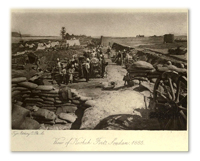
In the early morning of 8 Sep the brigade marched to where the Guards were camped, and ordered to remove their knapsacks and feather bonnets in preparation for service in the forward trenches. They moved forward under heavy fire from the defenders of the Great Redan, and were placed in the 5th parallel, the nearest trench to the Redan. The 79th, commanded by Lt-Col R C H Taylor, was on the right of the 72nd Highlanders. They were supported by the 42nd and 93rd in the 4th Parallel behind them. By this time the Redan had been assaulted by the Light and 2nd Division but the attack was repulsed with severe loss. Meanwhile the French attacked the Malakoff successfully. For the rest of the day the 79th remained in the trench under a heavy fire and were told that they would be the next ones to attempt an assault on the Redan the next morning. But by midnight the firing had slackened and explosions were heard inside Sevastopol. At 2am the whole city was on fire and it was clear that the Russians were destroying everything before evacuating. At dawn on the 9th Sep they realised that the enemy had abandoned the Redan and other defensive positions. Two companies of the 79th occupied the Redan and the rest of the Highland Brigade returned to camp which they reached at 3pm having been ‘under arms’ for 33 hours.
The End of the Siege
The lack of opportunity to be directly involved in the assaults and battles during the siege of Sevastopol did not prevent the Cameron Highlanders from sustaining casualties. They lost 17 men killed, and the wounded included a subaltern, the Assistant Surgeon, 3 sergeants, a drummer and 39 rank-and-file. The regiment spent the winter a little more comfortably than the previous winter, as their huts were positioned at Kamara where they did not suffer from mould and damp flooring. There was an expectation of resumed hostilities but on 2 April 1856 a Peace Treaty was signed creating much rejoicing. A salute of 100 guns announced the end of the war and there was ‘a friendly interchange of civilities’ between the Russians and the allied armies. There was even a Review where the allied armies were paraded before His Excellency General Luders, the Russian Commander-in-Chief and his staff. The 79th embarked at Balaclava on 15 June 1856, arriving at Portsmouth on 5 July.
|
|
The Indian Mutiny 1857 - 1859
|
|
Voyage to India
The 79th took part in a grand review in Hyde Park on 26 June 1857, attended by Queen Victoria. After the ceremony the regiment travelled by train to Liverpool and embarked for Ireland. But their posting there was cut short when they were ordered to prepare for service in India to quell the Mutiny. Volunteers from other regiments were drafted in to bring the strength up to 1,000 rank-and-file. On 31 July the regimental HQ, two companies, and the band were embarked on the ‘Walmer Castle’, the other six companies embarked the next day on two more transports. The regiment was commanded by Colonel John Douglas. The other officers consisted of two majors, 10 captains, 15 lieutenants, and 8 ensigns. There were also the Adjutant, Paymaster, surgeon and three assistant surgeons.
The two transports stopped at Ceylon and the 6 companies were transferred to HMS Simoon which arrived at Calcutta on 17 Nov. Lieutenant-Colonel RCH Taylor travelled to India overland and took command of the 6 companies in Calcutta. They were joined by 7 young East India Company officers who remained with the 79th throughout the campaign. Meanwhile, the other part of the regiment that sailed on the Walmer Castle reached Madras on 1 Nov and then re-embarked for Calcutta which was reached on 27 Nov.
Secundragunge, 5 Jan 1858
They spent two weeks in December at Allahabad where Sir Colin Campbell was in command. He had made an emotional speech to the Highland Brigade at the end of the Crimean War, fully expecting never to command his beloved Highlanders again but here he was commanding a column sent out to Munseala, a force of Rifles, Artillery and the 79th. They set out in the early hours of 5 Jan and at dawn found the mutineers at Secundra Gunge defending a position with 3 guns. The enemy did not stay long after firing a few rounds. They abandoned their guns and fled. They were pursued, but at the village of Papahnow the force was halted. The rebels lost 600, killed, wounded, and large numbers were captured. The 79th suffered no casualties. The column returned to Allahabad having covered a distance of 48 miles in 23 hours.
Siege of Lucknow 2 - 22 March 1858
In February 1858 Colonel Douglas was promoted to take charge of the 5th Brigade, so command of the 79th was taken up by Colonel Taylor. On 2 march the regiment joined the force under Sir Colin Campbell and Sir James Outram at Camp Bunterah where preparations were underway for an attack on the rebels in Lucknow. Campbell planned to attack the eastern defences but at the same time turn the enemy flank on the less strongly defended north side which was protected by the River Gomtee. The 79th spent the 2nd March helping prepare batteries in Dilkusha park for bombarding the first line of the rebel defence. The next three days were spent building pontoon bridges over the Gomtee at the village of Bidiapore. On the night of the 5th March Sir James Outram’s force crossed to the north bank of the river. The 79th were in Douglas’s 5th Brigade, part of Outram’s division. Also in this division was the Queen’s Bays who engaged rebel cavalry supported by the 79th. In this action they came under fire from enemy guns causing light casualties. On 7 March the regiment engaged with rebels, advancing in line for a mile. The next day Outram set up his artillery to fire across the river and on 8 March two companies of the 79th took part in Lt-General Walpole’s attack and capture of the Yellow House.
 |
|
|
The next objective of the two companies was the Badshah Bagh which, having been captured, allowed guns to be set up to enfilade the rebel trenches. The other eight companies of the 79th secured buildings in the vicinity of the Badshah Bagh. The Grenadier Company and no.1 Company occupied a large house that gave them control of entrance to the city over the Iron Bridge. On the morning of 10 March the rebels attacked the picquet of the 79th but were repulsed, however they maintained a steady fire on the picquet. The 79th made a determined bayonet charge led by the Grenadier and No.1 Companies which resulted in two men killed and two men badly wounded.
Meanwhile Campbell’s force captured the Martiniere, the Secundra Bagh, Shah Nujeef and Begum Kothie. On 11 march the 79th cleared the rebels from the suburbs near the Goomtee and the buildings near the Iron and Stone bridges. Outram’s artillery bombarded the Kaiser Bagh (King’s Palace). On 12 March the objective was the Iron Bridge with a view to throwing a breastwork across it. The construction of the breastwork was led by Lt Wynne RE who called for volunteers. He was joined by Capt Stevenson, Lt Wimberley, Sgt Mackenzie and 10 men of the 79th. At midnight the party advanced with gabions (baskets filled with earth) and sandbags, placing them halfway across the bridge. Sandbags were passed forward and the breastwork was soon completed, at which point men of the Bengal Fusiliers took up positions on the breastwork and fired on the rebels, covering the withdrawal of the Highlanders.
The 79th were posted to the Yellow House for three days while the siege of the Kaiser Bagh proceeded. On 16 March the 79th and two other regiments under Outram, crossed the Goomtee on a bridge of barrels near Secundra Bagh and joined Campbell at the Kaiser Bagh. They then stormed the Residency where the rebels offered little resistance and evacuated the place. The next day the 79th captured the Great Imambara where nine carts full of gunpowder were seized. They were ordered to destroy them but the explosion occurred prematurely causing 2 officers and 30 men to be killed or wounded. Sergeant James Blythe was killed, and the medic, Private Kerr, was honourably mentioned for his hard work in helping the wounded.
On 19 March the 79th, together with the 23rd Welsh Fusiliers, the 2nd Punjab Infantry and 3 companies of the 29th Regiment attacked Musagh Bagh. The light company of the 79th stormed and captured the house of Nawab Ali Khan. Three men were killed in the fighting that day. But the action resulted in the capture of four enemy guns and the Colours of the 7th Oude Irregular Infantry. The battle of Lucknow was finally over by 22 March. The casualties of the 79th over the three weeks were: 2 sergeants and 5 men killed, two officers, one sergeant and 20 men wounded.
Fort Rooya and Allygunge April 1858
On 7 April a Division under Lt-General Walpole left Lucknow to penetrate into Rohilkhand. The force contained the 79th, 42nd and 93rd Highlanders with the 9th Lancers, 2nd Punjab Cavalry, 4th Punjab Rifles and artillery. On 16 April they besieged Fort Rooya, the 79th being in reserve. The storming party suffered many casualties but the attack failed because no reconnaissance had been carried out and the attack was made against the most strongly held part of the fort. The 79th lost one man killed and one wounded. Another attack was launched on 22 April, against a position held at Allygunge, 40 miles from Fort Rooya. In this, the rebels were unable to withstand the attack and retreated, abandoning four guns. The 79th had no casualties.
Bareilly, 5 May 1858
Sir Colin Campbell arrived at Allygunge and assumed command. He led them towards Bareilly, and on 5 May the rebels were found to be defending a position in front of the town. A frontal attack consisting of a line formed by the Highland Brigade, supported by Native Infantry and flanked by cavalry, caused the enemy to retreat across a stream from their position. The force pursued for three quarters of a mile until they came to the suburbs of Bareilly. The line was halted to allow the artillery to come up. But Campbell became aware that some of the enemy were trying to turn his left flank, so sent a company of Camerons to occupy woods to the left front, with instructions to Captain McBarnet to hold the position at all costs. Once in the woods McBarnet and his men came under attack but were able to drive the rebels back. The 42nd Highlanders were also attacked but bayoneted their way out of trouble. The enemy occupied houses in the suburbs but were driven out by the 79th and 93rd Highlanders. The battle had cost the regiment two men killed and two wounded.
Shahjehanpore, May 1858
Sir Colin Campbell received news that troops left at the fort at Shahjehanpore were under siege, so sent a column consisting of the 60th Rifles, 79th Cameron Highlanders and 22nd Punjab Native Infantry, with two guns, to relieve the garrison. They left Bareilly on 8 May and made a forced march to arrive on 11 May at daybreak. Both the fort and the village were occupied by mutineers while the troops were holding out in the jail. Rebel cavalry came out of the village and rode around the column but the guns were brought into action and the rebels retreated. The midday heat was now unbearable and the men halted for two hours. When they resumed they found the village deserted and were able to rescue the troops in the jail. In this action there had been no casualties but 23 men suffered sunstroke and many died.
The enemy had withdrawn to Mahomdie so the column set up camp outside Shahjehanpore facing towards Mahomdie. They remained inactive until 15 May when rebel cavalry appeared from a wood and charged at the 79th. They formed square and fired on their attackers, causing many rebel casualties. But the cavalry kept coming so that the gunners had to leave their guns and take refuge in the square. The rebels seemed fearless but were unable to penetrate the formation, and eventually retreated. The 79th retained their position all day and returned to their camp. On 24 May they had to march to the fort at Remi, which the rebels abandoned, and then attacked their position at Mahomdie on 25 May.
The action on 25 May at Mahomdie was successful, although the 79th had two men wounded. However, the principal danger was the intense heat which killed 10 men on 25 May, 8 men on the 26th and 4 on the 27th. Many men were invalided following these few days. The regimental surgeon Dr Thomas Goldie Scot worked tirelessly to help the stricken men and through his care and attention many lives were saved. An account of his life and work is in the Library and Archive of the Royal College of Surgeons of Edinburgh.
Rampore Kussia, 3 Nov 1858 The regiment was inactive for the rest of the summer, posted at Futtehghur and then Cawnpore. On 18 October they moved by rail to Allahabad and prepared to carry on with the campaign. They were part of a field force commanded by Brigadier-General Weatherall in Oude. On 1 Nov they marched towards Rumpore Kussia, arriving on 3 Nov and found the rebels strongly entrenched. Four companies of the 79th were ordered to storm the defences, supported by the rest of the regiment. This was done quickly so that the enemy were taken by surprise. The attack was successful, but two men were killed and a sergeant and 6 men were wounded. The regiment was commanded by Major Butt, in the absence of Lt-Col Taylor who was commanding a brigade.
Muchligan Nov 1858
The Historical Record does not give dates for the rest of the campaign in 1858. At the crossing of the Gogra river there were many quicksands from which men had to be extricated and where the artillery had great difficulty. They advanced to Muchligan where they encountered the enemy. The mutineers were driven into the jungle which proved a difficult place to continue the fight, but Private Robert Winning distinguished himself when, finding himself cut off and facing 6 rebels, he shot one, bayoneted another so that the other four fled. The regiment marched through Sultanpore and later crossed the Raptee river on Christmas day. There was a battle at Bundwa Kote on 3 Jan in which 27 guns were captured, but the regiment’s involvement is not made clear.
The End of the Campaign
The surviving rebels that had been pursued by the field force took refuge in Nepal, and the regiments were returned to their stations. On 22 Jan 1859 the 79th arrived at Lucknow where they were greeted by Sir Colin Campbell who inspected them and made a speech congratulating them on their bravery and hard work throughout the Indian Mutiny campaign, and telling them that they would be sent to Mean Meer in the Punjab. The regiment had lost 158 men through disease and action, and on 3 Sep 1863 was awarded the battle honour LUCKNOW for the fighting during the difficult days in March 1858. They arrived at Mean Meer on 8 April 1859 and remained there until January 1861.
|
|
Service In India 1859 - 1871
|
| 1860 Stationed at Mean Meer, although a Detachment of 100 men under Capt Harrison was sent to Fort Kangra from 1 Nov 1860 to 21 Jan 1862.
1860 On 5 Nov the right wing, 287 all ranks, under Major McBarnet went to Amritsar.
1861 The left wing left Mean Meer on 19 Jan 1861, marched to Ferozepore where they were joined by the right wing from Amritsar.
1862 They marched from Ferozepore on 13 Feb 1862, arriving at Nowshera on 18 March. A detachment of 3 companies went to Fort Attock.
1862 On 23 Nov 1862 they moved from Nowshera to Peshawar and were joined by the men from Fort Attock. Many men suffered from Peshawar fever while stationed there.
1863 Two officers volunteered to join Sir Neville Chamberlain’s expedition against the Sitanas. Both were killed, Lieut Dougal, on picquet on 6 Nov and Lieut Jones on 18 Nov. They were serving with the 71st Highland Light Infantry.
1863 In Jan 1863 four companies under Major Miller went to Shubkudder Pass at the entrance to the Khyber to join Colonel Macdonell’s field force against the Mohmunds. They served until Jan 1864 and received the Indian Medal for the North-West Frontier Campaigns.
1864 In January 1864 the regiment marched from Peshawar to Rawalpindi. On 4 March they were inspected by the Commander-in-Chief, General Sir Hugh Rose. The fever contracted in Peshawar continued to afflict the men.
1864 In April they provided volunteers to work on the road from Murree to Abbottabad. On 28 April Captain Conway Gordon and 300 men went to Camp Durrgaw Gully and stayed there until 18 July, then moved to Khyra Gully, returning to Rawalpindi on 2 Nov.
1865 On 5 April the regiment was increased by three officers and 20 men from their UK depot. On 8 April they provided a working party of 650 men in the Murree Hills.
1865 The regiment were camped at Gora Gully and Grogur Gully. A terrible thunderstorm struck the Gora Gully camp and a falling tree killed Sergeant Angus. The health of the men improved in the Murree Hills.
1865 The rainy season began in June so the men were housed in huts at Khyra Gully until 24 Oct when they returned to Rawalpindi.
1866 In February 1866 the regiment was joined by a draft of two Colour Sergeants, 3 Corporals and 44 men from the depot. Later in Feb a detachment of 104 men under Capt Everett went to Fort Attock, relieved a month later by a similar detachment under Capt Leith. The CO, Colonel Hodgson went on leave in March 1866 leaving the regiment under the command of Colonel Richard Mordesley Best who had exchanged to the 79th from the 10th Foot on 13 Sep1864.
1866 On 28 April a detachment of 170 men under Capt McNair worked in the Murree Hills until October.
1866 The regiment relocated on 28 October; the HQ and left wing marched to Roorkee and the right wing went to Delhi.
1867 In January 1867 a draft of 52 men and three officers joined them at Roorkee. In the spring they had to be moved to a camp five miles from Roorkee to avoid fever which killed six men. The CO, Colonel Hodgson returned from a 21-month leave on 24 Dec. The two wings of the regiment changed places at the end of December but the HQ remained at Roorkee.
1868 The regiment was joined by a draft of two officers, 3 sergeants and 78 men on 27 April 1868. The two wings of the regiment swapped places again towards the end of the year.
1869 At the end of January 1869 they were augmented with a draft of 130 men, two officers and a sergeant.
1869 The regiment took part in two important ceremonial occasions in 1869. In March they relocated to Ambala to take part in the ceremony where the Viceroy Earl Mayo met Shere Ali Khan, Ameer of Kabul. The 79th provided the Viceroy’s escort and Guard of Honour at the Durbar. They also lined the streets and performed similar tasks a few days later when the Viceroy visited the Ameer. In May they were ordered to attend a Durbar in honour of the Duke of Edinburgh, but the Durbar was cancelled due to famine. The regiment was moved from Roorkee and Delhi to Kamptee in December.
1870 In Jan 1870 the 93rd Sutherland Highlanders passed through Kamptee en route for home. The two regiments exchanged offers to grant each other honorary membership of each other’s officer’s mess.
1870 The 79th remained at Kamptee for two years, during which time a detachment was sent to Fort Nagpore. Many men were sent to sanitariums to convalesce.
1871 A detachment was sent to Puchmurree in 1871. In August they were ordered to prepare for the return to the UK. Many men took the opportunity to remain in India, and 177 transferred to regiments stationed there. On 28 Aug Captain Donald Macdonald fell down dead whilst at gun drill in the Artillery Barracks. He had been with the Cameron Highlanders for 17 years. A monument was put on his grave at Kamptee, paid for by his fellow officers.
1871 The regiment split into two wings to march from Kamptee to Nagpore in September 1871. They were then sent by rail to Deolali, then to Bombay to embark on the Jumna which sailed on 1 October. They sailed through the Suez Canal which had opened in 1869, arriving at Spithead on 6 Nov. They transhipped to Cowes and marched to Parkhurst. The 79th had spent 13 years in India and lost 336 officers and men.
|
|
The 79th Cameron Highlanders at Parkhurst
|
|
In February 1872 the regiment was stationed at Albany Barracks, Parkhurst, Isle of Wight. In that month, Queen Victoria was staying at Osborne House and expressed her desire to see the 79th Cameron Highlanders in marching order. At 10am on 16 Feb they proceeded towards Osborne and saw the Queen and members of her family by the side of the road watching them as they marched past. The 79th then made a detour towards East Cowes, then Newport on their way back to Parkhurst. Victoria appeared a second time, showing a great interest in the men’s dress and appearance. Her Majesty’s impromptu inspection was disastrous in one respect. The Commanding Officer, Colonel William Chauval Hodgson, was in London at the time of her request, so had to hurry back. He ‘took cold’ on the journey and this developed into erysipelas. He was able to be with the regiment as they marched around the island but died soon afterwards on 1 March. Colonel Hodgson’s funeral was on 5 March, attended by every man of the 79th and the 103rd Fusiliers as well as the Isle of Wight Militia and Volunteers.
Visited by Emperor Napoleon III
On 17 Sep 1872 the regiment was visited by the French Emperor Napoleon III and his son the Prince Imperial. They inspected the men and watched as they performed drill movements, then had lunch in the officer’s mess. ‘He expressed his admiration of the splendid appearance and physique of the men, and the magnificent manner in which the drill had been performed.'
Presentation of New Colours, 17 April 1873
A new stand of Coloursn was presented to the regiment by Queen Victoria in a ceremony at Parkhurst Barracks on 17 April 1873. Newport was decorated and triumphal arches were erected in the street, but the presentation was in the drill field, witnessed by a large crowd. The 79th was under the command of Lt-Colonel Miller. This was the 5th stand of Colours, emblazoned with 13 battle honours including ALMA, SEVASTOPOL and LUCKNOW. The Queen’s Colour was a Union flag with the regimental number and crown in the centre. The Regimental Colour was green with a small Union flag in the top corner, a wreath in the middle and LXXIX in the centre. The unfortunate part about this stand of Colours was that the green Regimental Colour had to be replaced by a blue one a few months later, when the regiment became The 79th Queen’s Own Cameron Highlanders.
Visited by Emperor Napoleon IIITitled Queen’s Own
A letter from Horse Guards, dated 10 July 1873 was sent to the Officer Commanding the 79th Cameron Highlanders at Parkhurst Barracks, Isle of Wight:
‘Sir,
By direction of the Field-Marshal Commanding-in-Chief, I have the honour to acquaint you that Her Majesty has been pleased to command that the 79th regiment be in future styled ‘79th Queen’s Own Cameron Highlanders,’ that the facings be accordingly changed from green to blue, and that the regiment be permitted to bear in the centre of the second colour, as a regimental badge, the ‘Thistle ensigned with the Imperial Crown,’ being the badge of Scotland as sanctioned by Queen Anne in 1707, after the confirmation of the act of Union of the Kingdoms.
J. W. Armstrong,
Deputy-Adjutant-General.’
Lieutenant-Colonel G M Miller wrote a letter of gratitude, dated 12 July, to Major-General Ponsonby, Equerry in waiting to HM the Queen at Osborne. On 13 Aug Lt-Col Miller was asked to have the regiment drawn up as a Guard of Honour at East Cowes on 14 August 1873 for Queen Victoria’s departure from the Isle of Wight to travel to Balmoral. The regiment left the island on 18 Sep to relocate to Aldershot.
|
|
The Ashanti War 1874
|
|
Under Cardwell’s Localisation Scheme of 1873, and up until the Army Reforms of 1881, the 79th were linked with the 42nd Royal Highlanders (Black Watch). The joint depot of No.57 Sub District was established at Perth, and the two regiments were allocated a recruiting area of Kincardine and Forfarshire. Under this arrangement it was the home battalion’s duty to keep the overseas battalion up to strength with drafts. The system was put to the test when the 42nd were sent at short notice to join Garnet Wolseley’s Ashanti expedition to the Gold Coast (now Ghana). On 25 Nov 1873 the regiment was called upon to provide 130 men and two officers to be drafted into the 42nd. The officers were Lieutenants Reginald Carey Annesley and James Dalgleish Kellie McCallum.
The 130 men of the 79th were divided up amongst the Black Watch companies. They arrived at the coast of West Africa towards the end of January 1874 and were present at the battle of Amoaful where the infantry suffered heavy casualties, the attack and burning of the town of Becquah, the battle of Ordahsu which was also costly in casualties, and the capture of Coomassie. The Ashanti king, Coffee Calcalli managed to escape, but the war was over. The Cameron Highlanders contingent suffered 6 men killed and 32 wounded, including Lieutenant Annesley. Medals for the campaign were issued with a clasp for COOMASSIE, and medals for distinguished conduct were given to Private William Bell who lost an arm, Pte George Cameron and Pte Henry Jones.
|
|
Return to Scotland 1875
|
| The 79th Queen’s Own Cameron Highlanders left England to return to Scotland. The regiment was last in Scotland in 1851, so an absence of 24 years. They left Aldershot on 28 July 1875 and sailed from Portsmouth, disembarking at Leith on 2 August, occupying quarters at Edinburgh Castle. Detachments were sent at various times to Greenlaw, Dundee, Stirling and Ballater where they frequently provided the Guard of Honour to the Queen. In 1876 the regiment relocated to Fort George and in October 1877 were stationed at Glasgow. As the regiment was linked with the 42nd Royal Highlanders they were obliged to provide a large contingent when the 42nd were sent to Malta. In 1877, on 25 July, 271 privates, 13 corporals and two drummers were shipped off to the Mediterranean.
|
|
Gibraltar 1879 - 1882
|
|
The order to proceed to Gibraltar came on 15 May 1879. The regiment was commanded by Lieut-Colonel Edward Cumming and had a strength of 3 field officers, 17 captains and subalterns, 35 sergeants, 18 drummers and 485 rank-and-file. They sailed on the HMS Himalaya from Greenock and landed at Gibraltar on 11 June. They were quartered in Buena Vista barracks until March 1880 when they moved to the Town Range Barracks, with two companies detached to the North front. The strength of the regiment was increased when some of the men that had been sent to the 42nd in July 1788 returned to the 79th: two sergeants, two corporals and 153 privates. The strength was again increased to 700 privates in January 1881.
|
|
The Reorganisation of 1881
|
|
Under the Army Reforms of 1881 the 79th were the only single battalion infantry regiment to escape amalgamation. The reforms also abolished the old numbers so that ‘79th’ was officially dropped from the title. The regiment was actually earmarked for amalgamation with the 42nd Black Watch, their linked battalion since 1873. While they were stationed at Gibraltar, the CO received this telegram from the Adjutant-General on 29 Jan 1881:
‘If 79th is linked to 42nd will your regiment adopt tartan of 42nd regiment? Linked regiments must wear the same tartan. Wire reply.’
The CO, Colonel Cumming was on sick leave so the acting CO, Lieutenant-Colonel John Macdonald Leith, sent this reply:
‘No. The Cameron Highlanders will not adopt 42nd tartan.’
Colonel Leith also wrote the Adjutant-General the following letter, dated 30 Jan 1881:
‘Sir,
I have the honour to forward a copy of a telegram despatched by me this morning in reply to your telegram received yesterday evening, which, in transmission through Spain, had become somewhat illegible.'
It was with the greatest sorrow that the officers of the 79th Cameron Highlanders heard of the proposal to deprive the regiment of the Cameron tartan, worn by them for so many years and regarded with pride and affection by all ranks. No one serving in the 79th would willingly adopt the tartan of the 42nd regiment, which would virtually mean the extinction of the 79th Cameron Highlanders as a regiment.
|
|
Regimental Depot at Inverness
|
|
Colonel Lieth’s objection was received favourably and the 79th remained a single battalion regiment titled The Queen’s Own Cameron Highlanders. The regimental depot was now located at Inverness. This depot was a new building, started in 1876, intended for the combined 71st and 78th Highlanders, but in 1881 was allocated to the QO Cameron Highlanders. However the building was not completed until 1886 so until then the regimental depot was at Fort George. The recruiting area was Inverness-shire and Nairn. Although they were regarded as a single battalion regiment, the Highland Light Infantry Militia became their second, feeder, battalion.
|
|
Egypt and Sudan 1882 - 1887
|
|
Voyage to Egypt, Jul - Aug 1882
The Queen’s Own Cameron Highlanders were still in Gibraltar in July 1882 when the order came to embark for Egypt. Soldiers under the age of 20 were not permitted to go on this campaign, although drummers were exempt from the order. On 14 July they embarked on the Orontes, arriving at Alexandria on 14 August, but had to stay on board until the arrival of Sir Garnet Wolseley on the 19th. They camped at Ramleh, outside Alexandria, with the Highland Brigade commanded by Major-General Sir Archibald Alison. The other regiments in the brigade were the 42nd, 74th and 75th. On 20 Aug there was a reconnaissance against the position held by Arabi Pasha’s rebels at Kafr-ed-Dauar which exposed the men to artillery fire.
The Voyage and March to Kassassin
On 29 Aug 1882 the Highland Brigade was ordered to join the main army at Ismailia, and embarked at Alexandria to take them down the Suez Canal to Lake Timsa. They disembarked on 9 Sep and marched westward along the railway and Freshwater Canal that stretches from the Suez Canal to the Nile. They halted for the night at El Magfar and marched only 2 miles before halting for the day as the heat was too much for even for hardy Highlanders. Two days later they reached Kassassin where they received tents which had been brought by rail with their valises. They rested until 12 September when they filled water-bottles, some carrying two, were issued with 100 rounds of ammunition, and given strict instructions to maintain absolute silence on the night march. They were also ordered not to load their rifles as the attack was to be made with the bayonet.
The Night March to Tel-el-Kebir
The night march began at 1am on 13 Sep. There was no moon and they were guided by a Naval officer who could steer by the stars. The Regimental record said this:
‘The weird night march, long to be retained in the annals of the regiment and the country, can never be forgotten by those who took part in it; the monotonous tramp, the sombre lines, the dimly discerned sea of desert faintly lighted by the stars, were at once ghostly and impressive. The pace was necessarily slow; one halt was made, and shortly afterwards the directing star, having become concealed, another one was chosen, and the direction slightly changed to the right. The 42nd, 74th and 75th did not at once conform, and the consequence was that a halt had to be made as these regiments found themselves almost facing each other. This line was quickly and silently re-formed, and the advance continued.’
The Battle of Tel el Kebir, 13 Sep 1882
The Egyptian army was entrenched in a position facing the approaching British, a line of defences with its right flank on the railway. As dawn broke the rebels became aware of the Highlanders on the left of the British deployed line, only 200 yards away, and two shots were fired, killing Private James Pollock of the Camerons. The Scotsmen fixed bayonets and advanced against a hail of fire, led by Colonel Leith on his horse and urged on by the pipers playing the March of the Cameron Men. Private Donald Cameron was the first man to gain the top of the embankment but was killed immediately. Men climbed on each others’ shoulders to gain access to the defenders. Lieutenant Malcolm attacked some gunners with his sword and suffered a head wound. The Highlanders soon filled the trench with a frenzied, bloody hand-to-hand fight; dead and wounded men falling thick and fast.
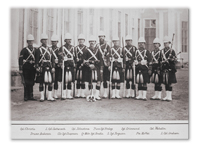 |
|
|
The Egyptians were forced to run, occasionally stopping to fire at the soldiers. There was cross fire coming from shelter trenches on each side. Some sergeants attacked a redoubt on the left and were able to kill three gunners manning a Krupp gun. This was turned on the retreating Egyptians. It also deterred some enemy cavalry from charging the Highlanders. The rest of the Highland Brigade pursued the retreating enemy and came to the crest of a hill overlooking Arabi’s camp and the railway station. In the confusion the rebels were running across the desert, or jumping into the canal. The Highlanders had been supported by the 46th and the 60th Rifles, who came up and cleared the camp. The battle had lasted only half an hour.
As the Camerons rested in the enemy tents, Sergeant-Major Joseph Campbell gathered volunteers to assist the wounded. Surgeon-Major Will was already busy giving first aid despite the dysentery he had been suffering himself. The casualties were: 13 men killed, 3 officers, 4 sergeants and 40 men wounded. Out of the wounded, four men died of their wounds.
The Army of Occupation
The regiment marched towards Zagazig, 5 miles the first day and 13 the next. They then moved on to Benha on the Nile and were put on a train for Cairo which they reached on 16 Sep. They were quartered in the Citadel. The place where they were to sleep had been occupied by the Egyptian army, ‘and the smell and dirt was beyond description’. They stayed there for 5 days until 21 Sep when they were moved to a camp at Ghesireh. However, a month later they were moved back to the Citadel, of which Colonel Leith had been appointed Commandant.
Cholera, July 1883
On 21 Feb 1883 the regiment paraded to receive their medals for the Egypt campaign with a clasp for TEL-EL-KEBIR. The Khedive distributed his bronze star medals on 2 June the same year. The establishment of the regiment was reduced in June so that there were only 480 privates. The quarters in the Citadel were unhealthy so that when cholera reached the regiment in July there were several fatalities. Ten men died, including Sergeant-Piper John McGregor Grant who had inspired the men as they stormed the trenches at Tel-el-Kebir. The regiment was relocated to a camp at Mokkattam, leaving G Company in charge of the barracks. The effect of leaving the Citadel was that there were very few cases of cholera. But the regiment moved back there on 1 Sep. Detachment to Suakin, Jan - Mar 1884
The reduction of the regimental establishment proved to be unwise as they were too depleted in numbers to be selected for Sir Gerald Graham’s expedition to Suakin in Jan 1884. However three officers, and 15 NCOs and men went with the expedition. Captain and Adjutant K S Baynes was appointed assistant military secretary and Lieutenant W A Scott was ADC to Major-General Graham. Lieutenant C F H Davidson was attached to the Gordon Highlanders. They were all present at the battles of El Teb and Tamaii. Baynes and Scott were mentioned in despatches and Captain Kenneth Baynes was promoted to brevet major.
The Gordon Relief Column 1884-5
On 18 Nov 1884 the regiment set off to travel up the Nile to take part in Sir Garnet Wolseley’s expedition to rescue General Gordon from a dangerous situation caused by the Mahdist rebellion in Sudan. The starting point was Assioot where the men embarked on barges towed by steamers which sailed by day and stopped at night until the first cataract was reached at Assouan on 30 Nov. The men were obliged to disembark and travel by train to Philae where it again embarked for Korosko on sailing barges and barges towed by steamer. They bivouacked at Korosko which was reached on 4 Dec 1884. The next day tents arrived and a more permanent camp was established. Most of December and January 1885 was spent at Korosko while Arab levies were raised with a view to opening a desert road to Abu Hamad in conjunction with the Cameron Highlanders. However, all plans were changed when news came of the fall of Khartoum and the death of General Gordon. For its services on this expedition the regiment was awarded the battle honour NILE 1884-85.
Frontier Field Force
The QO Cameron Highlanders remained in Korosko during the summer of 1885 and made the camp even more permanent by building huts out of mud and palm branches. These were completed by the middle of May. In July a frontier field force was formed consisting of the 20th Hussars, West Kents, Staffords, Yorkshires and the Camerons, with Major-General F W Grenfell in command. The force was distributed between Halfa, Assouan and Korosko, meaning that the Camerons stayed at Korosko until October. On 13 Oct 1885 the regiment embarked on 3 steamers and reached Wadi Halfa in Sudan 4 days later.
Fort Kosheh 5 - 29 Dec 1885
The regiment was split in two on 17 Oct with half, under Lt-Col St Leger, staying at Wadi Halfa and the other half, under Lt-Col Everett, going to the outposts of Kosheh and Akasheh. Kosheh was the most advanced outpost, 113 miles south of Wady Halfa. Detachments were at first distributed at Akasheh, Sarras and a blockhouse at Mohrat Wells 13 miles from Sarras, but by 7 Nov Everett’s half battalion was concentrated at Kosheh. At Wadi Halfa a camel corps was formed to which 25 Highlanders were attached, under Lieutenant Scott-Elliot.
Fort Mograkeh, 21 Nov 1885
Colonel St Leger’s half battalion went to Akasheh on 19 Nov 1885, then went by whale boats to the Dal Cataract and marched 8 miles to Firket. On 21 Nov they were ordered to proceed to an old ruined Arab fort, Mograkeh. They set about improving the defences and establish the place to maintain the lines of communication between Akasheh and Kosheh, where Everett’s men were busy building a zeriba on the west bank of the Nile. When news came that the Sudanese were only a few days away, St Leger led his men to Kosheh, leaving Mograkeh in the care of the 3rd Battalion, Egyptian Army and a small signalling party of Camerons. Fort Kosheh Under Siege, Dec 1885
On 27 Nov 1885 the enemy were only 6 miles away and the garrison of Kosheh remained under arms all night but no attack came. The next day the Mahdist army, numbering around 7,000, could be seen on the hills above Amara. Fort Kosheh was by this time, garrisoned by the Cameron Highlanders, the 9th Sudan Battalion, one Troop of the 20th Hussars, a Troop of Mounted Infantry and some artillerymen. Also there were 2 gun-boats patrolling the River Nile. On 1 Dec the enemy destroyed a length of railway near Akasheh and attacked a post at Ambigole Wells. On 3 Dec they came within 700 yards of Kosheh on reconnaissance, but no shots were fired. The next day, all the mounted troops were sent to protect the railway at Akasheh.
The siege of Kosheh began in earnest on 5 Dec when the enemy opened fire with rifles and artillery, targeting the fort on the east bank, and the zeriba on the west bank. The garrison suffered many casualties so the internal defences were strengthened with covered ways to allow easier movement. At all times, one third of the garrison was on watch. On 9 Dec, C Company and 80 Sudanese cleared and burned the village of Absari. On 12 Dec the fort at Mograkeh came under attack but this was repulsed by Sudanese troops. Two men of the Camerons’ signalling party were wounded.
Skirmish at Absari, 16 Dec 1885
A sortie was organised on 16 Dec in which two companies of the Camerons under Lt-Col Everett went out at 6am to attack the enemy at Absari. They were fired on from loopholes in the houses but returned fire. Three men under Lt Riach went along the river bank to engage with some dervishes in the nullah between Absari and Kosheh. They killed 14 and came out almost unscathed. Corporal MacRae was wounded in the hand and Lieutenant Riach had his hair parted by a bullet that went through his helmet. The companies withdrew to the Fort under coving fire. They had five men wounded and Lieutenant William Gordon Cameron died of his wounds 3 days later.
Battle of Ginnis, 30 Dec 1885
On 20 Dec the fort came under artillery fire, during which a sergeant and two men were wounded. In the following days there were more casualties, and a man was killed on 29 Dec, the day that the fort was relieved by a force of 4,000 British and Egyptian troops under Lieutenant-General Sir Frederick Stephenson. A battle was fought at Ginnis in which the enemy was defeated. The Cameron Highlanders and 9th Sudan Battalion of the Egyptian Army, under the command of Lt-Colonel Everett captured the village of Absari where the bayonet was the main weapon used. They burned what was left of the buildings and occupied the place. The defeat of the Mahdists at Ginnis resulted in the capture of all the enemy standards as well as 5 guns and all their wagons and ammunition. In this battle the casualties sustained by the Cameron Highlanders were 8 men wounded. The regiment bivouacked at Ginnis and the next morning there was a further fight when two companies of the Camerons under Captains Hackett-Thompson and Urquhart cleared some houses near Kosheh. There were no further casualties as a result of this action.
Casualties of the Sudan Campaign
Amongst the officers Major N G Chalmers, the first commander at Fort Kosheh (22 Oct), was severely wounded, Captain Hackett-Thompson and Lieutenant D Davidson were wounded and Lieutenant William Cameron was killed. Three privates were killed and three died of wounds. Armourer-Sergeant H Messenger was wounded. One drummer was dangerously wounded. Also dangerously or severely wounded were 14 rank-and-file. Nine more were wounded, one of them, J Stanley was wounded twice. One man, Piper J McDonald died of fever. The End of Campaign in Egypt and Sudan 1886
The retreating Mahdist army was pursued by cavalry in January 1886, after their defeat at Ginnis. The Cameron Highlanders, as part of Brigadier-General Huyshe’s brigade, advanced to Abri, 14 miles beyond Kosheh. The force bivouacked for 4 days, waiting for orders from the British Government. The plan to re-occupy Dongola was abandoned and the army returned to Kosheh, and on 8 Jan handed over the fort to the Durham Light Infantry. They marched to Dal Cataract and embarked on whale boats for Akasheh, sailing to Wady Halfa where they were accommodated in mud huts. They stayed until 4 April when they were ordered to Cairo. They went via Assouan (Aswan) where the intense heat caused fatalities. Leaving that place on 27 April they embarked for the final part of their journey to Cairo. There they were placed in Kasr-el-Nil and Abdin barracks. They remained in Cairo for the rest of the year and, from 7 December 1886 until 2 Feb 1887 they attended the annual course of musketry. On 4 March they were ordered home and on 11 March embarked at Alexandria on HMS Tamar, stopping at Malta. The regiment landed at Devonport on 26 Mar 1887. |
|
A Bad Idea.1887
|
| The regiment returned to Britain in 1887 after an absence of 8 years to discover that the authorities were planning to convert the Cameron Highlanders into the 3rd Battalion Scots Guards, a proposition that meant the extinction of the regiment as kilted Highlanders. It was met with outrage and predictable stiff opposition from the officers and notable military figures as well as the Scottish nobility, not to mention the Highlanders themselves and the inhabitants of Inverness. Several influential bodies such as the Highland Society of London held protest meetings with the result that, on 17 May 1887, Lord Lovat was authorised by the Secretary of State for War to announce that the proposed change would not take place, ‘and that the question was as dead as if it had never been mooted.’
|
|
The Jubilee Review, July 1887
|
|
On 6 July the regiment left Devonport, where they were stationed, and, with a strength of 756 all ranks, sailed on the Tamar to Portsmouth. They boarded a train for Aldershot and encamped at Church Plateau. The Golden Jubilee of Queen Victoria was to be celebrated in military fashion by a grand Field State Review in which all the regiments serving in the UK marched past Her Majesty. The Queen’s Own Cameron Highlanders was the only Highland regiment present at the review in Long Valley on 9 July ‘and its appearance elicited the loudest applause from the enormous crowds present to see the march past.’
|
|
The Reconquest of the Sudan 1898
|
|
Service 1888 to 1898
In 1888 the regiment moved from Devonport, Plymouth to Edinburgh Castle where they were based for four years, during which time they provided the Royal Guard at Balmoral. They were sent to the Mediterranean to serve in Malta from 1891 to 1895, and Gibraltar from 1895 to 1897. In late 1897 they sailed to Cairo.
The Mahdi had died in 1885 and Sudan had descended into anarchy, putting Egypt in danger. Britain had occupied Egypt since the defeat of Arabi Pasha in 1882 and the Egyptian army was led by British officers. Major General Sir Herbert Kitchener led this army into Sudan in late 1887 but soon found that he needed British troops as well. In 1898 a brigade under Major-General Gatacre was assembled consisting of the Cameron Highlanders, The Seaforths, the Warwicks and the Lincolns.
Battle of the Atbara, 8 April 1898
They moved by train from Cairo and then by boat up the Nile to Wadi Halfa from where they travelled on Kitchener’s new railway to Abu Hamed. The rebel Dervishes had abandoned Berber and withdrawn to a position on the dried-up river Atbara. They were in a circular formation defended by a thorn bush zeriba. Kitchener’s army approached by night and after an artillery bombardment attacked at dawn on 8 April 1898. The Camerons had the task of advancing in line ahead of the British brigade from a start position 600 yards from the enemy, firing as they went, and then of making three breaches in the thorn fence. The Seaforths, Warwicks and Lincolns followed in column of companies, passing through the breaches, and the whole brigade cleared the Dervish position. The enemy was completely defeated and their leader captured. It was a short battle but the Camerons lost 18 men killed.
Omdurman, 2 Sep 1898
After the victory at the Atbara river, Kitchener’s force spent three months preparing to advance on the Khalifa’s capital of Omdurman. The army was reinforced by a further British infantry brigade and the 21st Lancers, and moved south in August. The army encamped about 10 miles from Omdurman and the 21st Lancers went on a reconnaissance towards the Khalifa’s capital. They saw the Dervish army of around 55,000 advancing towards them and retired towards the British position. Meanwhile the gunboats bombarded enemy forts near the city and forced the garrisons to evacuate.
The infantry left camp on 1 September and set up a defensive position at the small village of El Egeiga, between the Jebel Kerreri and Jebel Surgham Hills. With their backs to the Nile they built a long curved trench and zeriba of thorn bushes. The approaching Mahdist army formed a 4-mile long line, and stopped at 1.45pm, settling down so that the British could only spend the afternoon watching them. A night-time attack did not materialise so the battle began on 2 Sep. The artillery fired on them from a range of 3,000 yards. As they ran towards the British defences, they fell thick and fast under the fire of Lee Metfords and Maxim guns. The Egyptian and Sudanese troops were armed with the older Martini Henrys which had a slower rate of fire. But altogether the British and Egyptians held off the attack and the Dervishes pulled back.
 |
|
|
The first phase of the battle was over and the force left the safety of the zeriba and advanced towards the Surgham hills to try and cut off the Dervish retreat to Omdurman. The 21st Lancers had been ordered to go ahead and prevent the enemy reaching the city, but they encountered a determined column of the Khalifa’s men under a black flag which they charged heroically. The assumed enemy retreat was not actually happening and there were around 35,000 Dervishes, those under the black flag behind the Jebel Surgham and another force under the red flag in the Kerrei Hills. The Sudanese brigade, commanded by Hector Macdonald, was threatened by the enemy positioned to the west of the Jebel Surgham. Wauchope, who commanded the 1st Brigade which included the Camerons, went to Macdonald’s aid.
Two Maxim guns were somehow manhandled up to the top of Jebel Surgham and fired down on the Khalifa’s elite troops, including the black flag Dervishes. This saved Macdonald’s men, and the Lincolnshires opened fire enfilading the attacking Dervishes. The Sudanese, under the expert leadership of Macdonald and his British officers and NCOs, had contributed greatly to the defeat of the Mahdists. The role of the Camerons in this second phase of the battle is not clear. The retreating enemy was expected to take up defensive positions in Omdurman but the Khalifa was horrified to see his men disperse across the desert to get home. Kitchener led his army into the city unopposed. The Cameron Highlanders had lost two men killed and 29 wounded.
The Dervish capital consisted of two towns on each side of the river at the junction of the Blue and White Niles. Khartoum on the east side was the old centre of government, and included the palace where Gordon had been murdered. Omdurman on the west side was the Dervish capital and included the Mahdi’s tomb, an important religious shrine. The battle took place outside Omdurman which gives its name to the battle, but the battle honour awarded to the regiments that took part is KHARTOUM.
|
|
The Fashoda Incident, 18 Sep 1898
|
|
In 1896 the French organised a small force of 150 men under Jean-Baptiste Marchand to lay claim to South Sudan. By July 1898 they reached an abandoned Arab fort, Fashoda, located on the White Nile in the northeast part of South Sudan. The French had already colonised part of Africa to the south west of Sudan in what is now the Central African Republic and the Congo, while the British were in East Africa (later Uganda and Kenya) and the Germans in what later became British Tanganyika.
When Kitchener was in Khartoum after defeating the Khalifa’a army, he was 500 kilometres north of Fashoda. He took a force of 2 Egyptian battalions and E company of the Cameron Highlanders up the Nile by steamer. There was no fighting but Kitchener and Marchand could not agree as to who had the better claim to the place. The French Foreign Minister, Declassé, did not want to upset the British, who he needed for support against the Germans, so the French withdrew, and although they tried to claim other posts in the Sudan, they eventually agreed, in March 1899, that the watershed of the Nile and the Congo rivers should mark the boundary, and colonial Africa was carved up, leading to the Anglo-French Entente of 1904. Fashoda is now known as Kodok.
|
|
Reinforcing the Service Battalion 1882-87
|
|
The 1st Battalion serving in Egypt and Sudan had relied on their depot to recruit men and train them so that drafts could be sent out. This compilation gives an indication of how the regiment relied on supplies of officers and other ranks whilst on service abroad:
On 15 March 1882 the battalion was joined at Gibraltar by Major Orr Boswell Gordon (Adjutant Jul 1878 - Oct 1879) together with a sergeant and 119 men from the depot which may have been at Glasgow or Perth. The regimental history says that in 1879 the regiment was stationed at Glasgow where 270 recruits were raised, and a further 208 raised at the Brigade Depot (42nd and 79th) at Perth.
After Tel-el-Kebir, on 15 Oct 1882 they were joined by a draft of reservists: 4 sergeants, 10 corporals, 2 drummers and 132 privates all commanded by three officers from the Royal Scots Fusiliers in Cyprus.
On 15 Sep 1884 a draft from the depot at Fort George arrived at Cairo: a sergeant and corporal with 54 men.
While the regiment was on its way up the Nile they received a draft of 31 men on 23 Jan 1885, reaching Korosko from the Reserve depot at Cairo.
The Cairo depot also supplied 2 officers and 30 men on 8 Mar 1885.
On 1 July 1885 the Fort George depot sent Captain Hackett-Thompson with a sergeant and 61 reservists to Korosko. These men had come from other regiments.
On 29 Sep 1885 a sergeant and 17 men from the Cairo depot arrived with 3 subalterns.
When the regiment was at Wadi Halfa in the Sudan they received a draft of 156 men with a sergeant and a lieutenant, all from Fort George.
In January 1886, on their way back to Egypt after the battles of Kosheh and Ginnis the regiment received 3 officers, a sergeant and 194 men at Wadi Halfa.
On their return to Cairo in May 1886 they received a lieutenant, a corporal and 51 men.
On their return to Britain they were stationed at Devonport and, on 1 April 1887 received a draft from their new depot at Inverness: two officers, two sergeants and 199 men.
|
|
Raising of the 2nd Battalion 1897-99
|
|
Following the Army Reforms of 1881 the Queen’s Own Cameron Highlanders had been left as the only regiment in the Army to have a single regular battalion. This meant that while serving abroad they were in danger of being understrength whereas other regiments could be reinforced by trained men from their second battalion based in the UK. Proposals to convert the Camerons to a 3rd Battalion Scots Guards had been put forward in 1887 and in 1893. Influential people had prevented this from happening, including Queen Victoria, so to counteract the threat to the existence of the Cameron Highlanders they raised a 2nd Battalion.
Authority to raise the battalion came in March 1897. A nucleus of officers and NCOs left Gibraltar in April 1897 and arrived at Fort George a week later. They were allowed to recruit throughout Scotland, aiming to raise three companies in 1897, two more in 1898 and two more in 1899. On 29 Oct 1898 the 2nd Battalion, Queen’s Own Cameron Highlanders were presented with their Colours by Queen Victoria at Balmoral. They also furnished the Royal Guard at Balmoral in that year. In December 1898 they moved to Aldershot with a strength of 618. In October 1899 they embarked for Gibraltar, having gained the final two companies. |
|
South African War 1900 - 1902
|
|
Mobilisation March 1900
The 1st Cameron Highlanders were still in Cairo when the war broke out in South Africa in 1899. After Black Week in December 1899 reinforcements were urgently needed and the battalion, under the command of Lt-Colonel Watson Kennedy, was sent to South Africa, arriving at East London on 24 March 1900. They joined the 21st Infantry Brigade in General Ian Hamilton’s column, and took part in the advance from Bloemfontein to Johannesburg and Pretoria.
Diamond Hill, 11-12 June 1900
After the fall of Pretoria, the 1st Camerons joined the pursuit of the Boer forces who had escaped from the town. On 11 June 1900 the battalion was engaged in the successful attack on the Boer position at Diamond Hill outside Pretoria.
The Capture of Spitz Kop, 21 July 1900
In July 1900 the 1st Camerons joined General Sir Archibald Hunter’s force which included the Highland Brigade, for the operations in the Orange River Colony. They took part in the arduous pursuit of General Prinsloo’s army until it was eventually surrounded and captured in the Brandwater Basin in the Wittebergen mountains on 30 July. The battalion had a particularly fierce engagement in the capture of Spitz Kop. General Bruce Hamilton led an attack on a strong Boer position on Spitz Kop near Bethlehem on 21 July. The Camerons, assisted by the 7th mounted Infantry and 82nd Battery stormed the hill. This resulted in heavy casualties, three Highlanders were killed, 3 officers and 16 men were wounded.
Boers Surrender, July 1900
Bruce Hamilton’s column was involved in clearing Boers from several positions on 28 July and the next day they had two hard fights at two neks near the farm of Sebastopol. The Camerons bore the brunt of the fighting but the Mounted Infantry were also involved.The operations led to the second major surrender of Boer troops during the war. On 30 July 1900 General Hunter received the surrender of Generals Prinsloo and Crowther, and of the Ficksburg and Ladybrand commandos.
Nooitgedaght, 13 Dec 1900
On 8 Dec 1900, Major-General Ralph Clements and a force of 1.500 men were engaged in the destruction of farms, crops and livestock belonging to Boers suspected of hostile activity. Clements and his force, including 9 guns and 100 wagons, camped at Nooitgedacht in the Magaliesberg valley, northwest of Johannesburg. Picquet guards were posted at the top of the mountain overlooking the camp site, consisting of 150 men. They were observed by 1,500 Boers commanded by De la Rey and Smuts who were waiting to be reinforced by similar commandos under Christiaan Beyers. The attack was well planned, with commandos sent to deal separately with the picquets on the mountain, a Mounted Infantry camp outside the main camp, a commando placed to cut off the expected British retreat, and men posted to prevent the intervention of Brigadier-General Broadwood’s cavalry.
The attack on the Mounted Infantry was repulsed and when the picquets on the mountain saw this they cheered, which infuriated the commandos attacking them and emboldened them to launch a frenzied assault which wiped out the British soldiers on the mountain top. The Boers were now able to fire down on the British camp. Men were scattering in all directions and a detachment of the Cameron Highlanders was ordered to climb a narrow path to retake the summit. They came under heavy fire that killed two and wounded five. In this calamitous action Sergeant Donald Farmer earned the Victoria Cross for rescuing Lieutenant Sandilands who was wounded. Fortunately for Clements, the attack on the camp was delayed by De la Rey, allowing time for him to regain control and organise a disciplined retreat. He led the men to Vaal Kop and staged a rearguard action. A third of the British force were either dead, wounded or captured. Meanwhile a large section of the Boer army were whooping it up and looting the abandoned camp.
The Later Stages of the Boer War 1900 - 02
The 1st Camerons spent the rest of the year in the Orange River Colony on operations around Kroonstad. They trekked to Ladybrand and to the northwest of the Colony. In 1901 the battalion moved north to the Transvaal, and took part in the building and manning of the lines of blockhouses, Kitchener’s strategy designed to contain and clear large areas.
During their two-and-a-half years in South Africa, the 1st Cameron Highlanders completed just under 3,000 miles of marching on operational duty. The battalion lost 24 all ranks, killed during the campaign. For their service and sacrifice they earned the single battle honour SOUTH AFRICA 1900-1902. |
|
 |
| Badges
|
| Colonels-in-Chief
|
HM King George V
HM King George VI
HRH Prince Philip
|
| Colonels
|
| 1793 - 1994
|
| Commanding Officers
|
| 1793 - 1994
|
| Soldiers
|
| 1793 - 1994
|
| Uniforms
|
| 1793 - 1994
|
| Band & Drummers
|
| 1793 - 1994
|
| Pipers
|
| 1793 - 1994
|
| Weapons
|
| 1793 - 1994
|
| Colours
|
| 1793 - 1994
|
| Battle Honours
|
|
French Revolutionary Wars 1793-1802
EGMONT OP ZEE
EGYPT (with the Sphinx)
Peninsular War 1808-1814
CORUNNA
BUSACO
FUENTES D’ONOR
SALAMANCA
PYRENEES
NIVELLE
NIVE
TOULOUSE
PENINSULA
Hundred Days 1815
WATERLOO
Crimean War 1854-56
ALMA
SEVASTOPOL
Indian Mutiny 1857-58
LUCKNOW
Egyptian Campaign 1882-85
TEL-EL-KEBIR
EGYPT 1882
NILE 1884-5
Reconquest of the Sudan 1896-98
ATBARA
KHARTOUM
South Africa 1899-1902
SOUTH AFRICA 1900-02
World War One 1914-18
Emblazoned Battle Honours
MARNE 1914 1918
AISNE 1914
YPRES 1914 1915 1917 1918
NEUVE CHAPELLE
LOOS
SOMME 1916 1918
DELVILLE WOOD
ARRAS 1917 1918
SAMBREv
MACEDONIA 1915-18
Accredited Battle Honours
RETREAT FROM MONS
LANGEMARCK 1914
GHELUVELT
NONNE BOSSCHEN
GIVENCHY 1914
HILL 60
GRAVENSTAFEL
ST JULIEN
FREZENBERG
BELLEWAARDE
AUBERS
FESTUBERT 1915
ALBERT 1916
BAZENTINE
POZIÈRES
FLERS-COURCELETTE
MORVAL
LE TRANSLOY
ANCRE HEIGHTS
SCARPE 1917
ARLEUX
PILCKEM
MENIN ROAD
POLYGON WOOD
POELCAPELLE
PASSCHENDAELE
ST QUENTIN
BAPAUME 1918
LYS
ESTAIRES
MESSINES 1918
KEMMEL
BÉTHUNE
SOISSONAIS-OURQ
DROCOURT-QUÉANT
HINDENBURG LINE
EPÉHY
ST QUENTIN CANAL
COURTRAI
SELLE
FRANCE AND FLANDERS 1914-18
STRUMA
World War Two 1939-45
Emblazoned Battle Honours
ST OMER-LA BASSEE
REICHSWALD
RHINE
KEREN
SIDI BARRANI
EL ALAMEIN
AKARIT
GOTHIC LINE
KOHIMA
MANDALAY
Accredited Battle Honours
DEFENCE OF ESCAUT
SOMME 1940
ST VALERY-EN-CAUX
FALAISE
FALAISE ROAD
LA VIE CROSSING
LA HAVRE
LOWER MAAS
VENLO POCKET
RHINELAND
GOCH
NORTH WEST EUROPE 1940 1944-45
AGORDAT
ABYSSINIA 1941
TOBRUK 1941 1942
GUBI II
CARMUSA
GAZALA
MARETH
WADI ZIGZAOU
DJEBEL ROUMANA
NORTH AFRICA 1940-43
FRANCOFONTE
ADRANO
SFERRO HILLS
SICILY 1943
CASSINO I
POGGIO DEL GRILLO
TAVOLETO
CORIANO
PIAN DI CASTELLO
MONTE REGGIANO
RIMINI LINE
SAN MARINO
ITALY 1944
RELIEF OF KOHIMA
NAGA VILLAGE
ARADURA
SHWEBO
AVA
IRRAWADDY
MT POPA
BURMA 1944-45
|
|
| Titles
|
| 1793 | 79th Regiment of Foot (or Cameronian Volunteers) |
| 1804 | 79th Regiment of Foot (or Cameronian Highlanders) |
| 1806 | 79th Regiment of Foot (or Cameron Highlanders) |
| 1873 | 79th Queen’s Own Cameron Highlanders |
| 1881 | Queen’s Own Cameron Highlanders |
| 1961 | Queen’s Own Highlanders (Seaforth and Camerons) |
| 1994 | The Highlanders (QOH and Gordons) |
| 2006 | The Highlanders, 4th Battalion, The Royal Regiment of Scotland (4SCOTS) |
|
|
Regimental Museum
|
The Highlanders Museum
Fort George
Ardersier
Inverness
IV2 7TD
tel: +44 131 310 8701
Museum of the Royal Regiment of Scotland
Edinburgh Castle
EH1 2NG
tel: +44 131 310 5040
|
|
Suggested Reading
|
CUIDICH N RIGH, A History of the Queen s Own Highlanders (Seaforth and Camerons)
by Lt-Colonel Angus Fairrie ( Regimental HQ 1983)
Historical Records of the Queen's Own Cameron Highlanders
(7 vols) (Blackwood 1909 1931 1952 1962)
Historical Records of the Seventy-Ninth Regiment of Foot or Cameron Highlanders
by Captain Robert Jameson (Blackwood 1863)
Historical Records of the 79th Queen s Own Cameron Highlanders
by Captain T A Mackenzie and others (Hamilton Adams 1887)
|
|