|
Raising of the Regiment
|
|
The Indian Mutiny of 1857 caused the British to restructure the Indian army, and the General Officer Commanding the Gwalior Division, Sir Robert Napier, to quell the rebellion, needed more cavalry. So Captain F H Smith was appointed to raise a regiment of irregular horse at Morar. It was intended that it should consist mainly of Maharattas and so was called the 2nd Maharatta Horse, but although the name was retained for three years, the recruitment of Maharattas was not continued when it became clear that these wild horsemen were not trustworthy. Smith was allowed to raise a squadron of Jats from the Bulanshahr district. There was one other British officer in the regiment, Lieutenant Hugh Gough VC, who had previously served in the 3rd Bengal Light Cavalry and Hodson’s Horse.
|
|
Pursuit of Firoze Shah 1858 - 59
|
|
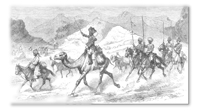
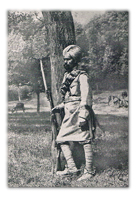
Gough was not impressed with the Jats, describing them as ‘dunderheaded’ but they made up a large proportion of the 150 men under Smith’s command when he arrived at Gwalior on 11 Dec 1858. Napier’s task was to prevent the rebel leader, Firoze Shah and his 2,000 followers from joining up with Tantia Topi in Central India. A flying column was formed, consisting of the 14th Light Dragoons, the 71st Highland Light Infantry mounted on camels, and Smith’s Maharatta Horse. There was also a small body of independent cavalry known as the Tiwana Horse, led by Jahan Khan. They came under Smith’s command and were later incorporated into his regiment.
The pursuit continued for three days until early on 17 Dec they caught up with stragglers. They came to the village of Ramade and heard that the rebels had been there to demand supplies. The enemy were expected to return so an ambush of 350 men was laid, and in the ensuing battle, Feroze Shah’s force was entirely defeated. Only the 14th LD were mounted well enough to pursue the fleeing enemy, according to Gough, “..for seven miles over a most breakneck country, black cotton soil, with cracks and fissures large enough to swallow a camel..” Napier was pleased with the result and rewarded Jahan Khan the Tiwana leader by awarding him the Order of British India, which the 18th regarded as their first such decoration. The regiment escaped disbandment because of their efficiency, and on 31 Jan 1859, returned to Gwalior for serious reorganisation and training.
|
|
The Fakir’s Curse 1876
|
|
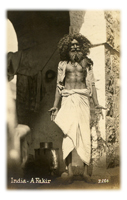
In 1876 the 18th Bengal Cavalry regiment was quartered at Nowshera where housing was found to be unsatisfactory. So three officers decided to build a bungalow. A suitable spot was found by the banks of the Kabul river, and a solid foundation was already in place from a previously destroyed building. A few days after they had begun to build, an old fakir approached and told them that they must not build there as it belonged to fakirs and was consecrated ground. The officers ignored his pleas and carried on with their work. The fakir then put a curse on them, saying that within a year all three officers would be dead and their house destroyed.
The first officer was killed in a game of polo, the second was out hawking near Mardan when his horse fell into a ravine and both horse and rider died. On the last day of the curse, the regiment was stationed at Allahabad and the third officer, Surgeon D P Palmer, was in a boat with two other officers. The boat capsized and the officers swam to shore. Two of them reached dry land but Dr Palmer, a known strong swimmer, was missing and never seen again. Later it was reported that the Kabul river had flooded and the bungalow swept away.
|
|
Afghanistan 1879-81
|
|
Kurram Valley, Nov 1879
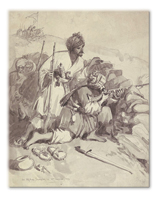
The 18th BC joined Sir Frederick Roberts’ Field Force, spending two years fighting Afghan tribesmen in the defence of the lines of communication. They marched from Umballa in September 1879, via Nowshera, to Kohat where they linked up with the 3rd Brigade in the Kurram Division. Their task was to operate in the Kurram Valley, protecting the extended supply lines from attack by Waziris on one side and the Zaimukhts on the other. The first action occurred on 20 Nov 1879 when an outpost patrol led by Risaldar Nadir Ali Khan dispersed a band of 100 Waziris who were attacking a convoy. Two days later the same officer led a charge of 37 against several hundred tribesmen and killed 17 compared with 3 severely wounded men of the 18th. Nadir Ali Khan and 12 others were recommended for the Order of Merit. A lone sowar, Zeadah Khan, came across a group of raiders which he charged and scattered. He was awarded the third class Order of Merit.
Attacks on the Zaimikhts, Dec 1879
The Zaimukhts had been threatening the convoys and it was decided to go on the offensive. On 16 Dec a squadron under the command of Major Davidson surrounded the village of Dand and arrested 13 ringleaders. This did not go far enough to solve the problem and a larger force was sent in under Brigadier Tytler which resulted in the destruction of the village of Chinarak. Major Wheeler’s squadron played a prominent part in that operation.
Captain Richardson’s Squadron
A few days after the attacks on the Zaimikhts, the Waziris, took advantage of the distraction, and raided convoys. So a squadron under Captain George Richardson was sent to the Madkani range of hills. He was accompanied by Lieutenants Macmullen and Nixon. As they approached, they were suddenly attacked by 800 tribesmen but their determined response caused the Waziris to hesitate, and they were forced to disperse. Only two horses were wounded in this fight. Later the next year, on 15 July 1880, Richardson’s squadron, including Lieutenant Money, went after a group of Waziris who had stolen some camels. The pursuit carried on for 25 miles but they recovered the camels and brought back prisoners. They were highly praised by the Commander-in-Chief for this ‘dashing bit of cavalry work’.
The Mahsud Wasiris 1881
The regiment suffered badly from August 1880 to February 1881 when their horses fell ill from ‘surra’, a disease that caused them to lose 161 horses and 78 ponies. However they still managed to have some success in October and November 1880 against Waziris. Although the Second Afghan War ended in September 1880 with the defeat of Ayub Khan, there was further peace-keeping work to be done on the Frontier. On 4 April 1881 they arrived at Bannu to take part in an expedition against the Mahsud Waziris. As the summer got under way the work became intolerable with the intense heat, lack of water and forage. By the end of May the expedition was over and they made their way to Nowshera.
|
|
Conversion to Lancers 1886
|
|
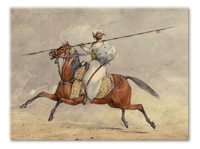
For most of the period from 1858 to 1886 the regiment was only partially equipped with lances. They were not government issue so had to be manufactured locally and supplied to those men who could afford them. It was customary for the cavalry to charge in two ranks with the front rank armed with lances, the rest having swords and some men having carbines. After the Afghan war of 1878-80 the commandant, T R Davidson, decided that all of the rank-and-file should have lances, and this was eventually achieved by 1886. In that year the title of the regiment was changed from 18th Bengal Cavalry to 18th Bengal Lancers, regarded by everyone as an improvement in status.
|
|
The Zhob Valley Expedition 1890
|
|
In 1890 the regiment was stationed at Lorelai from where they sent out two squadrons to reinforce an isolated garrison at Apozai in March. The reports claimed that 8,000 tribesmen were threatening the place but after a 60 mile trek they had to return without making contact with the enemy. Outpost duty and patrols continued until August when they were ordered to join a force under Major-General Sir George White for the pacification of troublesome Pakhtuns around the Zhob Valley. The column assembled at Apozai at the end of October and advanced against the Shirannis. ‘Then followed six weeks toilsome marching against an enemy who did not seem to exist, and certainly had no intention of fighting'.
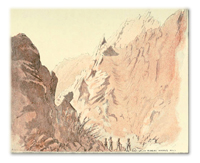
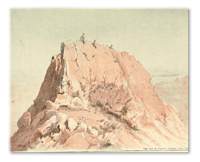
One tribal leader, Bungal Khan, and a few followers, offered some resistance, installing themselves on a prominent hill. It was 8,000 feet high above Tharispa. He declared that he would defend it to the last man. It would have been a difficult hill to storm, but Bungal Khan also realised that it could be difficult to get away, so took his men off the hill before the arrival of the Field Force. They were pursued by men of the 18th, but managed to escape. The troops had to traverse country not previously visited by the army and had to tolerate great hardship and exposure. The operations in the Zhob Valley have been described as ‘a campaign against nature rather than against man’.
|
|
Tirah Campaign 1897-98
|
|
Build-up to the Campaign
The various tribes of Afghanistan had been creating problems for the British/Indian units guarding the Northwest Frontier for many years but in 1897 there was a concerted effort by the Pakhtun tribes to join forces and defeat the infidels threatening their way of life. A Mullah, Saiad Akbar, an Aka Khel Afridi, urged the Afridis of Bagh in Tirah to rise up, but the Afridis had remained peaceful and were difficult to budge so the Mullah turned to the Orakzais. They also were reluctant and waited to see if the Afridis would be involved. On 23 Aug 1897 the Afridis were persuaded to attack Khyber and Jamrud. Another attack was made by the Mishtis at Shahu Khel. One Squadron of the 18th Under Captain Chesney was sent out to apprehend the attackers but they dispersed before the squadron arrived.
Shinauri
Other reports of attacks instigated further fruitless marching but the main troop concentration at Hangu was roused to action on 27 Aug. An infantry column went to relieve Lakha, and the 18th spent the day reconnoitring the Marai road and Shinauri. Two days later the post at Shinauri was destroyed although the garrison escaped. Two squadrons covered a detachment of Gurkhas sent to reinforce the post and found out that 1,000 Orakzais were close by. The cavalry went as far as the hills to cut them off but the tribesmen dispersed and were gone. After a 40 mile round trip they returned to Hangu.
Ambush at Doaba, 30 Aug 1897
On 30 Aug a detachment was sent to Thal and Sadda, consisting of two 18th Lancer squadrons, the 15th Sikhs, two mountain guns and a company of Bombay Sappers and Miners, commanded by Colonel Abbott of the 15th Sikhs. Captain Chesney was given a guide to lead the force to a suitable campsite at Doaba, but it was a trick to lure the force into an ambush. Chesney smelt a rat and ordered the men to dismount to exchange fire until the infantry came up at which point the tribesmen dispersed, leaving their dead and wounded. The 18th were then left at Thal while Abbott proceeded to Sadda in the Kurram, where 4,000 Orakzais were threatening the village. Trouble was averted and the main column, under the command of Colonel Richardson of the 18th, arrived in early September.
Organisational Chaos
The cavalry were employed in reconnaissance to seek out the best route for the army to invade Tirah. In October the regiment was concentrated at Shinauri but the invading force was split into two Divisions commanded by Major-General Yeatman-Biggs (2nd Div) and Maj-Gen Penn Symons (1st Div). The 18th at that time had four squadrons so A and D Squadrons were allotted to the 1st Division, and B and C to the 2nd. However, the organisation was in chaos as the whole army was concentrated in the wilderness of the Miranzai valley, with 70,000 animals. The assault of the Dargai Heights took place as the cavalry looked on, followed by an attempt to move men and animals to the new camp. But due to the poor work of staff officers the movement was held up and loaded animals were kept standing all day and night so that thousands died.
The Cause of the Problem
Apparently the cause of this disaster was the inability of the poorly trained staff officers to draw a distinction between the two types of camel.
The 18th Lancers used camels called ‘shutars’ (riding camels) which were fast and able to cope with difficult terrain. When Colonel Richrdson and Lt Wigram, both officers of the 18th, were seen to make their way through the pass with shutars carrying their baggage, it was assumed that all the animals would be capable of proceeding. But the slower, less hardy pack camels were not able to get through, and caused a blockage.
Duties of the 18th Lancers
The duties carried out by the regiment consisted of foraging for supplies for the army. They would be accompanied by mules and drivers to load up food and firewood, and return to camp. The cavalry covered this and were the last to return, after having exchanged fire with the watching Afridis. When they reached camp late at night the animals had to be watered, fed and groomed before the men could eat and turn in. But the camp was not a safe place; the Pakhtuns would fire on them as they slept in their tents, contributing to the difficulties of freezing night temperatures, sometimes falling to 12 degrees Fahrenheit (-11° C). Apart from foraging, the regiment also provided an escort of 27 men and an officer for General Sir William Lockhart. |
|
The Delhi Durbar of 1903
|
| The driving force behind the Durbar of 1903 was Lord Curzon who took over as Viceroy of India in 1899. Queen Victoria died in January 1901, succeeded by King Edward VII who also inherited the title Emperor of India. The coronation took place on 9 Aug 1902 but Curzon wanted to celebrate the accession of the King Emperor in India. He wanted an opulent show to impress the Maharajas, laying out gardens, and lawns of mustard and cress. The 18th Lancers took part in the grand parade and provided the escort for the Commander-in-Chief, Lord Kitchener. A detachment also escorted the Duke of Connaught at Nowgong. The Duke's military secretary sent the CO, Lt-Col Money, a letter complimenting the escort: ‘He was very much struck with their appearance and would like you to congratulate them on their smartness and the excellent condition and training of their horses. He desires me to say that the escort was in every way worthy of the proud name that the 18th Bengal Lancers bear.’
|
|
Prince of Wales Patronage 1906
|
|
In 1905 the Prince and Princess of Wales (the future King George V and Queen Mary) visited India.They arrived at Bombay on 9 Nov 1905, and Captain Clive Wigram of the 18th Lancers was appointed to the Prince’s staff as Assistant Chief of Staff. Perhaps through Wigram’s influence the Prince decided, on 1 Jan 1906, to be the Colonel-in-Chief of the regiment. This permitted the 18th to be titled Prince of Wales’s Own Tiwana Lancers. The Royal Tour took the Prince and Princess to Aligargh where the 18th were given the opportunity to show off their horsemanship and tent-pegging skills. Following this, the Colonel of the Regiment, Maj-Gen Richardson, informed the officers and men that the Prince had applied for the appointment and was pleased that he had made the right decision after seeing that all ranks of the 18th were as good at sport as they were in the field. The officers of the regiment added a silver Prince of Wales plumes badge to the front of their pouch-belts, a distinction that was never relinquished. |
|
Persia 1908
|
|
In 1908 a detachment of the regiment was sent to Isfahan in Persia as consular guard to Mr J H Bell. The party was attacked by robbers and two men of the escort were killed. The commander of the detachment, Jemadar Dost Mohammed Khan, was highly praised for his bravery and handling of the situation. Two other men were mentioned, Lance-Dafadar Murad Khan and Sowar Mohammed Khan, all three receiving the Indian Distinguished Service Medal. Jemadar Dost Mohammed Khan served in the 18th Lancers from 1896 and retired in 1821 with the rank of Honorary Lieutenant. In 1914 another detachment of the regiment, commanded by Captain A H Brookes, escorted a Commission sent to establish the boundary between Turkey and Persia. They were recalled, and Brookes was to rejoin via England. He sailed through the Dardanelles just before Turkey entered the war. The rest of the detachment, commanded by Jemadar Tawakli Khan, had to make their way, hundreds of miles through dangerous territories, to India.
|
|
World War One
|
|
In 1914 the 18th KGO Lancers were stationed at Meerut, and when war broke out on 4 August, they expected to be mobilised, but instead were called upon to supply men and horses for other regiments. Some officers on leave in England joined the BEF, one of whom, Lieutenant Spencer Railston, was killed at Messines on 1 Nov 1914 in an attempt to rescue a Belgian woman. It wasn’t until late October that the order came for the 18th Lancers to go to France as part of the Meerut Brigade commanded by Brigadier-General F M Edwards, in the Second Indian Cavalry Division. Also in the brigade were the 13th Hussars and the 3rd Skinner’s Horse. The regiment entrained on 13 Nov for Bombay and embarked on the ‘City of Birmingham’ and ‘Tactician’. The convoy consisted of 40 ships and was escorted to protect against an attack by the German cruiser ‘Emden’. The regiment was commanded by Lt-Col Grimston. They had 500 horses, 5 of which died on the voyage through the Red Sea. Having gone through the Suez Canal they reached Marseilles on 15 Dec.
In France, Dec 1914 The next destination was Orleans, reached on 21 Dec, in bitterly cold weather. The men were issued with bayonets for the first time, and new clothing. In January they were taken by train to the war zone of Aire-Béthune. They were billeted in the village of Estrée Blanche where they established good relations with the women, children and old men. But two weeks later they were sent to the trenches at Festubert which were water-logged and soon produced cases of trench foot. On 13 Jan a portion of the regiment, numbering 300 was sent to Béthune, but they were in the front line, for only a day, without seeing any action.
Neuve Chapelle 10 - 13 Mar 1915
At Neuve Chapelle in March the cavalry were held in readiness to exploit the progress of the infantry which initially managed to occupy German trenches, but the enemy were reinforced so that there was no gap wide enough for the cavalry. The 18th were ready to go in the early hours of 10 March, leaving Estrée Blanche at 4am and bivouacking in woods near Lapugnoy. But after four nights there they moved to fresh billets at Aire. They were then employed digging trenches in the Robeeq-St Venant area.
War Strength of the Regiment, May 1915
The regiment was back at Lapugnoy in May, in readiness for an attack on Festubert. The strength of the regiment was 483 rank-and-file, 13 British officers, 18 Indian officers, a medical officer and assistant surgeon, 3 attached Yeomanry officers (and their 6 batmen), 17 men of the Army Service Corps. To this were added 34 Indian followers and 3 French interpreters. The animals included 542 riding horses, 10 draft, 12 pack horses, 70 mules and a pony. There were 12 wagons and an ambulance wagon.
Trenches on the Somme, Aug 1915
The 2nd Indian Cavalry Division provided dismounted troops to man the front-line trenches in the Authuille area on the Somme. The 18th contributed 8 British officers and 300 rank-and-file for 10 days duty during which they experienced shelling and sniping. They operated a trench mortar which was an early primitive type, difficult to fire and not very effective. This was a response to the German Minenwerfer bomb. In late September the Indian Cavalry Corps were moved to the Doullens area ready to exploit any advantage gained during the attack at Loos. This attack involved the use of gas which had been manufactured in reaction to the German gas attacks near Ypres in April. But the attack at Loos was not as successful as had been hoped.
New Commanding Officer
Lieutenant-Colonel Grimston left the regiment in early June 1916 to take up a post in India. His successor was supposed to be Lt-Colonel Frank Maxwell VC but he had returned to England with the Viceroy, to whom he was Military Secretary, and given command of the 12th Battalion, Middlesex Regiment. The command of the 18th Lancers was given to Major V E Muspratt of the 30th (Gordon’s) Lancers. At this time the high command had decided that Indian soldiers were not suited to the climate or the conditions on the Western Front, and were not effective as trench-fighting units. The Meerut Brigade was thus earmarked for service in Mesopotamia, but the 18th was transferred to the Amballa Brigade and remained in France.
The Somme, July 1916
The Cavalry Corps were billeted 12 miles behind the lines ready to go into action once the infantry had broken through in the great offensive planned for July 1916. The 18th were bivouacked on the river Hallue at Querrieux, southwest of Albert. Towards the end of June the bombardment began, intended to last 5 days and nights but actually went on longer because the attack was delayed. By 1 July the 18th had moved up to Buire on the Ancre. The meagre gains in this offensive were not enough for the cavalry to take advantage so the 18th returned to Querrieux. On 13 July the regiment moved to Meaulte.The next morning there was a chance of action in the Carnoy Valley but the Secunderabad Cavalry Brigade were sent in first, so that the 18th were left to stand and wait.
Sabot Copse, 15 July 1916
At 3am on 15 July the regiment left Meaulte and moved up the valley east of Fricourt and Mametz Wood, leading to Sabot Copse. Tear gas clung to the mist and made the men sick. They reached Sabot Copse at 4.50am. There they were told that an attack was to be made on Martinpuich and if successful they were to cut off any retreating enemy to the north. Three Troops were sent forward to be ready to reconnoiter Flers, Eaucourt L’Abbaye and Martinpuich. One Troop went through a barrage without being hit. The infantry attack was not successful so the recce patrols were only able to gather information on Bazentin, High Wood and Longueval, which proved valuable intel for the Brigade commander of 100th Infantry Brigade.
Withdrawal to Meaulte
The German artillery was making life difficult for the regiment so they withdrew to Memetz. This ride was through ground pitted with holes and tree stumps, and the smell of rotting bodies. The enemy shelling hit an ammunition dump only 25 yards from a squadron. A man went down and his horse was blown to pieces. Then a deep ditch had to be crossed by means of a single plank which bent severely in the middle as each horse and rider crossed. But the creeping barrage was getting nearer so they needed to move fast. However, the sight of retreating, trotting cavalry was unnerving for the infantry, so they were ordered to move slowly. They reached safety at Meaulte at 9am. Their casualties were; 3 killed, 3 wounded and one missing. The Adjutant, Captain Dening was one of the wounded. He bravely continued his work after being hit and went to the Field Ambulance when he had finished. The regiment retired to Querrieux on 23 July, for a month. The Ambala Cavalry Brigade
During the winter of 1916/17 the Germans withdrew to the Hindenburg Line which they had been fortifying for the last 18 months. The areas they abandoned were devastated in a scorched earth policy, craters were blown in roads and booby traps left in unlikely places. This made the Allied advance very difficult. On 20 March 1917 the 18th were ordered to join the Ambala Brigade which contained 9th Hodson’s Horse, the 8th Hussars, and 30th Gordon’s Horse. They progressed eastwards from Dromesnil, crossing the Somme at Péronne. When they reached Hancourt they were told to hold the line of Beauvois-Flechin-Bernes- Marquaix with the French cavalry on their left and Canadian cavalry on their right. The Germans had not totally abandoned the wasteland; there were pockets of resistance manned with machine guns, at Roisel and Tincourt, both encountered by the 18th. They were fired on at Roisel, and A Squadron joined the Canadians who took Tincourt Wood.
Roisel, 26 Mar 1917
On the morning of the 26th March two companies of the 1/4th Oxfordshires advanced on Roisel. It was a cold wet blustery day, and A Squadron operated on the Oxfords’ left flank, clearing the high ground which was manned by enemy machine-guns, and chased off some mounted Germans. They held this position until relieved by the Oxfords. But on their way back they were fired on from an enemy position near Villers Faucon. Captain Dening and his orderly were out looking for A Squadron and came across two German troopers who fled, leaving their lances and carbines behind. They could not be pursued because of firing from about 50 Germans in a trench near the village. On the same day, C Squadron lost 8 horses from shelling before they could get to safety in Hancourt. The regiment had a lucky escape when Bernes and Flechin were heavily shelled soon after they were relieved by infantry on 28 March.
Somerville Wood, June 1917
The 18th were now commanded by Major Corbyn, after Lt-Col Muspratt was invalided out. On 5 June the Ambala Brigade went into the trenches in the Pontru area east of Vadencourt. No-man’s land was about 1,000 yards in depth, patrolled at night by parties of 20 men. The piece of ground known as Somerville Wood was fiercely fought over, the scene of raids and counter raids. On the north-west corner of the wood, some men of B Squadron were posted, commanded by Lieut Prinsep. A raiding party of 30 to 40 Germans attacked the Wood and were held up by an Indian officer and 4 men, but had better luck in the northwest corner until Prinsep’s men exchanged grenades with them. A German bomb wounded Prinsep in 8 places. One man was killed and 5 wounded. However, the enemy withdrew and the men were relieved at 2.45am.
Somerville Wood was the target for frequent enemy shelling. Captain Fraser, and an Indian officer and 6 sowars were wounded, and on the night of 15/16 June, the men of D Squadron were subjected to 200 shells in the space of 2 hours. One sowar was killed, but his body was brought out by Dafadar Mohammed Khan who bravely stayed behind to look for the body. Patrols went out every night; on one occasion a B Squadron patrol under Lieutenants Bletsoe and Danby cut the enemy wire near Max Copse and dashed into the German trench, chasing out two men who had been firing on them. They went along 300 yards of the trench throwing grenades into the dug-outs before withdrawing.
Battle of Cambrai, Nov 1917
From July the regiment had undergone training at Roellcourt near St Pol, then in October were ordered north to Belgium, but this was changed and they were sent back to the Somme area in November. Later that month the Cavalry were ordered to take up positions around Cambrai. The 5th Indian Cavalry Division, which included the Ambala Brigade, was to march 30 miles on the night of 19/20 November, to the Sensee Marshes, facing north. In the morning, they moved to Fins, a position of readiness, although at that stage no-one knew what was going to happen. At first light the battle began, but without the usual preliminary bombardment. The surprise attack of 380 tanks proved to be very successful, taking the Germans unawares.
The plan was for the 5th Indian Cavalry Division to follow up the gains made by the tanks and infantry, but although some advance was made they halted just west of Marcoing. After some orders and counter-orders, the regiment rested for the night in the cold and rain, spending the next day exploring the mysteries of the Hindenburg Line, where half-eaten food was a sign that the Germans had dropped everything and fled. There was also the work of collecting a few British dead. At around 3pm they were alerted when news came of a German counter-attack on the 1st Cavalry Division, but things soon calmed down and they were ordered back to Fins. So the cavalry had not been employed in the battle, and an opportunity had been missed.
The German Counter-Attack
The 18th Lancers spent a few days at Chipilly then moved to Caulaincourt, where Brigade HQ was established. On 30 Nov they were aware of ‘drum fire’ in the distance and ordered to march to a brigade concentration at a crossroads east of Estrées. The brigade then trotted through Hancourt and Roisel to a valley west of St Emilie sugar factory. This valley caused the mounted men to be jammed together, an easy target for artillery, made probable after a German spotter plane flew over. News arrived of the German success in regaining lost ground. They were now in possession of Villiers-Guislain, Gonnelieu and Gouzeaucourt. The Guards Division spent 10 days re-taking Gouzeaucourt.
The Ambala Brigade were given the task of driving back the enemy north of Epéhy, the 8th Hussars leading and Hodson’s in support with a machine-gun squadron, and the 18th in reserve. The 8th Hussars and Hodsons had suffered casualties, but were holding 400 yards of a sunken road west of Gauche Wood. The 18th were ordered to relieve them and reconnoiter Gauche Wood. The movements were all made in the dark so it was no easy task. However, by midnight the 8th were relieved and it was clear that the Germans were well established in the Wood.
Gauche Wood, 1 Dec 1917
The horses had been left at Revelon, so the 18th were operating as infantry. They were ordered to wait for 8 tanks to attack Gauche Wood and follow up their progress. There was to be a 15 minute barrage from the 13-pounders of a Canadian horse artillery battery, and they would advance half a mile east to the Wood. Fortunately Major A M Mills knew the area well, and the battalion that he had commanded had prepared a reserve trench 50 yards from Gauche Wood. He had since returned to the 18th Lancers to command D Squadron, from June onwards.
 |
|
|
At daylight 25 men of D Squadron were positioned on a crest which had a view of the objective but this exposed them to enemy fire, causing half of them to become casualties, including Captain Royston. Three Hotchkiss guns were put out of action and an officer and man on the machine guns were killed. When the allotted time came for the attack, the tanks had not arrived. Twenty minutes later they came out of the mist, and fired on the regiment by mistake. But the sight of the tanks raised morale, and the wire was flattened so that when B Squadron went into the attack, covered by fire from D Squadron, they could move fast and avoid heavy casualties.
On reaching Gauche Wood, it was found to be mostly untouched by artillery fire, 13 acres in size, with tall trees and undergrowth. They captured prisoners and found a complete battery of enemy howitzers with ammunition. The 2nd Bn Grenadier Guards had also attacked the Wood and found Mills’s trench but their casualties were heavier, as they launched their attack at the specified time without waiting for the tanks. Corbyn’s decision to wait for the tanks saved the regiment many casualties. The Grenadiers had only 3 unwounded officers; they were commanded by Lt-Col Guy Rasch, and it was at his suggestion that his severe lack of officers be made up by officers of the 18th. The Indian cavalrymen were now mixed up with guardsmen and occupying the Wood with D Squadron in the reserve trench suffering a day-long artillery barrage. An officer of the regiment wrote about the battle of Gauche Wood:
'Surely December 1st was the longest day most of us had ever spent or were likely to spend. We were shelled most of the day quite impartially by both sides. The Germans appeared to be trying to blow up their abandoned ammunition dump in our trench and knock out their abandoned guns. There were one or two instances of men being buried, but considering the duration of the shelling we escaped very lightly. Sitting in a trench and hearing the shells coming….We longed for a German counter-attack, just to relieve the monotony and give us a little respite from the shelling, but it came not.’
The officer wrote about shelling ‘by both sides’. This was because of an attack by the 4th Cavalry Division, which included the Canadians, targeting the area between Villiers-Guislain and Gauche Wood. The bombardment for that attack was earmarked for 2.30pm - 3pm, but the regiment was not informed until 2.50pm. ‘Nothing could be done, but it was encouraging to know for certain that there were only ten more minutes of it.’
A heavy bombardment from the German side commenced at 3.45pm, from 5.9inch guns, and the CO ordered B Squadron to relieve the depleted D Squadron in the trench. Captain Dening went off to deliver the message and returned 15 mins later to find that Regimental HQ had received a direct hit, killing Lieutenant-Colonel Corbyn. Lt Bletsoe was wounded and Lt Sandeman severely shaken, but the CO was the only fatality. Major Howell took temporary command and consolidated the various men from other units around the Wood in preparation for a counter-attack, but it never came. The regiment started to be relieved at 9pm, completed by 2 am on 2 Dec, and made their way back to Revelon to be reunited with their horses.
This was a significant battle for the 18th Lancers as the men had proved their worth, under great pressure and in the face of determined opposition. The Germans that were captured by the Indian troopers referred to them as the blue soldiers because of their blue kummerbands. The Grenadier Guards were impressed by the way the Lancers attacked the position ‘without turning a hair’. The casualties for the period of the 1st to the 8th Dec were one officer (Lt-Col Corbyn) and 6 men killed. Three British officers were wounded, one Indian officer and 28 others were also wounded, of which three died. Half the casualties were from D Squadron. Compared with other units the 18th had come off lightly.
|
|
Palestine 1918
|
|
The 18th Lancers left France in February 1918, embarking at Marseilles and sailing to Alexandria on four different ships, arriving on 15 March. They camped at Tel-el-Kebir and later Kantara. They marched beyond Gaza to Surafend and were then ordered to the Jordan Valley, which, even after the hellish winter wasteland of France, seemed like the worst place on earth, where the wind blew the dust into twisting pillars called ‘dust devils’. All the horses had to wear dust muzzles. The only lifeforms there were scorpions, tarantulas and flies. The Indian soldiers found the climate intolerable, worse than the most arid parts of India. The 18th were ordered to join the 5th Mounted Brigade, Australian Mounted Division, later renumbered as the 13th Cavalry Brigade. Tel-el-Rishi, May 1918 The regiment bivouacked near Wadi Auja, but at 1am were woken and ordered to reconnoiter Tel-el-Rishi. They reached their destination at daybreak and had a bloodless skirmish with Troops of Yeomanry, mistaking each other for Turks, as the Yeomen were wearing Balaclava caps. The actual Turks were in caves near the top of the cliffs, and began to fire on the troopers. This caused eight led horses to stampede and be caught by the enemy. Some of the horses still had rifles in their saddle buckets. The brigade then went into the outpost line, in the Wadi-el-Mellahah, dismounted. The 18th, being in reserve, supplied 60 dismounted men.
The 18th left the Jordan Valley on 18 August and marched by night to a camp near Rishon le Zion where training was carried out. This was necessary as experienced troopers had been sent off to join newly raised cavalry regiments, replaced by new recruits. A month later, on 16 Sep, the 18th moved to Sarona near Jaffa. The reason for the move was unclear as General Allenby’s plans were a well kept secret. He cleverly concentrated half the EEF (Egyptian Expeditionary Force) on the most effective part of the battle-front while keeping the Turks in the dark. The army went to great lengths to deceive the enemy, even to the extent of using 15,000 horse dummies to create the impression that troops and cavalry were concentrating on the east of their line when in fact the Desert Mounted Corps was on the western coastal plain.
The date set for the start of the offensive against the right flank of the Turkish line was 19 Sep. The 18th Lancers were in orange groves at Sommeil, and on 18 Sep crossed the river Auja, going along the shore to Arsuf. That night they slept on the sand dunes, and at 4.30am the preliminary bombardment opened up for 15 minutes, followed by a successful infantry attack by XXIst Corps under General Bulfin. The 18th were in the 13th Cavalry Brigade of the 5th Division and told to be ready at 5.30am. The actual start of the advance was 6am and it was virtually unopposed. The pace was fast and some horses were lost from exhaustion, mostly pack horses. There was a halt at Liktera and an outpost was sent out. One patrol brought in 14 prisoners and another killed 3 Turks from an enemy patrol.
Nazareth
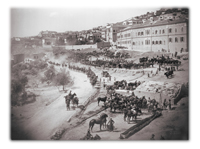
The 13th Brigade, consisting of the 18th Lancers, the 9th Hodson’s Horse, and the Gloucestershire Yeomanry marched by night and reached Subharin near Mount Carmel. They employed two guides but they took the wrong road and the brigade was lost for several hours. They reached a small town which they hoped was Nazareth but was actually Mejdel. Some Turks were quartered there, and taken prisoner. The way to Nazareth was now clear, after the brigade had covered 54 miles in 24 hours. They found the town to contain well-built stone houses, narrow streets, orange groves and gardens. There was a steep drop down to El Afule on the Esdraelon Plain. German officers were rounded up in a hotel but General Liman von Sanders escaped in his pyjamas. However German troops managed to bring their machine guns into action. They had been hidden in the north and west outskirts of the town and now presented the brigade with a serious threat. The brigade received an order to withdraw from the town and join the rest of the Division at El Afule.
 |
|
|
The raid on Nazareth had achieved the disruption of the German and Turkish Headquarters, the destruction of their wireless station, and the capture of 1,200 prisoners. The brigade had sustained less than 20 casualties. C Squadron, consisting of 40 dismounted men, commanded by Lieutenant Brayne, had operated on the southern hills. They captured a Turkish field treasure chest containing gold Turkish sovereigns valued at 20,000 pounds. It had to be handed over to the proper authority but five coins were returned to the regiment, one of which was given to Brayne, the other four became part of the Mess trophies. D Squadron remained at Mejdel and their Hotchkiss gun teams had a battle against three lorryloads of Turkish troops. One lorry caught fire and the other two fled. Sowar Khan Mohammed Khan distinguished himself in this action and received the Order of Merit.
Occupation of Nazareth, 21 Sep 1918
The brigade approached Nazareth stealthily on 21 Sep but their caution was unnecessary as the Turks and Germans had evacuated the town the night before, and Arabs were busy looting. The three regiments provided an outpost line and A and B Squadrons covered an area of 3,000 yards, a machine-gun covering the road to Acre. The other two squadrons were billeted in and around the Russian Hospice. At 8.30pm it was reported that a column of Turkish infantry was approaching from the direction of Haifa. A standing patrol of Hodson’s Horse was guarding this approach, however, A Squadron was in danger of being attacked, and contact with them had been lost. The CO, Lt-Col Keighley was with the squadron and sent a messenger to call for support. A large body of the enemy was only 40 yards to their front, lying down and unsure about launching an attack. If theTurks had charged, they would have overwhelmed A Squadron, but it was dark and their intel was insufficient.
The Bayonet Charge
C Squadron supplied 30 men for an attempt to move behind the Turks under covering fire, and launch a dismounted attack. This group was led by Major Mills and three other officers, and included Risaldar-Major Sultan Khan. The orders were to charge with the bayonet and make as much noise as possible. The regimental history provides a poetic description:
‘The effect was quite extraordinary. Lines of Turks rose like duck, and were silhouetted against the moon; they ran for their lives, some of them being intercepted and bayoneted by the attacking party.’
A Squadron was then encouraged to take part and joined the pursuit down the hill. At daybreak, D Squadron mounted up and continued the chase for 10 miles, bringing back 100 prisoners, 4 machine-guns and many carts. It is thought that the Turkish contingent numbered 700 men. A number of incidents of confused confrontation occurred in the dark, including Lieutenants Brooke and Cobb of C Squadron who spotted men wandering up the hill. They were assumed to be locals and were challenged by Cobb. He realised they were Turks and went for his revolver, but it was not in its holster so he ran at one of the men and seized his rifle. He knocked two men over, and a patrol of Turks a few yards further on was dispersed by Brooke and another soldier.
The Capture of Acre, 23 Sep
The brigade looked forward to a well earned rest in Nazareth but at 5am the next morning they were marched to Acre. Lt-Col Keighley was in the advance guard with B Squadron. The squadron made a bold charge at Acre led by Jemadar Munshi Singh, capturing two field guns and two machine guns. The Brigade commander was unaware of this and ordered the other squadrons of the 18th to ‘gallop the town’, a daunting prospect as the town was walled and surrounded by cactus. But they were relieved to see their tall CO standing on top of Napoleon’s Mound, in control of the town. Munshi Singh was awarded the Order of Merit and the two field guns were marked, ‘Captured by the 18th Lancers’ and placed permanently in front of the Regimental Quarter Guard. The End of the War
These operations all formed part of the battles of Megiddo and Sharon for which the 18th Lancers earned battle honours. They also received honours for Damascus and Palestine 1918. The great pursuit of the Turkish army through Palestine and Syria started at Jaffa on 17 Sep 1918 and ended at Khan Tuman and Haritan, north of Aleppo on 27 Oct 1918, the regiment covering a distance of 480 miles. The war against Germany ended with the Armistice on 11 Nov and was celebrated by all ranks who drank the King’s health with beer. The men were looking forward to returning to India but it was not to be for more than two years.
|
|
Protecting the Armenians of Cilicia
|
|
Aintab, Cilicia, Dec 1918
The Levant was no longer under the control of the Ottoman Empire so had to be governed by the Allies to prevent the return of the Turkish armies. Britain was responsible for Palestine, and France for Syria. But until France could establish its authority, the British/Indian army was required to maintain order. On 16 Dec Major Mills was sent to Aintab in the adjoining province of Cilicia to prevent the massacre of the Armenian population. He was in command of a Rolls-Royce armoured car section which travelled 80 miles to the Turkish controlled town; also accompanied by Sir Mark Sykes. The Americans had a Mission Colony there which was also under threat, and the American College, which had a large walled enclosure, provided a place of refuge for Mills’s party. But Sykes soon left Aintab, on 18 Dec, leaving Mills as the British Administrator, a task for which he was not at all trained. British Administration It was important not to let the Turks think that the British were going to administer with a heavy hand, as they depended on their goodwill for supplies. The head of the Turkish population was the Mutesariff, Effendi Jalal-ud-din, a sharp-featured gentleman who wore pince-nez glasses. Mills’s dealings with him were through an interpreter, the American missionary, Dr Merrill. The Mutesariff was informed that the 18th Lancers were on their way from Aleppo to reinforce the British presence. The lead squadron arrived on 27 Dec and the rest of the regiment reached Aintab on 2 Jan 1919. Colonel Keighley took over command of the town, relegating Mills to the position of Political Officer.
Following on from the increased military presence in Aintab, military and civil experts arrived to impose stricter control. The Armenians welcomed this as a relief from Turkish oppression, and named prominent Turks who had orchestrated their persecution. Three notable citizens were harangued for their belligerent behaviour and six more were sought out and deported for confinement in Malta, although one escaped. The next incident was the seizure of files in the Mutesariff’s office. The Turks in Constantinople wanted them destroyed in case they produced evidence of War crimes, so Mills had the job of seizing them, at the risk of spoiling his diplomatic relations with the Turks. The regimental history reports the conversation between Mills and Jalal-ud-din, involving Dr Merrill, which sounds like something out of ‘Casablanca’:
“Well, Jalal-ud-din, you and I are, I hope, good friends?”
“Pekki, Effendi.”
“I am glad to hear it, as now I have got something very unpleasant to tell you. I have got to seize all your files.”
“But that is impossible. I cannot allow it.”
“Why not?”
“Because you British are not going to be here always, and the moment you go I shall be hanged for being a traitor to my country.”
“Yes, I see. That certainly would be a bit awkward. But how would it be if you sent for 3 or 4 of your influential friends, and had them sitting in your office. I come with a squadron, seize you and your files; then nobody could say you had been a traitor.”
“Effendi, that would suit me excellently.”
The Armenian Women
The files were duly seized and scrutinised by officials for two months, but didn’t reveal anything incriminating. Major Mills had another problem. The Turks had taken many Armenian women, forcing them into sex slavery in harems. The Allied Powers at Versailles ordered them to be released. But there were so many that the British could not cope with them and had to ask the Turks to stop sending any more. One of the women had two children from her Turkish captor which were not allowed to accompany her. Mills had the job of coming up with a solution. After much discussion he suggested that the daughter stay with her mother but the son stay with the father. While the talk continued the woman managed to escape with both children.
Curfew Enforced in Aintab
The Armenians also suffered at the hands of the Moslem Arabs in Aleppo on 1 Mar 1919. Troops were called in to restore order but too late to save the lives of 43 Armenians and 80 more wounded. This unsettled the population of Aintab and the lancers were busy patrolling the city at night. Things escalated so that armoured cars had to be placed at strategic points, and a curfew enforced. The Mutesariff and 22 notable citizens appealed to Major Mills to have the restrictions lifted. He agreed but made them swear to keep the peace and not make any attempt to attack the Armenians. By the end of March the whole of the 13th Cavalry Brigade were posted in and around Aintab and life looked more peaceful. Training resumed and games of polo were organised.
French Rule
At the beginning of November the French arrived to take over the administration, and on 4 Nov 1919 the brigade marched out of Aintab. But the French were not so tactful in their dealings with the locals. The Tricolour was flown everywhere, in contrast to the British who kept the Union Flag out of sight, except over the hospital. To make matters worse the garrison was the Légion d’Orient, made up of expatriate Armenians from America. Within a month the American College was besieged and a massacre occurred in Marash, 80 miles to the north. The French had to withdraw altogether from Cilicia, especially as there was a rise in Turkish nationalism led by Mustafa Kemel.
The Return Home
Major Mills was in command of the 18th Lancers as they commenced their long march to Tripoli. The latter stages were in pouring rain; a storm raged for 3 hours during the night of 20-21 Nov. They camped for 3 weeks on the sand dunes of Tripoli and then marched to Beirut with 9th Hodson’s Horse and 20th Deccan Horse. At Beirut they prepared for embarkation to Egypt. This entailed the onerous task of killing 103 horses deemed too old at 15 years, or too sick. They arrived in Egypt on 3 Jan 1920 and manned the garrison at Tel-el-Kebir. The men who had been away from their homes since 1914 had to endure nine more months of overseas service. Those Moslems in the regiment who wanted to make the pilgrimage to Mecca were given leave to do so. Two officers and 30 other ranks went to Mecca, thus adding Hajji to their names. In September they took the train to Suez and sailed on the ‘Hanover’ to India. They reached Bombay on 30 Nov 1920.
|
|
Amalgamation
|
|
The Adjutant-General’s Memo, 15 Mar 1921
‘I am directed to inform you that the Government of India, with the approval of the Secretary of State, has decided:—
To reduce the number of pre-war Indian cavalry regiments, by a process of amalgamation, from 39 to 21.
To abolish the Silladar system and organise the regiments which are to remain on a non-Silladar basis.
To organise the 21 regiments on the three-squadron basis in order to conform with the Home organisation.
Composition of the Squadrons
The question of class composition had to be sorted out. It was decided that the amalgamated regiments should be formed into 7 groups. Each group should contain three amalgamated regiments, each of which having the same class composition. No regiment was to have more than 2 squadrons of Hindus or Moslems. There should be no mixed squadrons, and that classes should be limited to a squadron only.
The 18th and 19th Lancers were to be combined into one regiment and placed in Group 7. The other two regiments in the group were the 14th/15th and the 38th/39th (Central India Horse). In 1920 the class composition of the 18th Lancers was 3 squadrons of Punjabi Moslems and one squadron of Sikhs. The 19th Lancers were more complex; One and half squadrons of Sikhs, half a squadron of Dogras, one squadron of Punjabi Moslems and one squadron of Pakhtuns (Pathans).
The new class composition had to be the same for each of the three regiments in Group 7; One squadron of Sikhs, one of Jats and one of Punjabi Moslems. Furthermore, the Sikhs had to be Manjha Sikhs from the districts of Amritsar and Lahore. The Punjabi Moslems were to be Tiwanas and Awans from the Shahpur district, and the Jats from Rohtak, Delhi and Bulandshahr. Each regiment had to have 175 of all ranks in each class. There were no Jats in the 18th and 19th Lancers so these had to be taken from the 14th Murray’s Jat Lancers who had 4 squadrons of Jats. The 14th in turn had to be content with surplus Moslems, Rajas and Gakhars.
The two regiments, the 18th and the 19th Lancers finally came together at Delhi New Cantonments on 23 Aug 1921.
|
|
 |
| Badges
|
| Colonel-in-Chief
|
| 1905 - 1947
|
| Commanding Officers
|
| 1858 - 1947
|
| Risaldar-Majors
|
| 1858 - 1947
|
| Officers
|
| 1858 - 1947
|
| Uniforms
|
| 1858 - 1947
|
| Pouches & Pouchbelts
|
| 1858 - 1947
|
| Battle Honours
|
|
AFGHANISTAN 1879-80
PUNJAB FRONTIER
TIRAH
First World War
SOMME 1916
BAZENTIN
FLERS-COURCELETTE
MORVAL
CAMBRAI 1917
FRANCE & FLANDERS 1914-18
MEGIDDO
SHARON
DAMASCUS
PALESTINE 1918
|
|
| Titles
|
| 1858 | 2nd Regiment of Maharatta Horse |
| 1861 | 18th Regiment of Bengal Cavalry |
| 1886 | 18th Regiment of Bengal Lancers |
| 1901 | 18th Bengal Lancers |
| 1903 | 18th Tiwana Lancers |
| 1906 | 18th Prince of Wales’s Own Tiwana Lancers |
| 1910 | 18th Prince of Wales’s Own Tiwana Lancers |
| 1910 | 18th King George’s Own Lancers |
| 1921 | 19th King George’s Own Lancers (amalgamated with 19th Fanes’s Lancers) |
| 1947 | To Pakistan |
|
|
Suggested Reading
|
Old Memories by General Sir Hugh Gough
(William Blackwood & Sons 1897) (Naval & Military Press 2010)
History of the 19th King George s Own Lancer
by General Sir Havelock Hudson (Gale & Polden 1937) (Naval & Military Press 2007)
|
|