|
The Sieges of Venlo and Liège, 1702
The regiment embarked at Cork in June 1701, for foreign service in northern Europe, initially under King William, but he died on 8 March 1702. In that year they covered the siege of Kaiserwerth in April but their first action was in June when they were in the rearguard of a retreat after the French surrounded the allies near Nijmegen. Marlborough took command of the army in June and laid siege to Venlo which surrendered on 25 Sep. At the siege of Liège in October the regiment was involved in the assault on the citadel and the grenadiers distinguished themselves. The garrison was nearly all wiped out. They then wintered in Breda.
Siege of Huy, May 1703
The regiment was deployed for battle at Maastricht on 7 May but after some skirmishing and cannon fire the French/Spanish army retired. Marlborough advanced to Tongres and the enemy were found to be entrenched so that Huy on the Meuse had to be captured. The enemy vacated the town which lay beyond the river and the regiment occupied that part. They were commanded by their Colonel, Lord North. Limburg was captured next, thus ending the Spanish control of the Netherlands.
The March to the Danube, May 1704
Louis XIV’s army under de Villars and their Bavarian allies threatened Vienna, so Marlborough had to move his army quickly and without the knowledge of the Dutch who proved to be troublesome allies. The army consisted of 21,000 men, of which 16,000 were British but were joined by more troops so that the army was 40,000 strong by the end.The march began in mid May and moved along the Rhine to Coblenz, reached on 26 May. Marlborough managed to convince the French that the Moselle was his objective, and it was not until early June that the Dutch were informed of his objective. The army proceeded to cross the Rhine, the River Main, and the Neckar, traversing several German principalities. The feeding of the army was provided by ‘circles’ that had been established in the 17th century to supply armies as they moved through Germany. However, in July, 100 carts promised by the circles of Franconia and Swabia to provide bread, failed to turn up. Frankfort was a good place for Marlborough to purchase shoes for his soldiers. He carried a good supply of cash which was appreciated by the German states that they passed through. Marlborough met up with Prince Eugene of Savoy on 10 June, at Mundelsheim on the Neckar. By the time the army reached the Danube they had covered 400 kilometres in 5 weeks.
Battle of Schellenberg 2 July 1704
On reaching the Danube, Marlborough joined up with his allies. The storming of the heights of the Schellenberg involved a steep climb. The 10th were in the second line of assault following the grenadiers of each regiment. Near the top the French let rip with musket fire, “an iron tempest smote the ranks”. The men fled in panic, losing Captain Crow and 15 men killed. Three sergeants and 36 men were wounded. A German attack under the Margrave of Baden carried on the assault and the French/Bavarian defenders started to retire and the regiment took the opportunity to storm the defences once more. The defenders fled and were pursued by cavalry.
Battle of Blenheim, 13 Aug 1704
The 10th Regiment was brigaded with the 1st, 16th, 21st and 26th. After storming the Schellenberg, they crossed the Danube and took part in various battles in Bavaria. The enemy was encamped in a fortified position at Augsburg. Marlborough’s army joined up with Prince Eugene’s men at Munster on 11 August. On 12 Aug the 10th was ordered forward to support the piquets who were under attack. At the start of the battle, on 13 August, the brigade was ordered to attack the village of Blenheim which was heavily defended by the French in trenches and behind palisades. The 10th and 21st led the assault but their efforts were in vain. As they withdrew they were charged by French cavalry. A Hessian brigade came to their help, and another brigade assaulted the other side of the village, again, without success. Marlborough and Eugene concentrated their efforts on the main body of the French and Bavarians and after a pitched battle of several hours the enemy were roundly defeated. Marshal Tallard was taken prisoner along with many others.
The regiment lost many men although the number is not known. Casualties among the officers are named and include the Colonel of the regiment, Lord North who lost a hand. Eight officers were killed (the highest mortality rate out of all the British regiments present) and nine wounded. The 10th spent the night on the battlefield and was one of the five battalions detailed to guard the prisoners which were taken to Mentz and sent on boats to Holland. They were not involved in the operations in Germany after Blenheim. The battle honour BLENHEIM was not conferred on the Lincolns until 1882.
Battle of Elixheim, The Lines of Brabant, 18 July 1705
The regiment was brought up to strength in May 1705 by a draft of reinforcements. Marlborough took his army up the Moselle valley to confront the French at Sierck. But the Dutch States General ordered him to return to the Netherlands to relieve Huy and Liège which had been recaptured by Villeroi.
 |
|
| The forced march from Sierck brought great hardship to the men and the 10th lost many men. The allies recaptured Huy and were then faced with the Lines of Brabant. On 17 July the Dutch attacked the Chateau de Wang protecting bridges over the River Geete. They captured the castle and broke through the Lines at Oberhespen and Neerhespen.
That evening the Dutch, commanded by Marshal Nassau-Ouwerkerk, pretended to threaten Namur to draw Villeroi from the Lines. This removed 40,000 French troops from Marlborough’s objective. During the night he marched his British troops towards Elixheim. The Duke, himself was involved in the cavalry battle on the morning of the 18th, and the French cavalry retreated with heavy loss. The enemy artillery was captured by Dutch troops and French cavalry tried once more to attack the allied force, but this time were completely overwhelmed. The French infantry put up a brave fight, forming squares against Marlborough’s cavalry, but had to make a dignified retreat. The Lines of Brabant had been breached and the French army withdrew to the west behind the river Dyle. The regiment had been in the leading brigade in the nocturnal attack on Elixheim but there are no casualty figures for this action.
Battle of Ramillies, 12 May 1706
The regiment wintered in Holland and the 1706 campaign started at Tongres in May. As they advanced information was received that the enemy were positioned at Mont St André with the centre of their line on the village of Ramillies. The French and Bavarians were joined by Spanish troops, the whole army commanded by Marshal Villeroi and the Elector of Bavaria. The 10th was positioned on the right of the line, at Autreglise, opposite the enemy left flank. They, with other battalions, advanced to threaten the enemy flank, and Villeroi drew men away from the centre to strengthen it. This gave Marlborough the chance he was hoping for, and sent in a concerted attack on the weakened centre. The 10th were not at first involved in this main area of fighting and were able to watch from a high position. However, as the enemy were forced back they were ordered forward to take part.The tactic worked and soon the French, Spanish and Bavarians were in retreat. They were pursued for many miles and many guns and standards were captured along with hundreds of prisoners.
Sieges of Ostend and Menin, July 1706
The victory at Ramillies caused several places to surrender, including Brussels, Ghent and the principal towns of Brabant. Lord Grey was promoted to brigadier-general and given command of 3 battalions. The regiment marched to Arseele and Rouselaer, and formed part of the covering army during the siege of Ostend which capitulated on 8 July. They then marched to Menin on the Lys river, to take part in the siege. Menin was a well constructed fortress, the work of Vauban. The siege began on 23 July in which the 10th played a prominent part. They sustained heavy casualties but the numbers of killed and wounded are not recorded. This was not the end of the 1706 campaign and they went on to further action at Dendermonde and Aeth. They spent the winter in Ghent.
1707-08
There was little in the way of fighting in the 1707 campaign and they again wintered in Ghent. In 1708 there was news of a French invasion of Britain and the 10th were sent back to England, arriving at Tynemouth on 21 March. But the Royal Navy intercepted the French fleet and drove them back. The 10th returned to Ostend and sailed up river to Ghent.
Battle of Oudenarde, 30 June 1708
The French captured Ghent and Bruges and began a siege of the town of Oudenarde in the Spanish Netherlands. The army crossed the Scheldt on pontoon bridges and encountered the enemy, commanded by The Dukes of Burgundy and Vendôme. The 10th, commanded by Lt-Col Henry Grove, crossed the river near the Abbey of Eename and climbed the heights of Bevere. They halted for a while and then descended to engage the enemy at the village of Eyne. They maintained a steady rate of musket fire that evening which was augmented by the wings of the army advancing and forming a crescent that enveloped the French. Darkness prevented the destruction of the enemy and they were allowed to retreat in disorder towards Ghent.
Siege of Lille, Aug - Dec 1708
The fortress of Lille, capital of French Flanders, was deemed impregnable. It was garrisoned by 15,000 men, commanded by the veteran Marshal Boufflers. The siege was carried out by the army under Prince Eugene of Savoy but included 5 British battalions. Marlborough’s troops provided the covering army to prevent any reinforcements reaching the city. The 10th were employed in escorting supplies and providing men for outpost duty. The most important convoy of supplies was from Ostend, 45 miles from Lille. The French tried to intercept it and a battle was fought at Wijnendale on 28 Sep. The French were driven off and the convoy got through. The grenadier company of the 10th took part in attacks on the fortress of Lille. The citadel surrendered after 120 days, on 9 December. The siege had cost Marlborough the lives of 14,000 men.
Recapture of Ghent, Dec 1708 - Jan 1709
The 10th were part of a force sent to relieve Brussels which was besieged by the Bavarians. Brussels was relieved at the end of November and the 10th, expecting to go into winter quarters, were instead sent back to Ghent to evict the French who now occupied it. Their first action was driving in the enemy outposts and attacking the trenches between the Scheldt and the Lys, on the night of 24 Dec. Lord North led the attack and was highly praised for his bravery which brought him promotion to major-general. On 26 Dec French grenadiers made a sortie from the town and scattered the first troops they met. The 10th were sent to their aid and engaged the grenadiers in a fierce fight that resulted in their CO, Lt-Colonel Henry Grove, being captured, The grenadiers were forced back however and on 2 Jan 1709 the defenders surrendered. The regiment spent the rest of the winter in the recaptured town, the coldest winter in living memory.
Siege of Tournai, June -Sep 1709
In the spring of 1709 the regiment was camped on the Upper Dyle from where the army threatened the enemy lines. Villars withdrew men from the fortified towns to strengthen his army in the field. But Marlborough and Eugene turned their attention to Tournai. This was an unusual siege because much of the action occurred underground. The besieging army was in place by 27 June 1709 and trenches were dug around the city. The defenders were also entrenched outside the walls. In July, heavy rain filled the trenches and prevented the building of batteries for the siege guns. By the end of July the commander of the garrison, the Marquis de Surville, surrendered the city but retained the citadel with around 5,000 men. King Louis refused to allow him to surrender this last bastion. In August, Marlborough left the besieging action to the Dutch and Prussians, and took his covering army to Orchies, 19km away. The 10th were with Marlborough at this time.
The defenders of the fortress had dug tunnels outside the citadel so that mining and countermining became the main feature of the siege. The digging was hard and dirty work and contact with the enemy underground resulted in terrible fights in the dark, made worse by the danger of collapses and flooding. On 26 Aug the French detonated a mine that killed 400 men. Cannon’s history states that the 10th lost a number of men in the mines, indicating that Marlborough’s army reinforced the Dutch and Prussian besiegers. Finally, on 3 September, after a 70-day siege, the French, running short of supplies, surrendered, having lost half the garrison. De Surville had done well to keep the allies preoccupied for so long, but Villars and King Louis could not forgive him for surrendering. Sir Winston Churchill wrote, “the fall of Tournai was followed by an explosion of war-fury strangely out of keeping with the policy and temper in which the campaign had hitherto been conducted.”
Battle of Malplaquet, 11 Sep 1709
The army crossed the country towards Mons where another siege was anticipated. But they came across the French army under Villars and Boufflers, established in a carefully fortified entrenchment at Malplaquet. The trenches were fortified with ‘abatis de bois’ whole trees placed at right angles so that the branches faced outwards to make it almost impossible for infantry to approach, but at the same time gave some protection to the attackers from musket fire. This was, however, going to be a bloody battle causing more casualties than the last three field battles put together.
The 10th were brigaded with the Foot Guards, Royals, and the 37th, given the difficult task of attacking trenches in the woods of Taisnières. The Guards made a brave attempt but were repulsed. The Royals then went in at the same time that the Buffs assaulted trenches to the left. The 10th filled the gap between them, and the joint effort managed to extract the enemy from their trenches and push them back into the woods. The fight amongst the trees continued while the battle raged elsewhere. The French centre was forced back despite huge obstacles that made it so difficult to advance. The cavalry also made great progress against the enemy cavalry. The French were eventually driven from the field, abandoning guns and standards. The 10th, in spite of their hard fighting, suffered few casualties. Two officers were wounded but the rank-and-file numbers are unrecorded.
Sieges and Actions 1709 - 1715
1709 Siege of Mons. They were part of the covering army. October.
1710 Capture of Mortagne. April.
1710 Siege of Douai. Several men killed and wounded by artillery fire. June.
1710 Siege of Bethune. Part of the covering army. August.
1710 Siege of Aire. Severe losses in killed and wounded. The 10th were heavily engaged several times, storming outworks. They were highly praised by the Prince of Anhalt who commanded the besiegers. The garrison surrendered on 9 Nov.
1710 Marched to Courtrai where they received drafts of recruits.
1711 Review at Warde by Marlborough. April.
1711 Forcing the Lines at Arleux. June.
1711 Siege of Bouchain. Several men killed and wounded. Sept.
1712 Tournay. Marlborough was replaced by the Duke of Ormond. April.
1712 Regimental strength: 623 rank-and-file.
1712 Siege of Quesnoy. Part of the covering army. Fortress surrendered 4 July.
1713 Quartered at Ghent while peace was negotiated.
1714 In garrison at Nieuport. April. On the death of Queen Anne several regiments went home but the 10th remained in Flanders on garrison duty.
1715 The regiment returned home, arriving at London in mid August. They marched to Colchester. They remained in England during the Jacobite Rebellion.
|
|
Lexington 19 April 1775
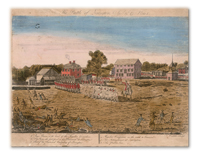
The 10th were stationed in Ireland throughout the period of the Seven Years War (1756-63). But Britain was having trouble with the colonists in North America and the regiment was one of the first to be sent across the Atlantic in 1767. They stayed briefly in Nova Scotia, then were sent to Boston in 1768 where the army was needed to suppress riotous citizens. The Boston Tea Party occurred in December 1773, but what measures were taken by the regiment under the command of General Gage is unclear. The War started in 1775 when it was discovered that military stores were being stockpiled in Concord, Massachusetts, 18 miles from Boston. The flank companies of the 10th and other regiments, numbering 700, under the command of Lieutenant-Colonel Francis Smith, were sent by boat on 18 April, to find and destroy the colonists’ stores. They landed at Phipps Farm and marched towards Concord, but were intercepted by enemy militia at Lexington in the early hours of 19 April. The Americans were ordered to disarm but took cover and fired on the redcoats. A soldier of the 10th was wounded, the first and only casualty of the battle. His comrades fired off a volley which killed several colonists and wounded many. The rest dispersed, and the flank companies continued on to Concord.Retreat from Concord
Light companies of the 4th and 10th Regiments were detached, under the command of Captain Parsons of the 10th, to secure the bridge beyond Concord. The remaining troops searched for the hidden stores. But Parsons’ men were attacked and fired on, killing three men and wounding several others. They were forced to withdraw into the town where stores were being destroyed. A general retreat back to Lexington was relentlessly attacked and ambushed along the way so that by the time they reached Lexington, the men were exhausted and their ammunition expended. On reaching the place, they were thankful to find reinforcements commanded by Colonel Earl Percy who had a brigade of infantry and two guns. The infantry formed square and the exhausted flank companies took cover inside. This second battle of Lexington resulted in the death of two men of the 10th and 17 wounded, including Lt-Colonel Smith, Captain Parsons and two other officers. Bunker Hill, 17 June 1775
The British were now under siege in Boston as American colonists converged on the city. The enemy took up position on Bunker Hill and Breed’s Hill in Charlestown, and fortified the top of the hills. The 10th were part of the force sent to dislodge the Americans. They arrived by boat and, on 17 June, began to make their way uphill through long grass and various fences. The men came under heavy fire and began to waver. But they were urged on and in the third attempt found renewed courage to assault the trenches with great determination. They bayoneted the defenders who had run out of ammunition, and drove the Americans from their position. The tenth’s grenadier companies were highly praised for their work, during which every one of their officers was wounded. Their loss was two sergeants and five men killed. Captain Parsons was wounded again, along with four other officers, a drummer and 39 rank-and-file. The whole British force lost 226 killed and 828 wounded.
The siege of Boston continued and the British troops suffered from hunger and lack of supplies as British ships were prevented from reaching Boston. Morale deteriorated and sickness was prevalent. Evacuation began in March 1776 and the regiment was sent to Nova Scotia. They were stationed in Halifax until June.
Long Island, 27 Aug 1776 The British, now commanded by General William Howe, renewed their efforts, and in June 1776 the fleet sailed to Staten Island where they received reinforcements from England, as well as Hessian troops. The 10th were formed into a brigade with the 37th, 38th and 52nd Regiments in Lt-General Earl Percy’s Division. While the British were advancing on New York, the Americans declared their independence on 4 July. Long Island became the focus of attack and the regiment supported the lead Division to seize a mountain pass on the night of 26 August. The pass was captured and they continued towards Brooklyn where the American army was placed. Arriving at Bedford they found the enemy quitting the wooded Guan Heights to return to their lines. The British pressed on towards the enemy lines but General Howe called a halt, presumably the general wished to preserve the army for a long campaign.
The decision to avoid unnecessary bloodshed proved to have been wise, as the Americans quit the lines and retreated across the East River to New York. The regiment crossed over to York Island (Manhattan) and took part in the operations to drive the enemy out of the city.
White Plains, Oct 1776
In the second week of October they embarked on boats and went upriver to the area around Westchester, then on to Pell’s Point where they skirmished with the enemy. They also forced the passage of the Bronx River on 28 October to reach the fortified position on White Plains. The Americans retreated and the regiment lost two men in this battle.
The Battle of Fort Washington, Nov 1776
The navigation of the Hudson River was obstructed by Forts Washington and Lee. The 10th were part of the force sent against Fort Washington on Manhattan Island, and on 16 November Earl Percy led his division against the enemy right flank. They assaulted an advanced entrenchment and went on to capture the main fortification. The American commander, Colonel Magaw, surrendered and 2,800 Americans were made prisoner, three quarters of which died in captivity. The regiment’s casualties were one officer and 3 men killed, and 5 wounded. George Washington withdrew his defeated army through New Jersey and famously crossed the Delaware river on Christmas Day into Pennsylvania. Rhode Island, Dec 1776
The American naval base on Rhode Island was an important objective as it was from there that privateers went out to attack British ships. The regiment was detached, with other troops, under the command of Lieutenant Generals Clinton and Earl Percy to sail over to Rhode Island on 9 Dec. The attack was a success, Newport was captured, and the Americans were forced to submit to British authority. The regiment remained there for several months, until the campaign of the following year.
|