|
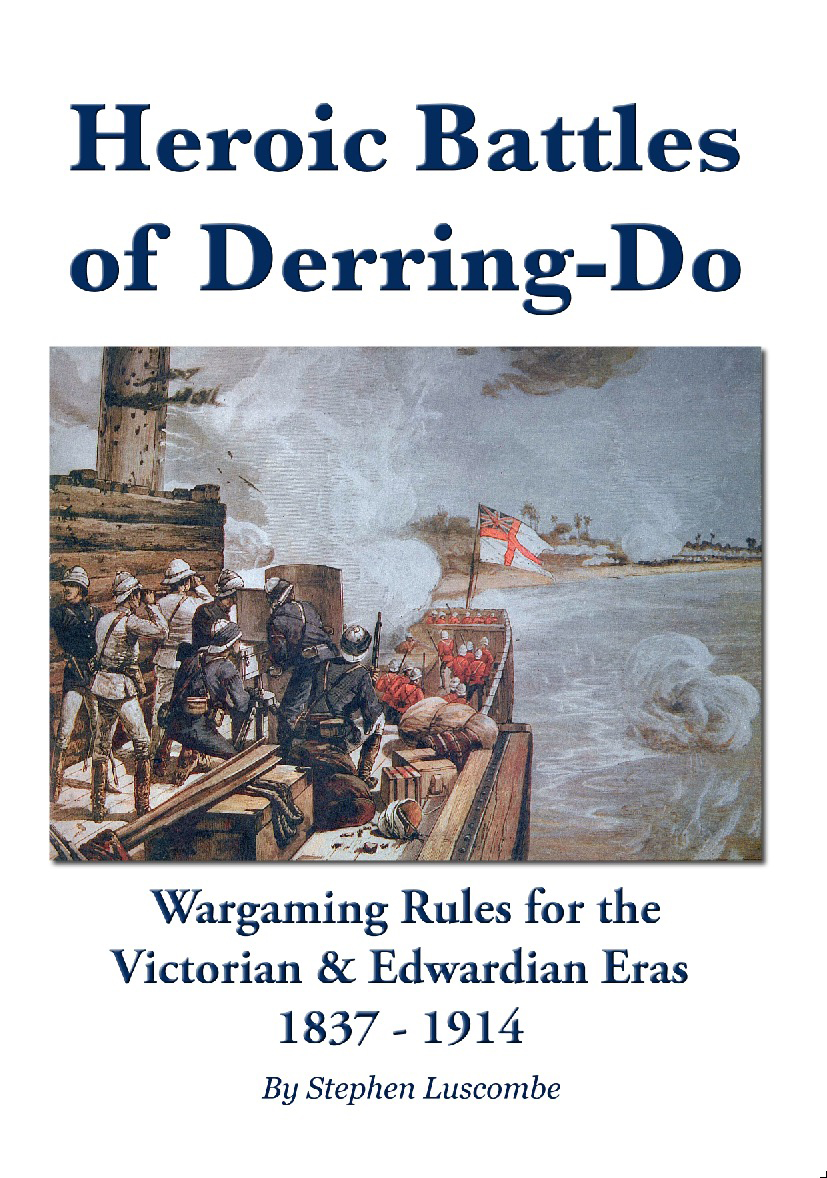
Heroic Battles of Derring‑Do has now been released in its first iteration as a PDF. A review of the rules appears on my Colonial War‑games Page, and the rules have their own dedicated webpage at Heroic Battles of Derring‑Do, where they can be purchased. The rules are designed to recreate battles from the Victorian and Edwardian eras in a fast, accessible, and enjoyable way. They draw inspiration from H. G. Wells’ Little Wars and from Larry Brom’s The Sword and the Flame, but they are also shaped by many years of running games for schools and conventions. The aim is straightforward: clear mechanics that produce memorable battles without unnecessary complexity, allowing newcomers to join in quickly with little or no prior knowledge of the system. They are suitable for colonial campaigns and for major nineteenth‑century conflicts between industrialised armies, including the American Civil War and the Franco‑Prussian War, as well as imagined wars between European powers.
The rules operate at what I would describe as large‑skirmish level. Anyone familiar with Sharp Practice will recognise the approximate size of units and games, although the mechanics here are entirely different. The system is simple enough to scale up for larger engagements and supports 28mm, 20mm, 15mm, or even 54mm figures. Heroic Battles of Derring‑Do is primarily intended for colonial theatres, but the scope extends across the Victorian and Edwardian periods, including hypothetical clashes of the type that inspired H. G. Wells—such as a Fashoda crisis escalating into war between Britain and France, or German intervention in the Boer War.
The core of the system is the Deck of Fate, which determines which units can act and how many activations they receive. Standard playing cards can be used instead if preferred. Because the action can jump unpredictably from one side to the other, commanders must judge carefully when to advance, hold back, or act decisively. Jokers can end turns before all units have been activated, and a separate Deck of Fortune introduces unexpected events that test a player’s ability to adapt as the battle unfolds. These random events fall into four categories: weather, logistics, battlefield environment, and the gods of war. A standard deck of cards can substitute for both decks, although the Resource Pack includes printable versions.
The period from 1837 to 1914 saw major changes in military technology, from muzzle‑loading muskets to modern breech‑loading rifles. Artillery and the later rapid‑firing guns that would evolve into machine guns are also represented. Ranges are deliberately abstracted: medium range is twice short range, and long range is twice medium, keeping the system easy to remember and quick to apply.
Different types of dice provide simple but effective granularity when applying modifiers, allowing variation in outcomes without adding layers of rules.
Movement combines fixed and variable elements. The first activation always provides a guaranteed amount of movement, preventing players from feeling stuck due to bad luck. Additional activations may vary, adding uncertainty without undermining basic manoeuvrability.
Units are intentionally small and abstracted, and figures are based individually. This makes it easy to track individual exploits. Because the rules are streamlined, battles can be scaled up to include many more units, with the Deck of Fate determining how effectively a commander can control them.
The rules employ single‑based figures to emphasise individual action. This reinforces the sense that individuals are the primary agents, rather than the industrialised mass warfare of the twentieth century. For this reason the rules cover only up to the Edwardian period. The game lends itself to following the actions of notable individuals, whether commanders or ordinary soldiers. Naming figures is optional, but it helps build a narrative around moments of bravery or failure. Players are encouraged to agree on which individuals deserve recognition, medals, or other honours as the story of the battle unfolds. Optional names are provided for all armies, and additional names can be supplied on request.
Six scenarios are included, although players are encouraged to devise their own. A points system is provided, and some scenarios allow for endless hordes to accelerate play. Another method is to select two armies and allow the opponent to choose which to command. The rules draw on years of experience at conventions and clubs with a wide range of systems. They are designed to be fast, enjoyable, and to generate engaging narratives. Although intended for multiplayer use, the card‑driven structure makes them particularly suitable for solo play, as the cards regulate the flow of events and the random events can assist or hinder either side impartially.
A range of army lists is provided to support these varied theatres of war, including Indian Mutineers, Indian Mutiny‑era British, ACW Union and Confederate forces, British Regular Army, Egyptian Regular Army, French Regulars and Foreign Legion, Prussian and German Regular and Colonial forces, Boers, Sudanese Mahdists, Tuareg, Arab forces, Hadendowah, Pashtun, and Zulus. More lists will be added in due course, but these are sufficient to begin play.
|