

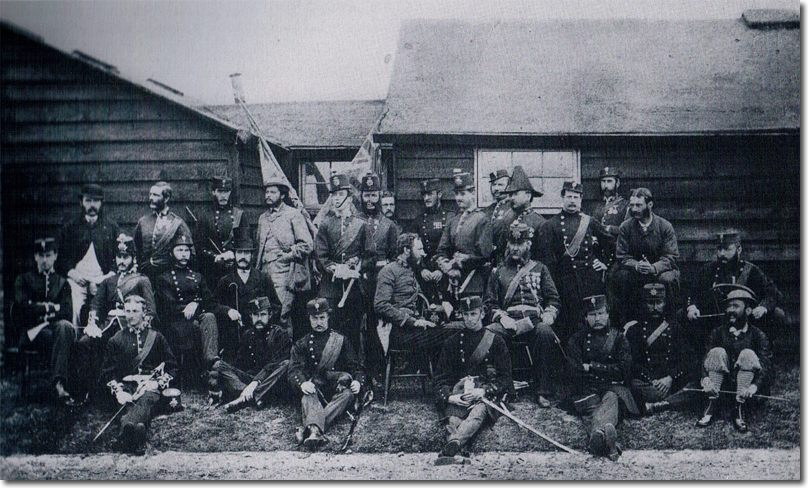
The 2nd Battalion were stationed in Aldershot in 1863 having returned from the campaign in China. Colonel Holcombe is sitting in front of the officer with the cocked hat. There are officers in dress uniform and some in blue frock-coats. The scarlet tunics have no epaulettes, only a crimson silk twisted cord on the left shoulder to secure the sash which from 1855 was to be worn on the shoulder instead of round the waist. Rank was shown on the collar; ensigns a star, lieutenants a crown, captains a crown and star. The same badges were repeated for major, lieutenant-colonel and colonel but with gold lace along the base of the collar as well as the top. A waist-belt was worn over the tunic to carry their sword.
Holcombe and four other officers wear the regimental shako, worn by the infantry from 1861 to 1869. For captains and subalterns the cap was without gold lace, but majors had one row of lace around the top and lieutenant-colonels two rows. A white over red ball tuft was held on top by a gilt clasp. Flank companies had been abolished after the Crimean War so all officers had the same pattern ball tuft. The 1861 badge on the front of the shako was 3.25ins deep by 2.75ins wide. Colonel Holcombe’s badge looks larger and it may be that he retained the 1855 badge (4.2ins deep by 3.5ins wide) from the previous pattern of shako.
The frock-coat was blue and double-breasted, having a double row of gilt buttons down each side of the chest. On the left shoulder was a crimson cord and button to hold the crimson sash in place. The cuffs had a blue slash flap with three smaller buttons. Field officers had rank badges on the collar but captains and below had plain collars. The forage cap was blue with a scarlet cap band. The Star of St Andrew badge had an embroidered 1 beneath it. In wet weather oilskin covers protected the forage cap and the shako. Two officers seated on the ground in front have swords slung from white waist-belts but the other officers wear the frock-coat without swords.

