

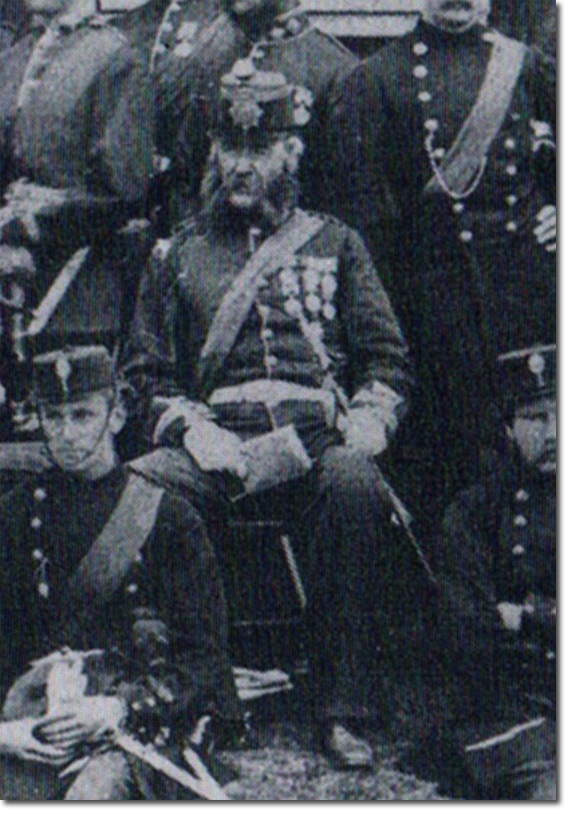
Alexander Holcombe was born on 10 May 1810. He was commissioned into the 13th Light Infantry as an ensign on 3 Dec 1830, promoted to lieutenant on 12 Sep 1834 and fought in Afghanistan from 1838 to 1843. He commanded the rearguard at the passage of the Kojak Pass on 14 April 1839 when his men repulsed enemy attacks on the baggage and recovered large amounts of captured equipment. He accompanied the expedition to Girishk and was present at the storming and capture of Ghuznee. He was also at the assault and capture of Tootumdoorah. He commanded two companies of the 13th that captured forts on the left of this position, and was involved with his regiment at all the engagements of that campaign. On 29 Oct 1841 at the advance and storming of Jugduluk Pass, Lieutenant Holcombe was severely wounded. He was at the defence of Jellalabad and the sorties. After this campaign he fought in the suppression of the sepoy mutiny at Sukkur in Scinde in 1844.
He was promoted to captain on 22 July 1842 and reached his majority on 9 Aug 1850. He went with the 13th to the Crimea in 1855 and fought in the siege of Sevastopol. He was promoted to 2nd Lieutenant-Colonel on 26 June 1855 and transferred to the Royal Regiment in 1857 to take command of the 2nd Battalion. He commanded half of the Berar Field Force in the Deccan from Nov 1858 to March 1859. He was highly praised for the performance of the Force, which, it was claimed, prevented the mutiny from spreading to the south of India. The battalion then went to China where they fought at Taku Forts and the capture of Peking in 1860. Holcombe was promoted to Colonel on 17 July 1860.
Colonel Holcombe was married twice, first to Louisa Lewis Squire. They had seven children. His second wife was Mary Thackeray and they had a daughter. He died whilst in command on 8 Feb 1867 at Nassuradad in India. The photo was taken at Aldershot in 1863 where the 2nd Battalion were stationed from 1861 to 1866.

