

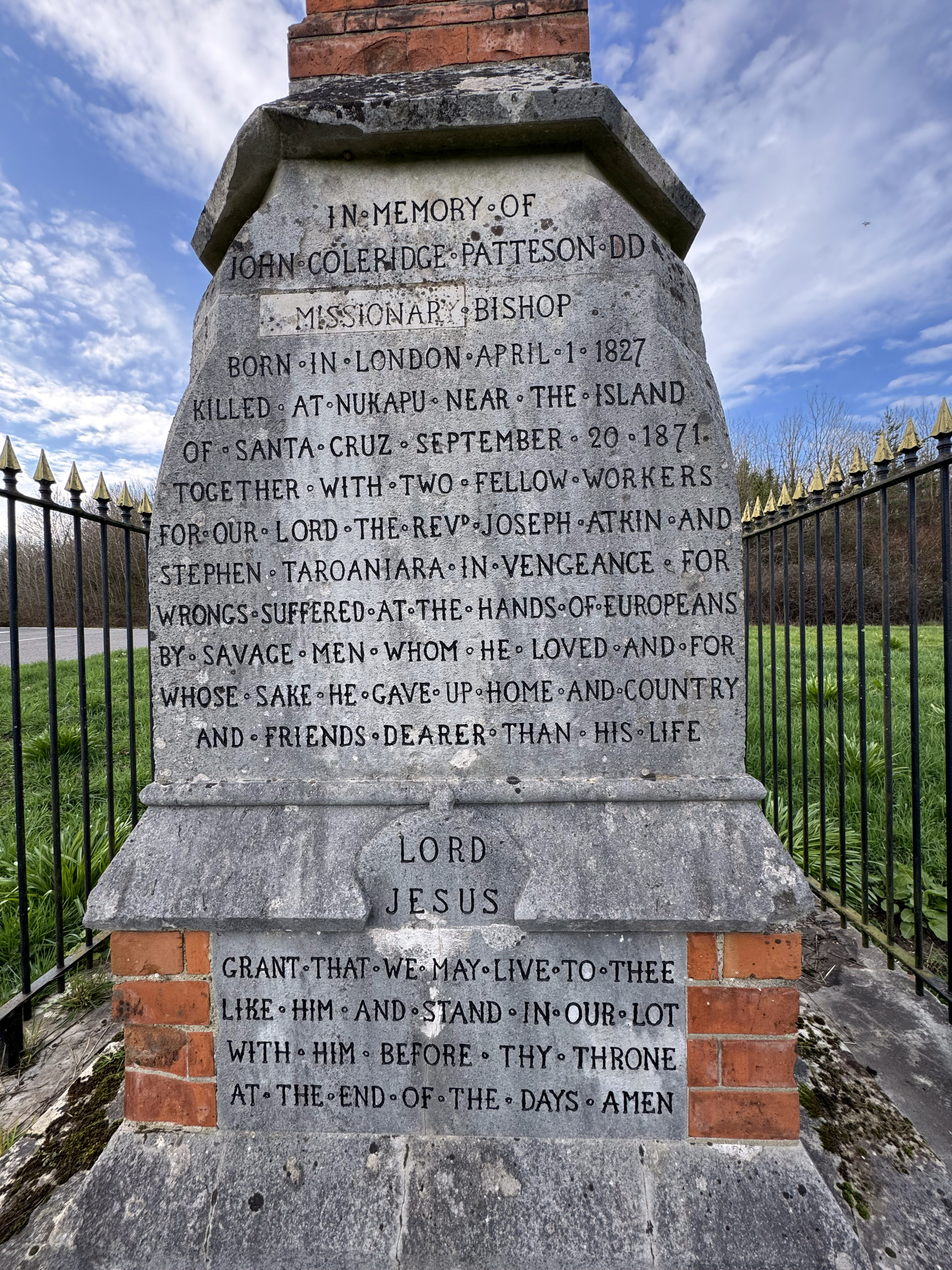
Patteson’s Cross is a Grade II listed wayside memorial erected in 1873 in memory of John Coleridge Patteson, the first Bishop of Melanesia, who was killed on Nukapu in the Solomon Islands in 1871. It stands at the crossroads historically known as Spence Cross, where the Ottery St Mary to Feniton road meets what was then the main Exeter–London road. The monument was designed by the Victorian church architect William Butterfield, a friend of Patteson and the architect of Alfington Church.
The memorial was commissioned and paid for by Patteson’s cousin, Sir John Duke Coleridge, later Lord Chief Justice of England. Coleridge’s sister, Frances Duke Coleridge, had married Sir John Patteson of Feniton Court, making the bishop their eldest son. The Morning Post of 17 September 1873 reported that the land for the memorial was provided by Sir John Kennaway, and that Coleridge, then Attorney General, oversaw its erection. Contemporary reports also note that the site was chosen because it lay on the route Patteson took when leaving Devon for his final journey.
The structure is built of red brick with stone dressings and carries a Latin cross. Its inscriptions are arranged on the four faces, each headed with the name of the direction it faces. These texts were selected by Coleridge and reflect both family connections and Patteson’s vocation.
North face (Feniton):
“The Lord hath his way in the whirlwind and the clouds are the dust of the feet.”
North base:
“A kinsman desires thus to keep alive for after time the name and example of a wise, a holy and a humble man.”
East face (Honiton):
“The path of the just is as the shining light that shineth more and more unto the perfect day.”
South face (Ottery St Mary):
“Wherewithal shall a young man cleanse his ways even by ruling himself after thy word.”
South base:
“In memory of John Coleridge Patteson D.D. Missionary Bishop. Born in London April 1 1827. Killed at Nukapu near the island of Santa Cruz September 20 1871. Together with two fellow workers for our Lord, the Revd. Joseph Atkin and Stephen Taroaniara, in vengeance for wrongs suffered at the hands of Europeans by men whom he loved and for whose sake he gave up home and country and friends dearer than his life.
Lord Jesus, grant that we may live to Thee like him and stand in our lot with him before Thy throne at the end of the days. Amen.”
The west face carries the Exeter inscription: “When a few years are come then I shall go the way whence I shall not return.”
The cross originally stood close to the roadside with no railings, supported on its north side by a brick retaining wall. It became known locally as Patteson’s Cross, and the crossroads itself adopted the name. A map of 1890 shows the monument in its original position, surrounded by trees.
The memorial suffered several accidents in the late twentieth century. It was struck by a motorcycle in the early 1980s and by a car in 1991, the latter destroying the shaft. During the re-routing of the A30, Devon County Council rebuilt the monument and moved it slightly southwards, adding protective railings. Further deterioration led to a community-led restoration in 2016, which included cleaning, minor brick and stone repairs, repainting the inscriptions, and replacing damaged railings. The project was supported by local fundraising and interest from the Melanesian Mission.
The cross remains an important local memorial to Bishop Patteson and is frequently visited by visitors from Melanesia. It also forms part of the wider network of Patteson memorials in Devon, including the Martyrs’ Pulpit in Exeter Cathedral, the plaque in Alfington Church, and the memorial stone in the Melanesian Chapel at Feniton.
The monument also links directly to the life of John Duke Coleridge, who financed its construction, and to the wider Coleridge and Patteson families whose histories are closely tied to Feniton, Alfington and Ottery St Mary.

