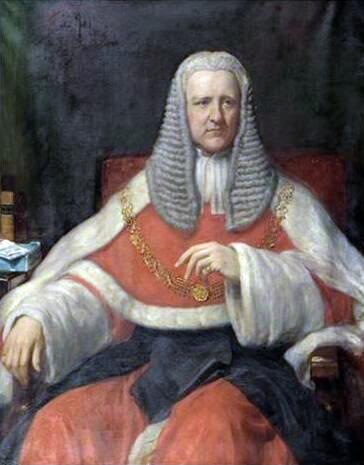
John Duke Coleridge (1820–1894), First Baron Coleridge, was one of the leading legal figures of Victorian Britain. Born at Heath’s Court, Ottery St Mary, he belonged to a family already prominent in law, literature and the Church. His grandfather was the judge Sir John Taylor Coleridge; his great‑uncle was the poet Samuel Taylor Coleridge; and his cousin was John Coleridge Patteson, later Bishop of Melanesia. The family’s influence in East Devon was long‑standing, and Coleridge’s later support for Alfington church reflects those ties.
Educated at Eton and Balliol College, Oxford, Coleridge excelled in classics and oratory. He became President of the Oxford Union and gained a reputation for clarity of argument and a strong command of rhetoric. Called to the Bar in 1846, he built a successful practice on the Western Circuit, noted for his fluency and careful preparation.
Coleridge entered Parliament in 1863 as Liberal MP for Exeter. He became Solicitor General in 1868 and Attorney General in 1871, working closely with Gladstone’s government. He played a significant role in the legal reforms of the period, including the Judicature Acts, which reorganised the English court system and created the modern High Court.
Several major Victorian trials are associated with his name. The most famous is the Tichborne Claimant case (1871–74), one of the longest trials in English legal history. As Attorney General, Coleridge led the prosecution against Arthur Orton, who falsely claimed to be Sir Roger Tichborne. His cross‑examination was central to exposing the fraud. He also appeared in the Franconia case (1876), which established English jurisdiction over crimes committed in territorial waters, and in the Ridsdale case (1877), a key moment in the disputes over ritualism in the Church of England.
In 1880 Coleridge succeeded Sir Alexander Cockburn as Lord Chief Justice of England and Wales. He was the first to hold the office under the newly unified High Court created by the Judicature Acts. His tenure was marked by the consolidation of the new court structure and by steady judicial administration during a period of political and legal change. He was raised to the peerage as Baron Coleridge of Ottery St Mary.
After the death of his cousin, Bishop John Coleridge Patteson, killed in 1871 on Nukapu in the Solomon Islands, Coleridge financed the memorial to him in Alfington church. The work is attributed to William Butterfield, who was already closely associated with the Coleridge family through his restoration of St Mary’s, Ottery St Mary, and his design of the church at Alfington. The two memorials — Patteson’s and Coleridge’s — stand within the same building, marking the different careers of two members of the same Devon family.
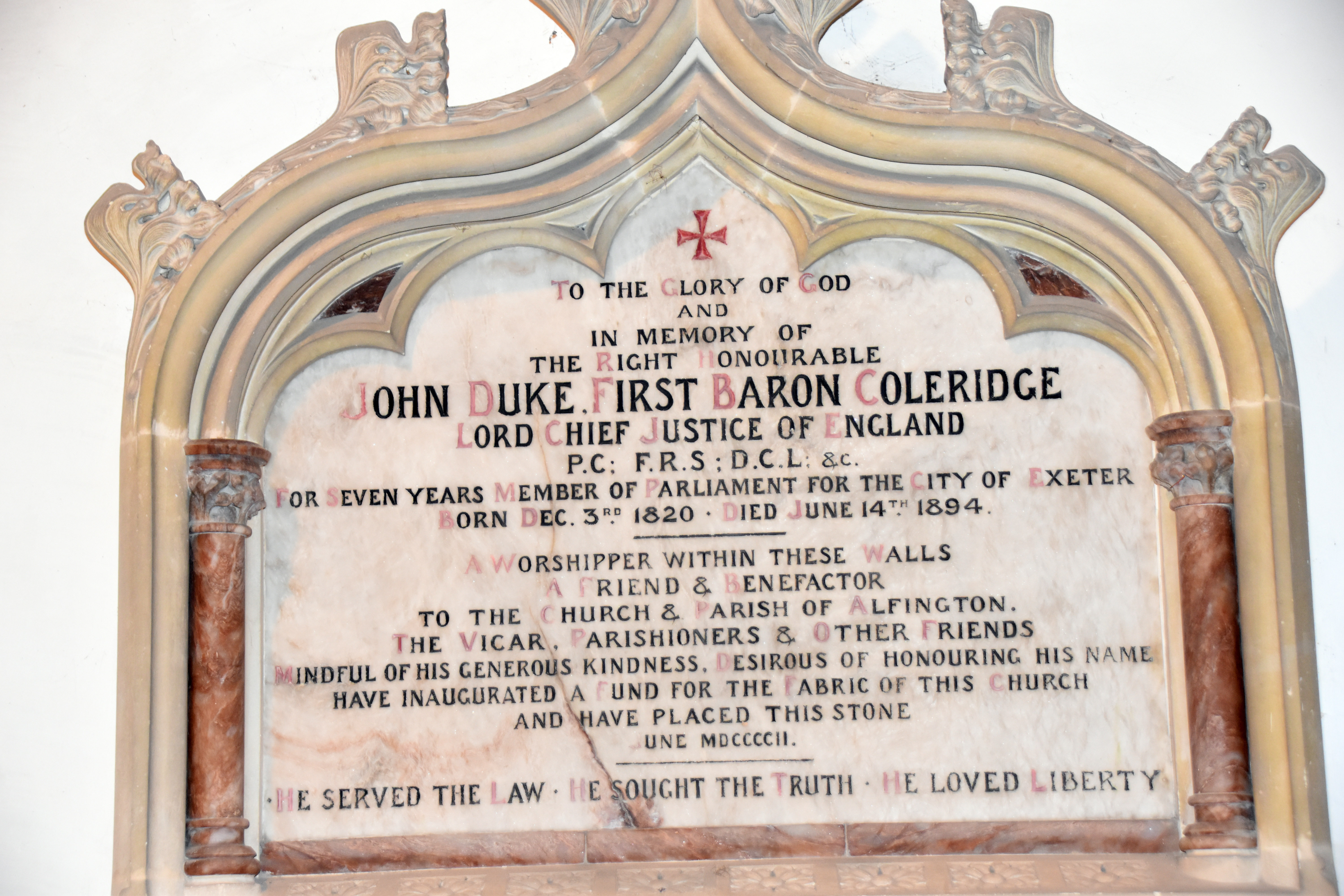
The plaque to John Duke Coleridge in Alfington church was erected in 1902 by parishioners and friends. It records his service as Lord Chief Justice, his years as MP for Exeter, and his role as a benefactor to the parish. The inscription summarises his public character in three phrases: “He served the law · He sought the truth · He loved liberty.”
Coleridge died in 1894 and was buried at Ottery St Mary. His memorial in Alfington reflects the long relationship between the Coleridge family and the parish, and his role in supporting the church alongside his national legal career.