

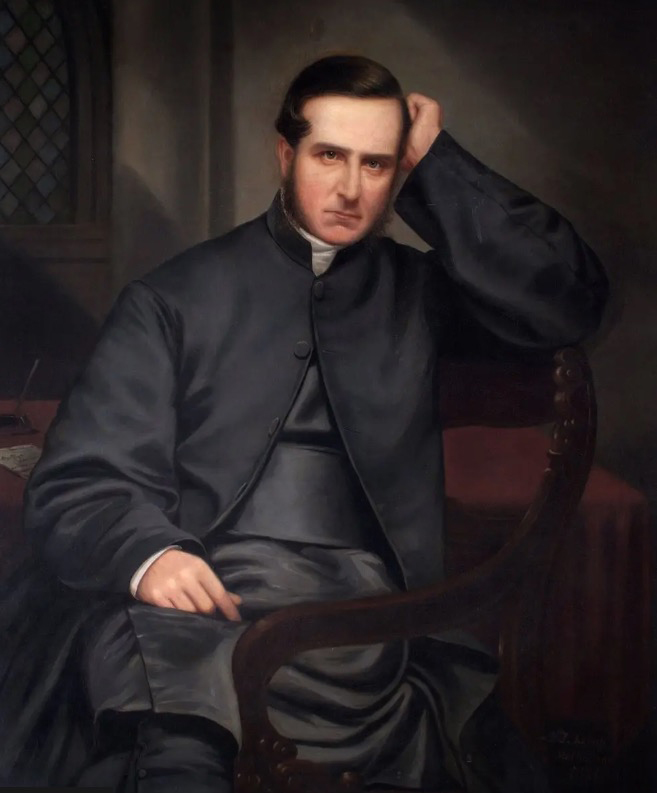
John Coleridge Patteson was born in 1827, the eldest son of Sir John Patteson and Frances Duke Coleridge, and although his birthplace was London, his formative years were spent at Feniton Court. The house had been acquired by his father in 1841, and the family’s life there placed him within the orbit of the Coleridges at Ottery St Mary and the wider intellectual and clerical networks of the period. Feniton Court, its grounds and the surrounding parish were the landscape of his childhood, and St Andrew’s Church was the setting for the ordinary patterns of worship and family observance. The Patteson family memorials in the churchyard, the later Melanesian Chapel inside the church, and the surviving records of the parish all reflect the depth of that connection.
His early education followed the expected path for a family of his standing: King’s College School in London, then Eton under the supervision of his relative the Rev. Edward Coleridge, and later Balliol College, Oxford. He was a capable linguist with an interest in Hebrew, Syriac, Welsh, Arabic, Greek and Latin, and although he did not always meet the academic expectations placed upon him, he was widely regarded as intelligent, personable and serious-minded. His first clerical appointment brought him back to the immediate neighbourhood. In 1853 he was ordained deacon at Exeter Cathedral and became curate of Alfington, a small church built largely through the efforts of his uncle, Sir John Taylor Coleridge. Alfington Church, dedicated to St James and St Anne, was intended to serve a scattered rural population, and Patteson’s brief ministry there was marked by the same pastoral attentiveness that would later define his work overseas. The church still preserves this link in its memorials and early records.
The decisive turn in his life came through Bishop George Augustus Selwyn, whose work in New Zealand and the Pacific had already captured Patteson’s imagination. Selwyn visited Feniton Court while in England, and it was in the library there that the question of Patteson joining the Melanesian Mission was discussed. Sir John Patteson, already in failing health, understood that if his son accepted the invitation he might never see him again. He nevertheless agreed, and in 1855 Patteson left Feniton, walking first to the coach that would take him to Cullompton to join the railway. His own letter home records that he paused in St Andrew’s churchyard to pick primrose buds from his mother’s grave before beginning the long journey that would take him to the other side of the world.
Once in the Pacific, Patteson’s aptitude for languages and his willingness to learn from the islanders made him an unusually effective missionary. He travelled widely aboard the mission ship Southern Cross, visiting islands where European contact was often limited or fraught. In 1861 he was consecrated the first Bishop of Melanesia. His work was increasingly shaped by the realities of the labour trade, or “blackbirding”, in which islanders were taken—sometimes forcibly, sometimes through deception—to work in Fiji, Queensland and elsewhere. His opposition to these practices and his attempts to protect local communities placed him in a complex and often dangerous position.
In September 1871 he visited the island of Nukapu, where a group of young men had recently been abducted by labour traffickers. The following day he was killed in retaliation by the uncle of one of the captured boys. His body, prepared with care by local people, was placed in a canoe with a palm frond knotted five times—one knot for each of the abducted islanders—and was recovered by the crew of the Southern Cross. He was buried at sea. The mat in which he had been wrapped was later given to Bishop Selwyn, then to Patteson’s brother James Henry, and eventually buried in the family vault in Feniton churchyard. In 1905, at the request of the Melanesian Church, the mat was exhumed with a diocesan faculty and returned to the Pacific. It now rests in a shrine at St Barnabas Cathedral on Norfolk Island.
The local memorial landscape reflects the depth of the connection between Patteson and East Devon. St Andrew’s contains the Melanesian Chapel, the family memorials and the brass commemorating Sir John Patteson. Alfington Church preserves its own plaque to the former curate who went on to become a bishop. The most visible reminder is Patteson’s Cross, originally Spence Cross, a wayside monument erected in 1873 by his cousin Sir John Coleridge and designed by William Butterfield, who also designed Alfington Church. The cross marks the point where the Ottery St Mary road meets the old A30 and was intended as a public memorial to a man whose death had resonated far beyond the parish. Its inscriptions, drawn from scripture, reflect Victorian commemorative language rather than Patteson’s own voice, but the monument remains a significant landmark. It has been damaged and rebuilt more than once, moved slightly during road alterations, and restored in recent years through local initiative.
The story continues in smaller details: the bust of Patteson now in the Melanesian Chapel, given by Alfington Church; the embroidered kneeler made in the 1970s by a Feniton resident to mark the centenary of his death; the stained glass window commemorating Sir John Patteson; and the continuing interest in the route he took when he left Feniton for the last time. These traces, scattered across church, chapel, crossroads and churchyard, form a coherent local record of a life that moved from a Devon parish to the islands of the Pacific and ended in circumstances that shaped the later history of the Melanesian Mission.
Image courtesy of Lambeth Palace

