

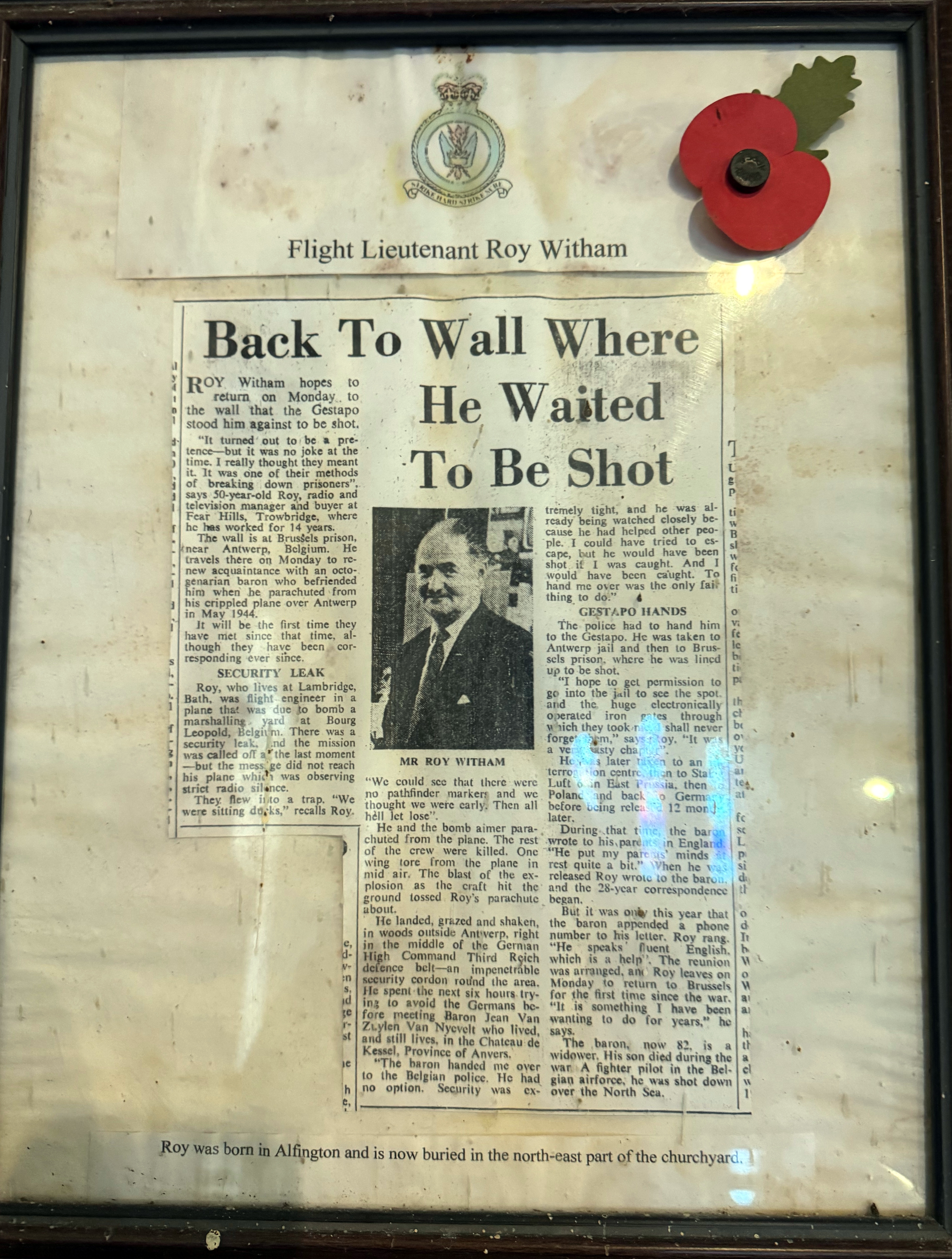
Flight Lieutenant Roy Witham was born in Alfington and served as a flight engineer with the Royal Air Force during the Second World War. A framed newspaper cutting preserved in the church records his return, years after the war, to the wall where the Gestapo had once stood him for execution. The cutting includes a photograph of Witham standing again before the same wall, and sets out the circumstances of his capture and interrogation.
During his time in German hands, Witham was taken to a courtyard and placed against a wall while armed guards prepared to shoot him. He later recalled waiting there, expecting the shots that would follow. A security disruption elsewhere in the German system interrupted the process, and instead of carrying out the execution his captors returned him for further questioning. The reprieve was abrupt and unexpected. The newspaper article describes his later visit to the site, standing once more in front of the wall where he had been held.
Before his capture, Witham had been the flight engineer of Lancaster ME737 of 630 Squadron, piloted by P/O Wilfred “Wilf” Watt. The aircraft was shot down at 00:27 hours by Unteroffizier Woltanowski, the rear gunner of a Ju 88 night fighter flown by Unteroffizier Schwenke of 4./NJG 1. The attack was a textbook example of the upward‑firing Schräge Musik cannon installation used by German night fighters. Witham later described the moment: “without warning a JU88 came up from below and tore us apart from stern to bow, killing the gunners, wireless operator and navigator. The starboard engines caught fire and I feathered them, we lost height rapidly. The bomb aimer bailed out and I helped the pilot as he tried to maintain height but this was impossible and he told me to get out. I released his harness and baled out at just over 1,200 feet as the starboard main plane broke away. The aircraft exploded just as my chute opened and I landed less than a quarter of a mile from the burning wreckage.” ME737 crashed at Blauwbroek, three kilometres south‑east of Herenthout. P/O Watt is buried at Heverlee War Cemetery; the rest of the crew were reinterred at Schoonselhof Cemetery, Antwerp.
Witham and the bomb aimer, Keith Stuart of Greytown, New Zealand, both survived by parachute and were captured shortly afterwards. They spent the remainder of the war as prisoners at Stalag 357, first at Thorn and later at Fallingbostel. During the forced marches of April 1945, Witham was among a group of prisoners left only lightly supervised near a bridge over the Elbe that German engineers had prepared for demolition. He cut the detonation cables before the guards realised, an act that would almost certainly have resulted in his being shot had it been discovered. The column moved on before the sabotage was detected.
Witham returned to Alfington after the war and is buried in the north‑east part of the churchyard. His grave lies close to those of other men whose careers took them far from Devon, including Colonel John Cunningham Moore Hoskyn of the Indian Army and John Coleridge Patteson, Bishop of Melanesia.


