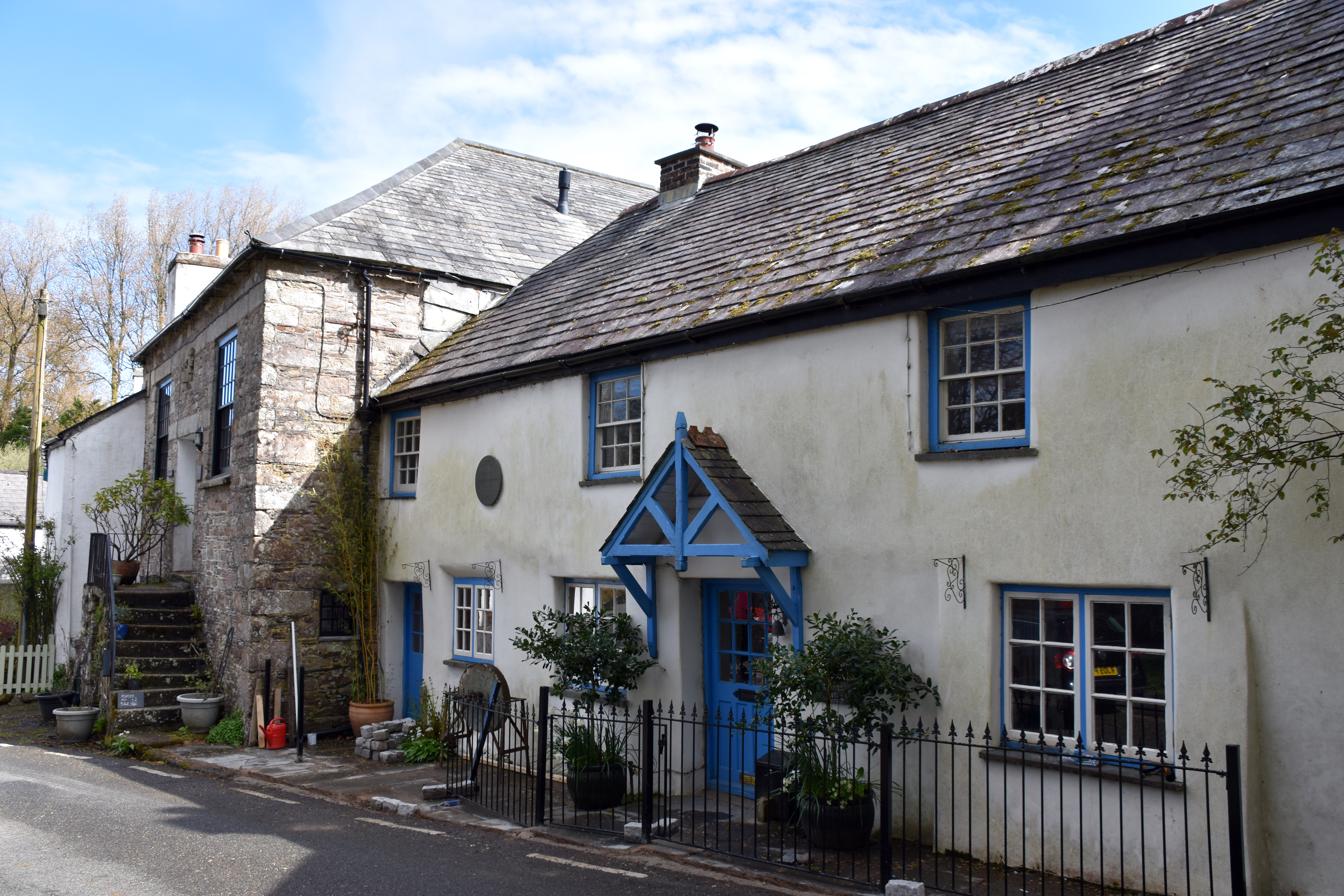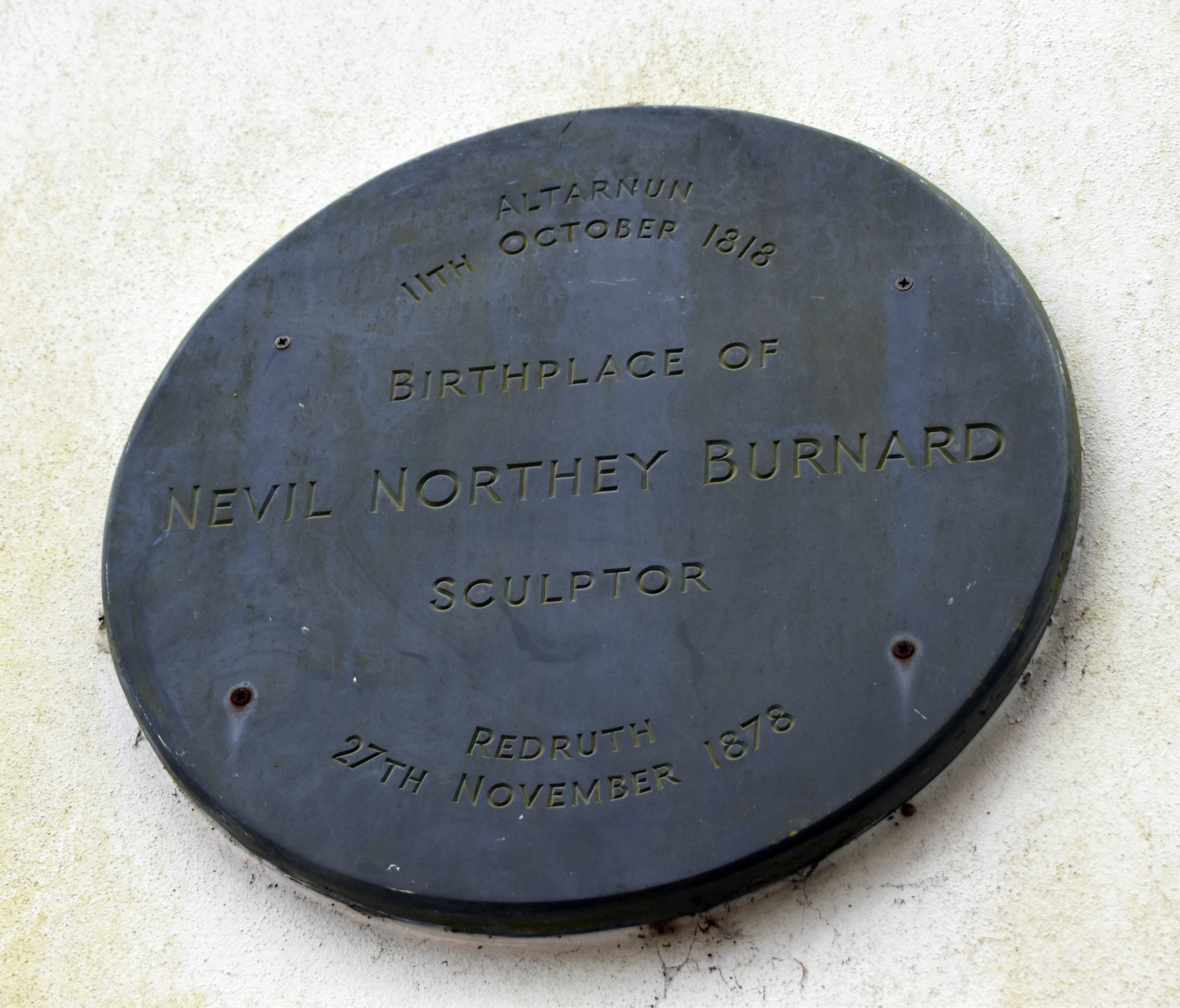
Nevil Northey Burnard (1818–1878) was one of Cornwall’s most accomplished nineteenth‑century sculptors, a man whose early brilliance, national success and later decline form one of the most striking artistic stories in the county’s history. He was born on 11 October 1818 in Altarnun, on the edge of Bodmin Moor, the son of George Burnard, a local stonemason. In early autumn that year his mother, Jane Burnard, gave birth to her first child, christened that November and remembered locally as a beautiful boy “with a head of golden curls”. The Burnards and the related Isbell family were long associated with stone‑carving in East Cornwall, and Nevil grew up in a workshop culture where slate, granite and church monuments were part of daily life. His childhood at Penpont Mill, in the centre of the village, was shaped by both parents: Jane supplemented the family income by making bonnets and running a small school, giving her son his earliest education, while George introduced him to the craft that would define his life.
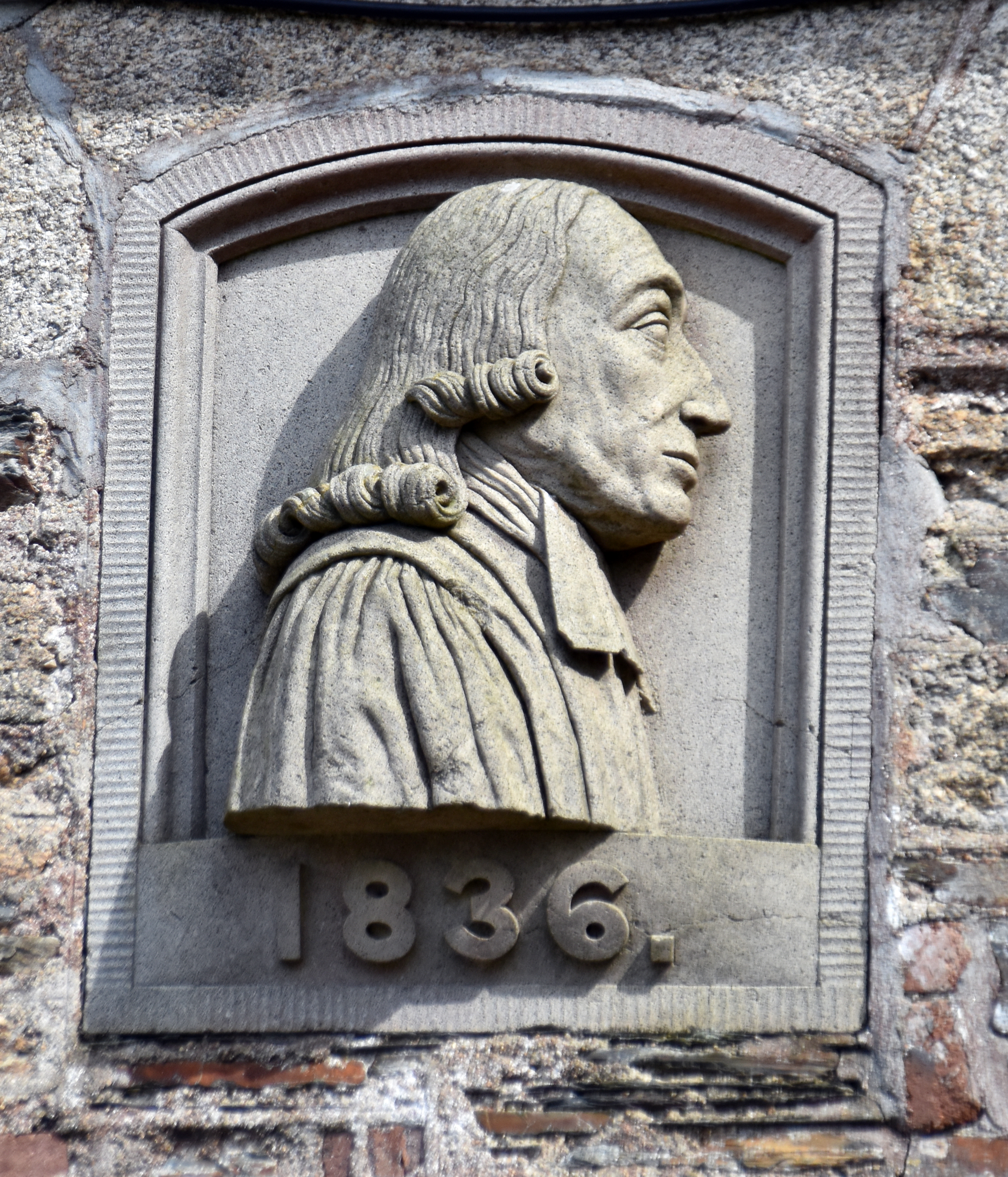
He showed a talent for carving at an early age. Neville began working with his father as a mortar boy, but in the evenings he practised carving with makeshift tools on rough pieces of wood. At fourteen he received his first “official” task: carving the decoration on his grandfather’s headstone in Altarnun churchyard. The writer Alice C. Bizley, in The Slate Figures of Cornwall, notes that the stone bears “an eagle in flight against the sun’s rays” and is signed “N N Bernard sculpt aged 14”. That carving and inscription can still be seen today. At sixteen he produced a relief portrait of John Wesley for the doorway of the Wesleyan Meeting House beside his home — a remarkable early work that survives today and is pictured above. The beautiful image, now part of a private dwelling, is still visible above the old chapel doorway, and it remains astonishing that such a refined piece was produced by a teenager. His ability was quickly recognised, and he twice won the Silver Medal of the Royal Cornwall Polytechnic Society. This early promise brought him to the attention of patrons beyond Cornwall, and he was encouraged to pursue formal training.
Burnard moved to London, where he worked under the sculptor Edward Hodges Baily, best known for the statue of Nelson atop Nelson’s Column. His path to London had been eased by Sir Charles Lemon, whom he met after exhibiting at the Royal Cornwall Polytechnic Society in 1834. Lemon became his patron, sponsoring his tutorship and introducing him to leading figures in the art world. Through Lemon he met Sir Francis Chantrey, who took him on as a carver in his London atelier, where Burnard worked alongside Henry Weekes. Weekes later inherited Chantrey’s studio after his master’s death in 1841. Burnard’s London years were marked by rapid progress: he produced portrait busts of notable figures, including William Makepeace Thackeray, and received commissions from aristocratic families. Impressively, one of his first major commissions came from Buckingham Palace in 1847, when he sculpted a bust of the six‑year‑old Albert Edward, Duke of Cornwall, later Prince of Wales. Exhibited at the Royal Academy in 1848, the bust was subsequently sent by Queen Victoria to Osborne House on the Isle of Wight. For a time he was in steady demand for public monuments, memorials and portrait sculpture, though he returned frequently to Cornwall and maintained strong ties with Altarnun.
Among his best‑known works is the statue of the explorer Richard Lander, placed atop the Lander Memorial in Lemon Street, Truro, in 1852. Two years later he sculpted the memorial to the poet Ebenezer Elliott in Sheffield. He also produced busts of Richard Trevithick (now in Truro), Dr George Smith for Camborne’s Wesley Chapel, and William Bickford‑Smith, MP for Truro and Helston, now at Trevarno. Many fine gravestones and smaller works survive, and examples of his sculpture can be seen in the Royal Cornwall Museum. He also made busts for eminent men of science, including John Couch Adams, the Cornish astronomer who discovered Neptune. His work entered national collections, including the National Portrait Gallery and Westminster Abbey. Despite his growing fame he frequently returned to Cornwall to see his family. He was the toast of the county and spent time with the Fox family, Quaker patrons of the arts. Caroline Fox described him in 1847 as “a great powerful, pugilistic looking fellow of twenty‑nine… with all the features massed in the centre”, and noted his habit of telling amusing stories about his fellow sculptors.
Despite his success, Burnard’s life took a tragic turn. In November 1844 he married Mary Ann Nicholson at All Saints Church, Marylebone. At first the marriage appears to have been a happy one: the couple lived comfortably in Hanover Square and had four children, the eldest, Thomas, becoming a sculptor himself. But in March 1870 disaster struck when both his eleven‑year‑old daughter Charlotte and his brother George died of scarlet fever within twenty‑four hours of each other. Burnard carved a relief of Charlotte — “Lottie” — for her tombstone, but the loss devastated him. Soon afterwards he began to drink heavily, and his career collapsed. He lost his wife, his clients and his London standing, and eventually returned to Cornwall as a wanderer. At one point he was found sheltering in a barn at St Cleer, where local people cared for him before he moved on again. His decline was steep, and he died in Redruth Workhouse on 27 November 1878. He was buried in a pauper’s grave in Camborne.
The Western Independent later described his final years: he begged his way from village to village, entertaining those who sheltered him with stories from his thirty years among London’s celebrities. He survived by sketching portraits of local people and writing occasional poems and newspaper pieces. On his last visit to Altarnun in 1875 he stayed with an old school friend, Mr S. Pearn, drawing pencil portraits “with a firm hand” and composing a long poem on the death of another friend. Villagers fitted him out with new clothes before he left, but he never recovered his former life.
In 1954 the Old Cornwall Society of Camborne erected a slate tombstone on his previously unmarked grave, restoring a measure of dignity to a man whose early achievements had once brought him national recognition. His life later inspired the poet Charles Causley, whose piece A Short Life of Neville Northey Burnard reflects on the sculptor’s rise and fall and his place in Cornish cultural memory. A moving account of his funeral, published in 1929, recalls how stonemasons working on the church paused their labour to carry his coffin when the curate told them the deceased had carved the celebrated Wesley medallion. “They dropped tools and took up the coffin,” the report records — a final tribute from craftsmen to one of their own.
Burnard remains an important figure in Cornwall’s artistic history. His early Wesley head at Altarnun, carved when he was still a teenager, links the rural craft tradition of the parish to the wider story of Methodism. His public monuments, portrait busts and memorials show the range of his ability, while his life story — from prodigy to celebrated sculptor to destitution — stands as a reminder of the precarious fortunes of nineteenth‑century artists. His surviving works continue to anchor his reputation in the county where his talent first emerged.