

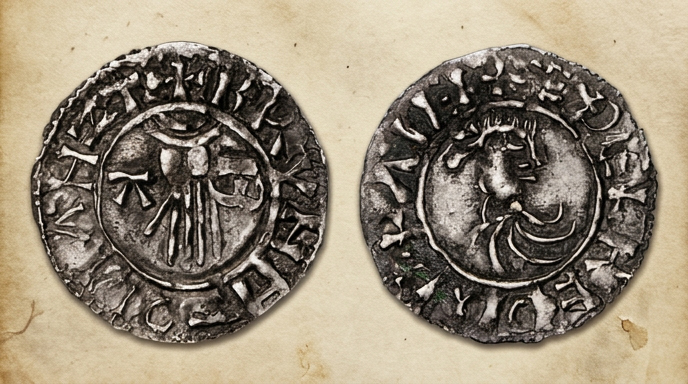
The Launceston Mint was one of the earliest expressions of royal authority in Cornwall, operating at a time when St Stephens served as the principal settlement and administrative centre of the region. Long before the Norman castle dominated the skyline, the mint stood as a symbol of economic and political control, issuing coinage under the authority of the English crown.
The mint functioned during the late Saxon and early Norman periods, producing silver pennies that circulated widely across the southwest. These coins typically bore the name of the reigning monarch along with the signature of the moneyer responsible for striking them. The presence of a mint at Launceston underscores the town’s importance as a burh, a fortified and economically active centre tasked with supporting royal governance.
Coins produced at Launceston followed the standard designs of the period. Early issues featured the portrait of the king on the obverse, often stylised in the distinctive linear fashion of late Saxon engravers. The reverse commonly displayed a cross design dividing the field into quadrants, accompanied by inscriptions identifying both the mint and the moneyer. Surviving examples include pennies of Æthelred II and Cnut, each bearing the unmistakable mark of Launceston’s place in the national minting network.
The mint’s activity declined as political and economic power shifted towards the newly established Norman castle and the developing town below St Stephens. By the twelfth century, minting had ceased, leaving behind only the coins themselves as evidence of Launceston’s early administrative significance. These coins, now rare, provide valuable insight into the region’s role in the wider economy of medieval England.
Today, the coins of the Launceston Mint stand as tangible reminders of a period when the town played a central role in royal administration. Their inscriptions preserve the names of long-forgotten moneyers, while their designs reflect the artistic and political conventions of their age. Together they form a small but important chapter in the history of Launceston and its enduring place within the story of Cornwall.

