

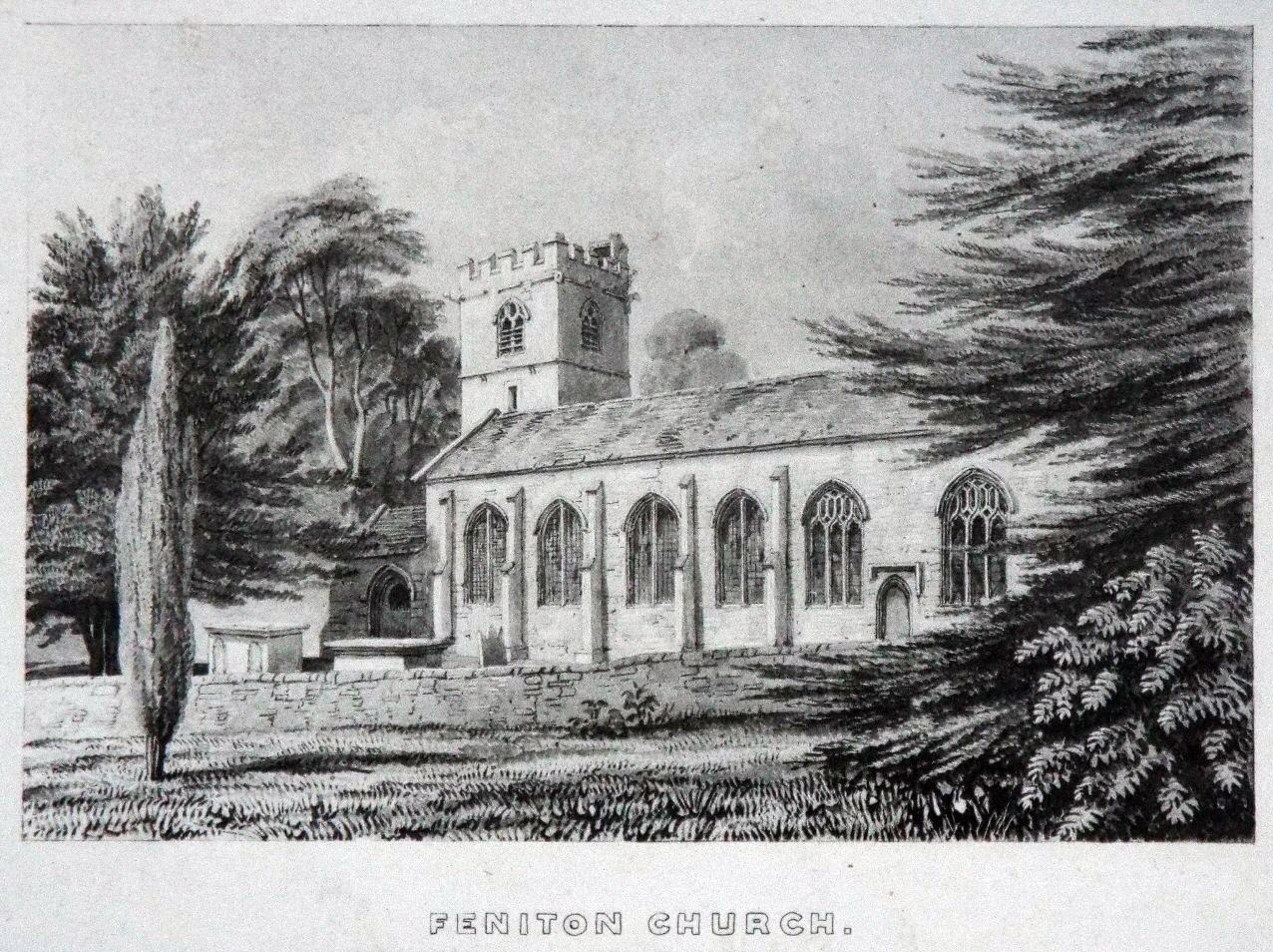
St Andrew’s Church stands in the southern part of Feniton parish, a landscape shaped by farms, orchards and the small hamlets of Colestocks, Colesworthy, Cheriton, Curscombe and Fenny Bridges. The village lies just north of the old Roman road between Exeter and Honiton, now followed by the A30, and the church has occupied this position for centuries. Although the present structure is largely fifteenth- and early sixteenth-century, its origins are Norman and probably earlier, with Saxon work implied beneath later rebuilding. The fabric is typical of East Devon: local stone and flint rubble, dressed flint in the north transept, and limestone, sandstone and Bath stone used for the architectural detail, all under slate roofs. Concerns about the condition of the building were already being voiced in 1602, and the major restoration of 1877 left a strong Victorian imprint while preserving the essential medieval plan of nave, chancel, south aisle, west tower and north transept.
The exterior shows the characteristic forms of the region. The low, unbuttressed west tower, with its embattled parapet and formerly pinnacled corners, is a familiar Devon type, marked by large carved gargoyles and later Perpendicular belfry windows. The west doorway has a moulded two-centred arch and hoodmould, with a three-light Perpendicular window above. The south aisle presents a long run of three-light windows divided by limestone buttresses, while the east chapel windows are set beneath volcanic ashlar voussoirs. The priest’s doorway, with its small Tudor arch and carved foliate spandrels, belongs to the late-medieval embellishment of the building. The north transept, built of coursed flint, has diagonal buttresses and an early nineteenth-century window, and the north side of the nave retains two Hamstone windows with Perpendicular tracery. The churchyard, approached through a traditional lych gate, frames the building in a setting that has altered little.
Inside, the church is a mixture of medieval survival and nineteenth-century intervention. The nave retains a ceiled wagon roof with moulded ribs and purlins, probably fifteenth or sixteenth century but heavily repaired. The chancel roof is similar in form but neater and likely Victorian. The tall tower arch has a double-chamfered ring, while the chancel arch is a nineteenth-century timber structure with open cusped cresting. The five-bay Beerstone arcade, one bay overlapping the chancel, has moulded piers and carved capitals of the type identified by Pevsner as Type B. The walls are plastered, and the floor is flagged with some old graveslabs. The fittings include a nineteenth-century panelled oak reredos, an altar made from panels carved in the manner of fifteenth-century bench ends, Gothic-style stalls, and a late nineteenth-century limestone font in Perpendicular style. An oak chest in the nave is dated 1681.
The late fifteenth-century rood screen is the most substantial medieval survival. Divided into two sections by the arcade—five bays to the nave and three to the aisle—it is carved with Perpendicular blind arcading on the wainscot, tracery of Pevsner’s Type A in the window heads, a coved vault with Gothic decoration and a frieze of three bands of undercut foliage. The rear coving is missing because the screen had been used as a reredos before being restored to its proper position in 1877. A plainer parclose screen stands nearby in a slightly different style. The church also contains a cadaver tomb, reset in a niche north of the sanctuary. The chest is carved with a frieze of quatrefoils, and on top lies the effigy of an emaciated cadaver partly covered by a shroud. Its identity is uncertain: the church guide suggests Sir William Fry (d. 1427), though some consider it earlier.
St Andrew’s also contains a memorial to John Coleridge Patteson, the first Bishop of Melanesia, whose family home at Feniton Court lies within the parish. After his death on Nukapu in 1871, a stone tablet was placed in the church by his relatives. In 1888 a small Melanesian Chapel was created in the north transept, furnished with items associated with the Melanesian Mission and used for services linked to the Patteson commemorations. The chapel and memorial reflect the close relationship between the parish and the Coleridge and Patteson families, who were central to the early support of the Melanesian Mission.
The documentary record adds detail to the building’s history. The earliest known rector was Gifford de Baketon, followed by Robert de Polammesforde in 1263–1264. In 1744 the rector, Christopher Ewings, noted that he had “four & forty Families in my parish one of these are Dissenters. Presbyterians.” In 1799 William Staverfield explained that he resided at Kew in Surrey to care for his elderly father, leaving the licensed curate Roger Andrews to serve the parish on a salary of forty pounds a year and Easter offerings. The parish registers, now held at the Devon Heritage Centre, begin in the mid-sixteenth century and run almost unbroken for five centuries. Later pew ends carry the coats of arms of families associated with Feniton Court, linking the church to the local gentry. In October 2008 St Andrew’s was damaged by a storm and closed for repair and re-ordering; it was re-dedicated on 5 March 2011.
The exterior also preserves an unusual group of medieval scratch dials. The most visible is cut into the porch buttress and consists of thirteen radiating lines, though damaged and patched with cement; the deeper cut line marking Terce suggests the main Mass time. Two further dials lie low on the same buttress, an uncommon pairing. One is a functioning early dial composed of pocks arranged within a segment of a circle, perhaps pre‑1400; the other is more doubtful, its irregular curve and lack of a clear gnomon hole suggesting imitation rather than use. Their low position implies that the stone was reset during later rebuilding, rendering the dials obsolete and leading to the creation of the larger, more accurate dial above. A fourth possible dial consists of two deliberate scratches diverging from a mortar line. Nearby are a well-preserved consecration cross, graffiti including a date that appears to read 1675, and a cluster of dots and lines forming what is likely an apotropaic symbol intended to protect the church.
St Andrew’s is a building shaped by continuous use, repair and adaptation. Its Norman beginnings on a Saxon religious site, medieval craftsmanship, Victorian restoration, cadaver tomb, scratch dials, documentary traces and the later association with the Melanesian Mission all contribute to its historical character and its place within the wider landscape of Feniton parish.

