

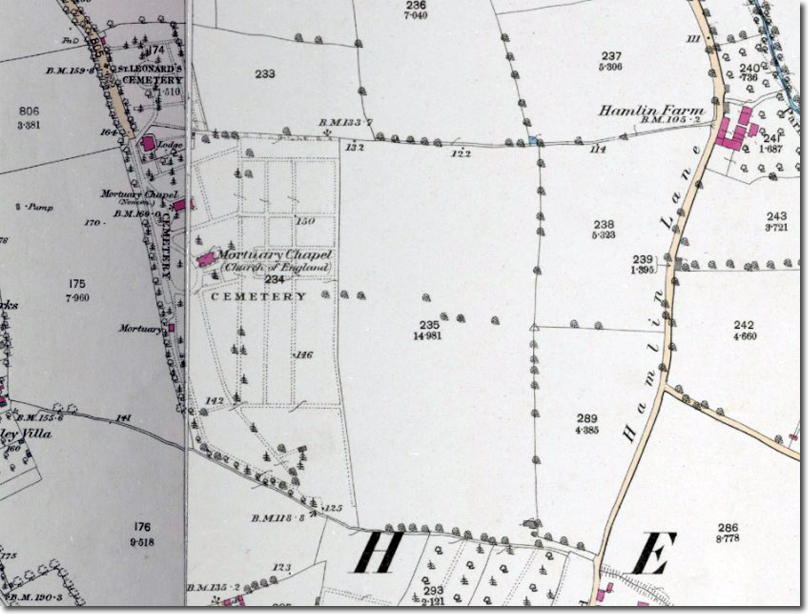
By the mid‑nineteenth century Exeter faced a serious burial crisis. For centuries the dead had been interred in Cathedral Yard and a handful of small parish grounds, but these were long past capacity. Public health concerns, combined with the Victorian shift toward planned municipal cemeteries, forced the city to look for new land. The opportunity came in 1854 with the death of Stephen Brunskill of Polsloe House, whose estate agreed to sell ten acres to the council. At the time the site was considered remote and inconveniently rural, well outside the built‑up limits of the city.
The cemetery was laid out with the characteristic features of the Victorian garden cemetery. Edward Ashworth, an ecclesiastical architect, designed the chapels and lodge, while Robert Veitch landscaped the grounds and introduced a wide variety of trees and shrubs. The Church of England’s burial rules shaped the layout: 4.5 acres were reserved for Anglicans, while only 1.5 acres were allocated to Nonconformists, a division that reflected the religious boundaries of the period.
Higher Cemetery was formally opened in 1866 by the Bishop of Colombo, standing in for the Bishop of Exeter, who was unwell. Over the following decades the cemetery expanded several times, eventually growing to more than 45 acres. Today it contains the remains of over 70,000 people and forms one of the largest municipal cemeteries in the South West.
The cemetery’s monuments chart the changing fashions of memorial design. Early sections contain Victorian obelisks, angels and Gothic crosses, while later areas show the shift toward simpler twentieth‑century headstones. The influence of Exeter’s own stonemasons is visible throughout, particularly the work of Harry Hems, who arrived in the city in 1866 and went on to design many of the cemetery’s most elaborate memorials.
Higher Cemetery also reflects the city’s civic history. The Theatre Royal fire of 1887, which killed 186 people, prompted national reforms in fire safety and left a prominent memorial in the cemetery. The First World War brought a new challenge: large numbers of wounded soldiers were treated in Exeter’s improvised hospitals, and those who died were buried locally. A dedicated military plot was created with space for 181 graves, though by the end of the war 219 burials had taken place. The uniform stone markers remain one of the most distinctive features of the site.
Further expansion occurred during and after the Second World War. The cemetery contains civilian victims of the Exeter Blitz, as well as German and Italian servicemen whose graves were not moved during the post‑war consolidation of Axis burials. The presence of these wartime sections gives the cemetery an unusually complete record of Exeter’s twentieth‑century experience.
In recent years the Friends of Higher Cemetery, founded in 2011, have played a major role in maintaining and interpreting the site. They organise guided walks, restore damaged memorials and work closely with the Commonwealth War Graves Commission. Their efforts have helped preserve the cemetery not only as a place of remembrance but also as a valuable public amenity, with tree trails, historical notes and regular community involvement.
Although Higher Cemetery contains thousands of individual stories, its own history is equally significant. It marks Exeter’s transition from medieval burial customs to modern municipal planning, reflects the city’s religious and social divisions, and records the impact of two world wars. What began as a remote rural plot in the 1860s is now an integral part of the city’s historical landscape.

