

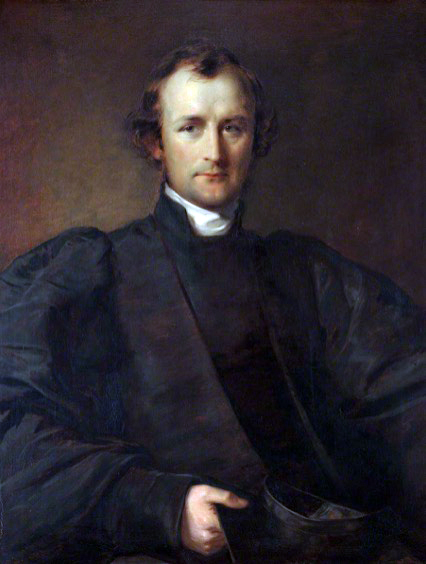
George Augustus Selwyn, born in 1809 and educated at Eton and St John’s College, Cambridge, belonged to the same clerical and intellectual world that shaped the Coleridges and the Pattesons. His friendship with members of the Coleridge family, formed early at Eton, created the link that would eventually draw him into the life of Feniton. By the time he became the first Bishop of New Zealand in 1841, he was already known for his energy, organisational skill and formidable physical stamina, qualities that would later define his work across the Pacific. His connection to Feniton came not through formal office but through family ties, hospitality and the influence he exerted on the young John Coleridge Patteson, whose life he helped to redirect.
Selwyn’s visits to Feniton Court were pivotal moments in the story of the Melanesian Mission. The house, acquired by Sir John Patteson in 1841, became a place where Selwyn was received as both a family friend and a respected churchman. It was in the library at Feniton Court that the crucial conversation took place in which Selwyn asked whether the young Patteson might join him in New Zealand. Sir John, already in failing health, understood the implications of the request: if his son accepted, he might never see him again. The decision was not made lightly, but the trust placed in Selwyn’s judgement was considerable. The outcome of that meeting shaped the next two decades of Anglican mission in the Pacific.
Selwyn’s influence extended beyond Feniton Court into the parish itself. St Andrew’s Church, where the Patteson family worshipped, became indirectly linked to the wider mission through Selwyn’s relationship with the family. The later creation of the Melanesian Chapel in St Andrew’s, the memorials to the Pattesons and the continued interest in the Pacific connection all stem from the chain of events set in motion by Selwyn’s visits. His presence in Feniton was not ceremonial; it was personal, familial and decisive. The primrose buds that Patteson picked from his mother’s grave before leaving Feniton in 1855 were gathered in a churchyard whose future associations with Melanesia were already being shaped by Selwyn’s influence.
Alfington, too, bears the imprint of Selwyn’s connection to the area. The church of St James and St Anne, built largely through the efforts of Sir John Taylor Coleridge, was the parish where Patteson served his first curacy. Selwyn’s visit to England in the early 1850s brought him into close contact with the Coleridge and Patteson families, and Alfington became one of the places where the practicalities of Patteson’s future were discussed. The Bible presented to Patteson by the Alfington parishioners on Christmas Day 1853, now part of the story of his departure, reflects the seriousness with which the community regarded his calling — a calling shaped directly by Selwyn’s example and encouragement.
Selwyn’s own work in the Pacific was extensive. As Bishop of New Zealand he travelled widely, often by small boat, visiting remote communities and establishing the foundations of what would become the Melanesian Mission. His 1854 proposal to create a separate Melanesian bishopric, and the subsequent gift of the mission schooner Southern Cross, laid the structural groundwork for Patteson’s later consecration as Bishop of Melanesia in 1861. Selwyn’s approach to mission — learning local languages, building long-term relationships and resisting the exploitative practices of the labour trade — shaped the ethos that Patteson would later embody.
The connection between Selwyn and Feniton is therefore not incidental. It is woven through the personal relationships, decisions and conversations that took place in the village, the church and the house at Feniton Court. Without Selwyn’s visits, his friendship with the Coleridges and his influence on the Patteson family, the history of the Melanesian Mission — and the memorial landscape of Feniton, Alfington and the surrounding parishes — would look very different. The presence of Patteson’s Cross, the Melanesian Chapel, the Alfington plaque and the various family memorials all trace their origins back to the moment Selwyn stepped into the library at Feniton Court and asked a young man to come with him to the other side of the world.
Image courtesy of Selwyn College

