

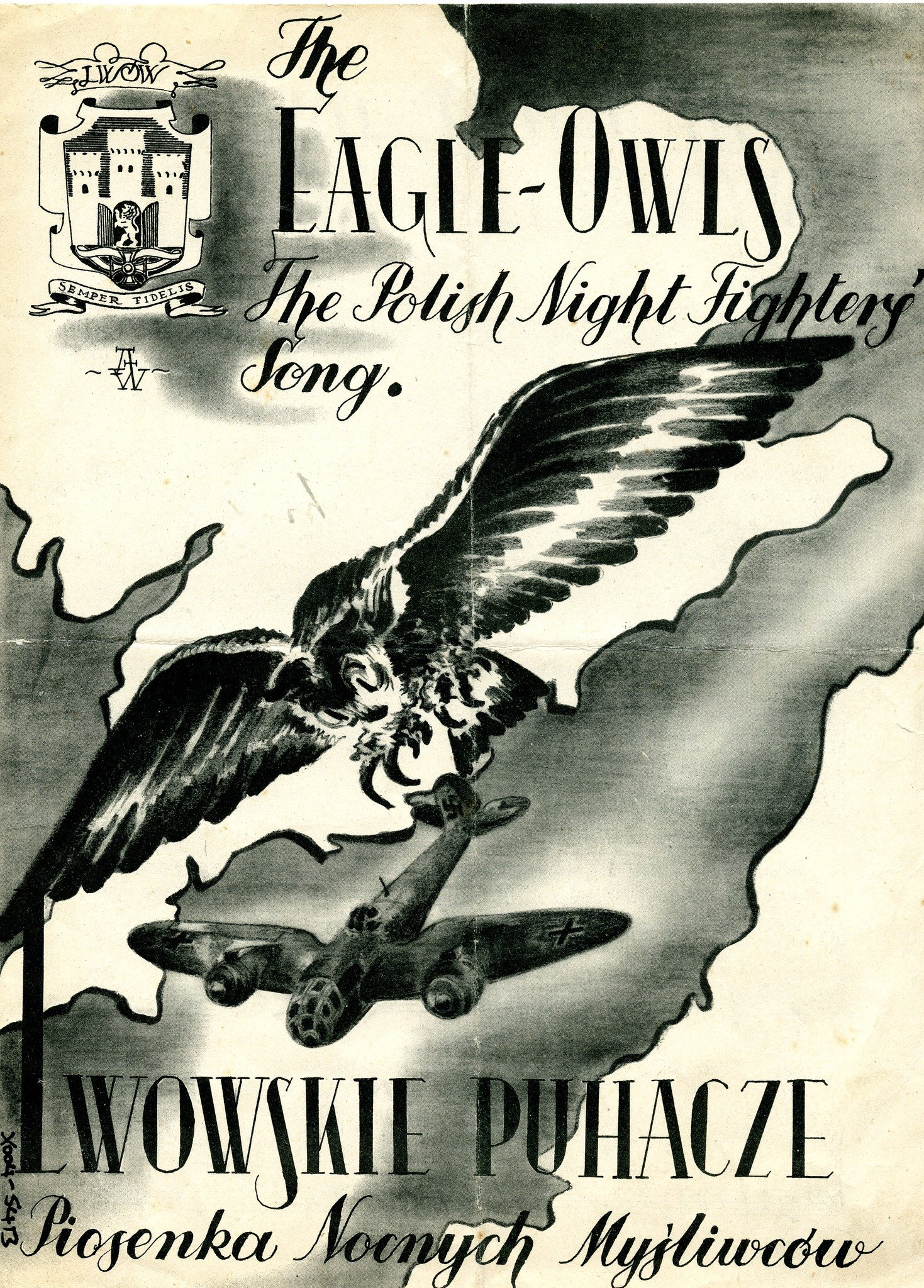
Polish 307 Squadron, the Lwów Eagle Owls, arrived at RAF Clyst Honiton (now Exeter Airport) in 1941. They were the only Polish night‑fighter squadron in the RAF and were formed from airmen who had escaped Nazi‑occupied Poland, many of whom had already fought in the defence of Poland and France. Their arrival gave Exeter its first dedicated night‑fighter protection at a time when the South West had almost no defensive cover after dark.
A particular bond formed between the squadron and the city. Lwów, the Polish city from which the squadron took its identity, shared the same motto as Exeter: Semper Fidelis — “Always Faithful”. The coincidence was not lost on the Polish airmen, many of whom regarded Exeter as a natural home during their exile. The motto appeared on squadron insignia and in correspondence, and it helped cement a relationship that has endured long after the war.
The squadron initially operated the Boulton Paul Defiant, already obsolete as a day fighter but still used at night because of its turret armament. The aircraft was slow and vulnerable, but the Polish crews adapted quickly, working closely with the local Ground Controlled Interception station to track and intercept incoming raiders over the Devon coastline. In 1942 they re‑equipped with Bristol Beaufighters, a more capable aircraft but one that brought its own hazards. Engine vibration and asymmetric failures caused several fatal accidents, particularly during single‑engine landings on Exeter’s short wartime runway.
These losses meant that when the Baedeker raids began in April and May 1942, the squadron had only three serviceable aircraft available. Despite this, they succeeded in shooting down four enemy bombers during the attacks, preventing further damage to the city at a time when Exeter was almost undefended. Their efforts earned them the nickname “Exeter’s Guardian Angels”, a reflection of the city’s recognition that without them the destruction would have been far worse.
The squadron’s time at Exeter was marked by both operational success and heavy personal cost. Several pilots and navigators were killed in flying accidents or combat. Among them were airmen such as F/O Stanisław Karpiński, lost during a night interception over the Channel, and Sgt Janusz Lewicki, killed when his Beaufighter suffered engine failure on approach. Their careers were typical of the squadron: experienced, determined, and operating in some of the most demanding conditions of the air war.
The most notable loss occurred in March 1943, when Squadron Commander Jan Michałowski and his navigator Stanisław Szkop were killed while attempting a single‑engine landing demonstration. Another aircraft inadvertently taxied onto the runway, leaving them no room to abort. Their Mosquito overshot and crashed beyond the airfield boundary. Michałowski had been one of the squadron’s most respected leaders, and his death was a significant blow to the unit.
By late 1942 and 1943 the squadron transitioned to the de Havilland Mosquito, which transformed their operational capability. The aircraft’s speed and endurance allowed longer‑range patrols and more effective interception, though it also demanded precision flying and brought its own risks. Training accidents remained common, and the squadron’s operational tempo remained high throughout its time in Devon.
307 Squadron left Exeter in 1943 as the focus of the night‑fighter war shifted eastwards. Their period at Clyst Honiton was relatively short, but it coincided with the most dangerous months Exeter faced. Their interceptions during the Baedeker raids prevented further destruction and reduced casualties at a time when the city had almost no other night‑fighter cover.
In recent years the squadron’s role has been increasingly recognised. Exhibitions, research projects and annual commemorations highlight the contribution of the Polish airmen who defended the city. The most prominent of these is the “Night Fighters: The Story of 307 Squadron” exhibition held at Exeter’s Guildhall, which presents film interviews, memorabilia and material relating to the squadron’s operations. Each November the Polish flag is raised above the Guildhall to mark the continuing link between Exeter and Poland — a tradition rooted in the wartime Semper Fidelis connection.
Several members of the squadron are buried in Higher Cemetery, their graves forming a small but distinctive group among the wartime sections. Together with the civilian and military burials from the Blitz, they provide the most direct physical record of the city’s experience of 1942 and of the airmen who helped prevent further destruction.

