|
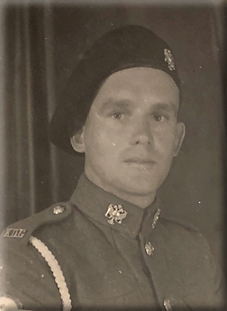
Frederick Leslie Paternoster was born in Strood, Kent on 25 July 1915. He enlisted in the Army on 5 Sep 1934 at Brompton Barracks, Chatham, as a private in the 7th Hussars. He took part in the parade on the occasion of King George V’s Silver Jubilee on 6 May 1935, for which men of the 7th Hussars wore dress uniform for the first time since 1914. A year later the regiment went to Egypt where they were to be mechanised. Trooper Paternoster transferred to the King’s Dragoon Guards, on 2 Oct 1935, a mounted regiment, also in Egypt, as he wanted to be with horses. The KDG went to India in October 1935 where they were posted for two years at Allenby Barracks, Trimulgherry. He took part in the last mounted parade of the regiment at Secunderabad on 23 Oct 1937.
When the KDG returned to the UK, they were stationed at Aldershot, in Beaumont Barracks. The regiment was mechanised there and Paternoster reluctantly exchanged riding for training on light tanks. He still had contact with horses as he was given care of the officer’s horses and polo ponies. Before the war he was involved with the family of Donald McCorquodale, an officer in the KDG who later commanded the regiment from 1940 to 1942. The family lived at Ongar in Essex where Frederick looked after a pony and taught the children how to ride.
He was going to leave the army in 1939 but when war broke out he was called up and served in A Squadron KDG. He went to the Middle East on 16 Nov 1940, arriving on 30 Dec.The regiment converted to armoured cars and he drove Marmon-Herringtons. He served in North Africa and was at Tobruk. At the end of the campaign he caught Malaria and was sent to 53 General Hospital in Haifa. When he rejoined the regiment on 7 Dec 1943 they were in Italy. He was then in B Squadron serving in a Horse Troop and on 25 July 1944 at Arezzo in Italy along with Major Harold Selby on his horse Rose and Fred who was on Patric.They were both part of the guard of honour to King George VI who came to visit the regiment and Fred carried the B Squadron Lance. On 7 August 1944 Fred came second in the Grooms Competition, in horse jumping, on Rose in Laterina, Italy.
They went to Athens where he took part in Dekemvriana in the winter of 1944/5. He went over in a horse-box onboard LST . The KDG were only allowed to take four horses to Greece; four other horses belonged to the North Irish Horse.
The British were able to enter Greece after the Germans retreated in October 1944, and fighting broke out between Greeks who had collaborated and those that had resisted the Nazi occupation. This was a prelude to the Greek Civil War of 1946.
Frederick was married on 26 Dec 1939 to Gwendoline Joan Haines. The wedding was in Windsor and the marriage produced seven children, their first, Michael was born in 1941. Michael’s grandson, Stephen Paternoster, has supplied this website with the story of Fred’s life and army service. After the war Fred and Gwendoline had six more children; Jaqueline, Susan, Kelvin, Verity, Norman and Jillian. He was discharged from the army on 16 Mar1946, and in civilian life was employed as a farm worker. This meant the family moved around; Crowthorne, Essex, Hungerford, Dogmersfield, Little Sandhurst and Sandhurst. His final home was at Swan Lane, Sandhurst, Berkshire. He died at Frimley Park Hospital on 9 July 1984.
The photo shows him c1940 in khaki service dress and black beret as a trooper in the King’s Dragoon Guards. The KDG badges are on each side of the collar and on his beret. The double-headed eagle of Hapsburg had been the regimental badge from 1896 until 1915 but because of its Austrian connection it was discontinued in WW1. It was restored officially on 18 Sept 1937 and the men started wearing it when supplies became available after February 1938. |