

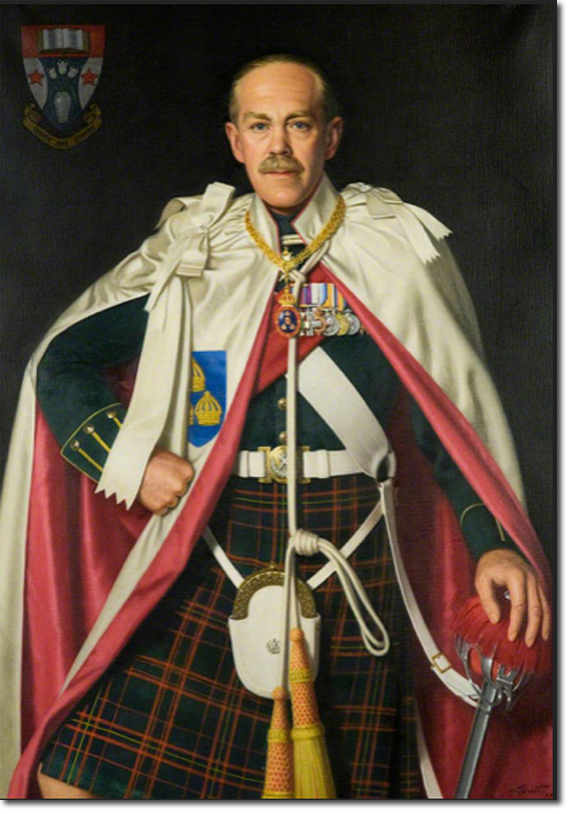
Douglas Neil Wimberley was born in Inverness on 15 Aug 1896, the son of Surgeon-Captain Charles Neil Campbell Wimberley. His mother was Minnie Lesmoir Gordon, daughter of R J Wimberley (they were first cousins). He was educated at Wellington College and Cambridge. After Sandhurst he was commissioned into The Queen’s Own Cameron Highlanders, on 11 May 1915. His first experience of action was at Loos with the 1st Battalion, appointed Machine-Gun Officer. In Jan 1916 he was seconded to the Machine Gun Corps and was on the Somme. In 1917 he was promoted to acting captain and in command of a Company which was attached to the 51st (Highland) Division. They fought at Passchendaele where he was wounded, and later earned the MC for his actions at Cambrai.
On 18 Feb 1918 he was promoted to acting major. He was wounded again in late March and evacuated to England and remained there until the end of the war, but he was fit enough to attend a machine-gun refresher course and a course in airplane observation. After the war he was sent to Russia during their civil war and was with the 2nd battalion in Ireland in 1921. In 1922 he was appointed Adjutant of the 2nd Battalion, and in 1924 was allowed to spend a year at Emmanuel College, Cambridge. On 29 April 1925 he married Elyse Myrle Livingston. They had a son and daughter. He then attended Staff College.
After Staff College, in 1929, he was sent to India to be brigade major of 1st Gurkha Brigade, operating in the North West Frontier. He was then at the War Officer as a staff officer for four years. He was promoted to lieutenant-colonel on 19 Dec 1938 and appointed CO of the 1st Battalion QO Cameron Highlanders. He commanded them when they went to France in Sep 1939 as part of the BEF, but was sent back to England to be chief instructor at the Senior Officers School, Sheerness. In June 1941 he was GOC 51st (Highland) Division and insisted that it had to consist of Scotsmen. This earned him the nickname of ‘Tartan Tam’. In the summer of 1942 they were posted to North Africa. They were prominently involved in the ‘crumbling phase’ of the Battle of Alamein and the actions around Kidney Ridge. During the battle his jeep was blown up by a mine, killing two of the occupants but only causing Wimberley to be shaken up. He led the 51st Division across North Africa, through the Tunisian campaign. In Dec 1942 he was awarded the DSO.
In July 1943, Wimberley led the Division in the invasion of Sicily where they were involved in heavy fighting. But Montgomery replaced him as Divisional commander and he was sent to the Staff College at Camberley to be Commandant. He had been given the CB in August 1943, and in July 1944 was promoted to major-general. His last job was Director of Infantry training, a post he held until his resignation from the army on 8 Oct 1946. He was always associated with the Highland Division, which, under his command, was one of the best known of all the British formations.
After the war he became principal of University College, Dundee which was a constituent part of the University of St Andrews. But Dundee wanted independence and Wimberley worked hard to make it happen, which it did in 1947. In 1954 University College was replaced by Queen’s College Dundee and Wimberley lost his job. He retired and took up genealogy, living in Coupar Angus, Perthshire with his wife Elyse. He was appointed Colonel of the QO Cameron Highlanders on 2 Sep 1951. He wrote an autobiography ‘Scottish Soldier’ which was unpublished but deposited in the National Library of Scotland. He died at Foxhall, Coupar Angus on 26 August 1983.
The portrait shows Major-General Wimberley in the robes of a Companion of the Order of the Bath. Pictures of notable people belonging to the Order have the pink colour on the outside. The blue shield has the three crowns of the Order. A photo of seven people taking part in an Order of the Bath service in Westminster Abbey in May 1975 in which Prince Charles was installed as Grand Master, shows five of the seven wearing their robes with the white on the outside and pink on the inside.
The General wears the No.1 Dress uniform of the Cameron Highlanders under his robes. This is the uniform that he wears in a photo of the regiment taken at Balmoral in 1955 when the Queen inspected the men and presented the regiment with new Colours.

