

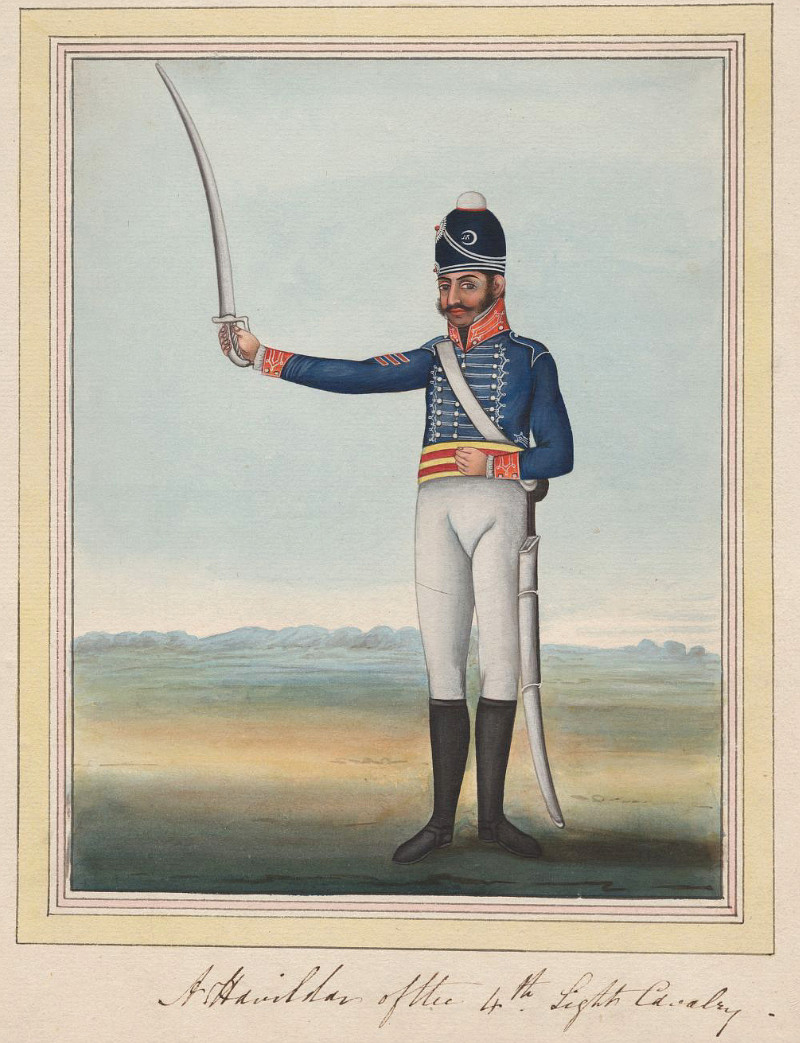
This painting depicts the early uniform of the Bengal Light Cavalry very clearly and in great detail. The first uniform was a red jacket which had, for the 4th Regiment, green facings. In December 1809 the red jackets were ordered to be changed to French grey with red facings and white buttons and braid. In 1810 the order was amended so that all the regiments were to have orange facings. However the new uniforms did not arrive until some time in 1811. The jacket worn here is mid-blue rather than the pale blue of most portraits. The collar and cuffs are dark orange. Some of the regiments stretched the colouring so that they appeared red, so an order of 7 July 1817 stressed that red facings were not allowed in the cavalry.
Early pictures of a sowar of Bengal Cavalry show the sword slung from a waist-belt, also with a sabretache. But this havildar has his sword slung from a shoulder belt on the right shoulder, and no apparent sabretache. He does not have a pouch-belt or a clip for a carbine. It had long been the custom in these regiments for only 15 men per Troop to carry a carbine to act as skirmishers. Officers and NCOs, although they did not have a carbine, did usually have a pouch-belt for pistol ammunition. Around his waist is a yellow and crimson girdle. This was worn in dress uniform for many years, until some time in the 1840s. The headdress is dark blue and decorated in a very distinctive way (see detail).
The three stripes on his right sleeve denote his rank of Havildar. In the early days in the Indian Army, up until, at least 1838, the ranks in the cavalry were titled the same as the infantry; Subadar, Jemadar, Havildar, Naik and Sepoy (or Trooper). Later the ranks in the cavalry were titled as Rissaldar, Jemedar, Daffadar, Lance-Daffadar and Sowar.
See detail

