

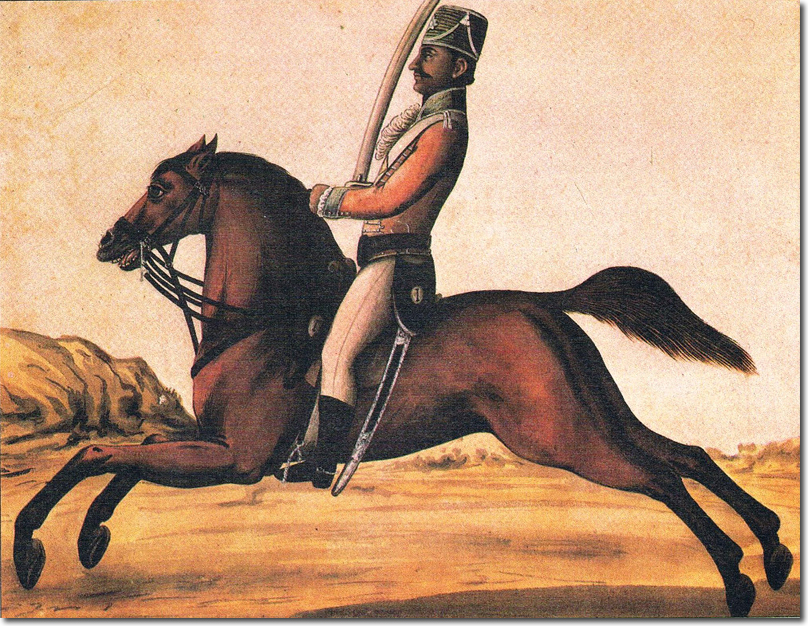
This painting of a mounted sowar of the Bengal Native Cavalry is reproduced in Boris Mollo’s book The Indian Army (Blandford Press 1981). The watercolour is by a company artist and dated 1780. In that year there were three regiments of cavalry in the service of the Nawab Wazir of Oudh of which the third survived to become the 1st Bengal Native Cavalry. The rider has a sabretache worn close to his waist-belt. The metal badge in the middle has the number 1 so is probably the first regiment, which was disbanded in May 1783. However, the uniform, based on British patterns, would have been similar for the three regiments, but it is not until 1793 that information on the uniform can be found.
W Y Carman, in his book Indian Army Uniforms: Cavalry (Leonard Hill Ltd 1961), says: ‘It is not until April 1793 [Bengal Military Regulations by Grace] that we find good evidence of the dress. Each native commissioned and non-commissioned officer, trumpeter and trooper was to have a headdress, not a helmet, which seems to indicate a turban or a watering cap. A subadar’s coat was to be of the best scarlet town-cloth, trimmed with silver twisted cord, plated or white metal buttons, and a loop on each shoulder of silver twisted cord. The jemadar’s coat was to be of the same cloth with silk twisted cord, buttons and loops as the subadar. The havildar’s coat was to be of superfine scarlet cloth with cotton twisted cord. The naique’s coat was of aurora [dull red] with cotton twisted cord and a cotton epaulette on one shoulder and a loop on the other of the same cord, the buttons being metal or tin. The trumpeter also wore aurora, the colour of the facings with the same cord and buttons, the latter also being worn by the trooper [sowar] who also had a cord on each shoulder. The facings for the 1st Native Cavalry were blue, and for the 2nd, yellow. Each trooper was to have two pairs of nankeen pantaloons. Native horse furniture was not approved and the order stated that the use of furniture or ornaments and trappings which seem only to encumber the horse and to heat it, should be entirely discontinued.’
In 1796 the 3rd Regiment was raised and had white facings, and the 4th had green. The 5th, raised in 1800, had buff facings and the 6th also raised in 1800 had orange, but in 1803 changed to grey. In 1805 the 7th and 8th were raised and both had yellow facings. All these distinctions were worn on the collar and cuffs of waist-length red jackets, however, in 1809 orders were issued that all the regiments of Bengal Native Cavalry were to wear a French grey jacket with, initially, red facings but soon changed to orange.

