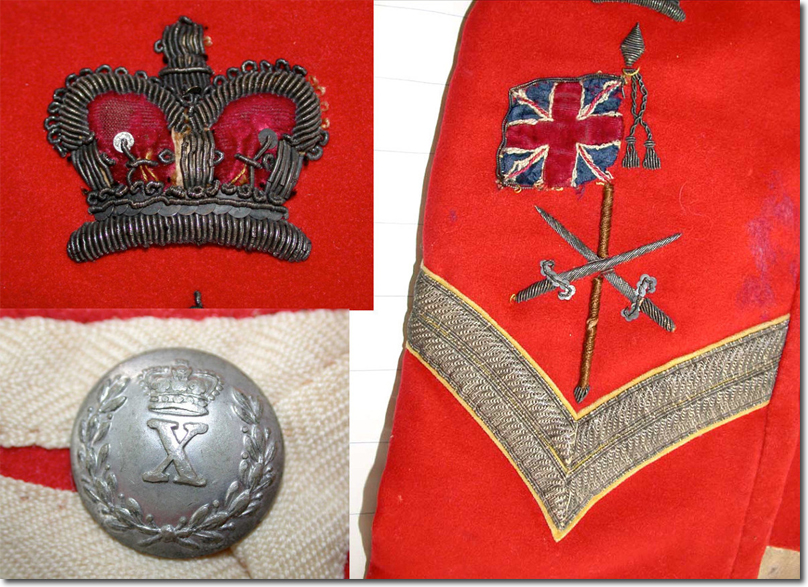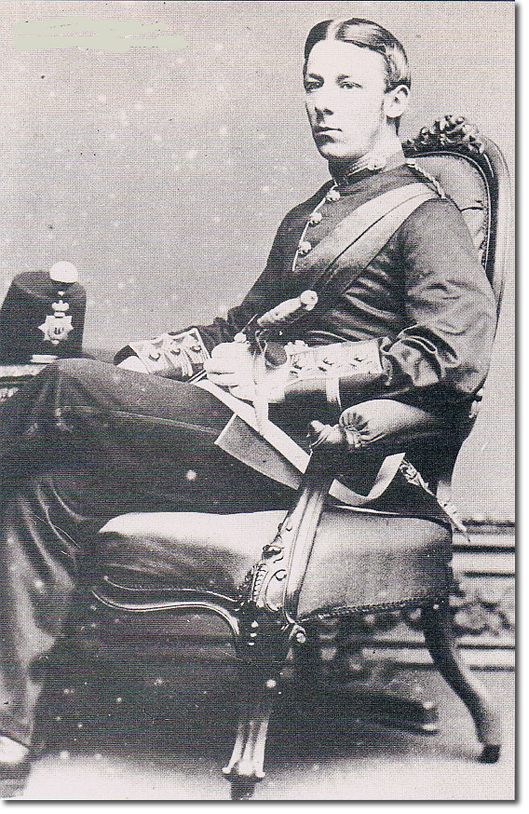
The dress tunic worn from 1857 to 1868 was a single breasted scarlet coat with yellow facings. His collar is rounded at the front and has a single star rank badge on each side. The round cuffs had a slashed flap of yellow edged in white and having three gilt buttons and half-inch gold lace button-holes. The gold lace was also along the top of the round cuff and the top of the collar. The front was fastened with eight gilt buttons of regimental pattern. The back shirts had false pocket flaps edged in white and having three gilt buttons and gold lace button-holes. These are just visible below the arm of the chair. His sword is carried with the scabbard attached to two white leather slings which hang from a white waist-belt. The belt was fastened with a regimental pattern waist-clasp. On his left shoulder there is a twisted crimson cord and small gilt button to ensure that his crimson silk sash stays on the shoulder. The right shoulder has no cord or strap.
On the table beside the young officer is his dress shako. It is the 1861-69 pattern, commonly known as the quilted shako. This cap has plain dark blue cloth covering a cork frame. Only field officers had gold lace edging around the top. The badge on the front is a gilt star, and the front is topped with a white over red ball tuft. His trousers are described in the 1864 Dress Regulations:
‘Trousers—from the 15th of October to the 30th of April, Oxford mixture cloth, with a scarlet welt, quarter inch broad, down the outward seam; from the 1st of May to the 14th of October, Oxford mixture Tartan serge, with same scarlet welt.’
The 10th served in India during the Sikh Wars and the Indian Mutiny. They returned to the UK in 1859. A second battalion was raised in 1858 and served in Ireland before sailing to South Africa. However, the army list of 1865 places the 1st Battalion at the Cape of Good Hope while the 2nd Battalion was at Hazareebagh in India. This photo shows the young officer in Britain c1865, perhaps before joining one of the two battalions abroad.