

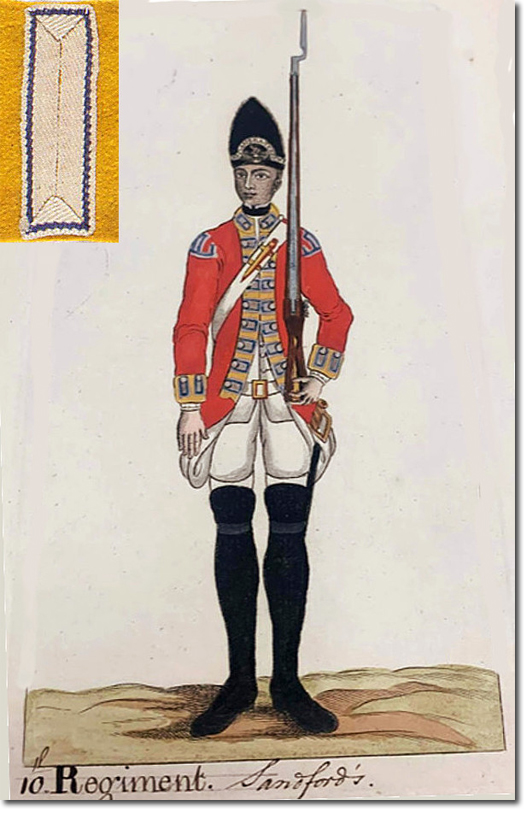
In 1768 a series of prints was produced to illustrate ‘Uniforms of the Infantry According to the King’s Regulations of the 19th December 1768’. The basic drawing was of a grenadier, coloured for each regiment with the facings and lace pattern. A sample of the lace on the facing colour is shown top left. The simple blue line on the edge of the white lace contrasts with the previous complicated pattern seen in the Morier painting of 1751. Sergeants had plain white lace.
The style of uniform was changed in 1768 to cope with the conditions encountered on foreign service, especially North America. Coats were close-fitting and had a turned-down collar. Lapels were 3ins wide down to the waist, and cuffs were neater and did not interfere with musket firing. Buttons were white metal, not dull pewter as before. This grenadier has shoulder wings that are sewn close to the sleeve but they became more open and raised as the uniform developed.
The headdress changed from the cloth mitre cap to a fur cap which had a metal plate on the front and a red patch on the back with a grenade and 10 embroidered in white.
Initially the belts consisted of an ammunition belt on the left shoulder with a brass match case attached to the front (probably obsolete at this stage). The waist-belt, worn under the coat supported a sword and bayonet. Grenadiers were the only men of the regiment to carry a sword from this date but it was discontinued in 1784. As time went on the waist-belt was removed to the right shoulder and a belt-plate clipped them together at the crossing point.
The print is captioned 10th Regiment. Sandford’s. Up until 1751 regiments were known by their Colonel’s name, but after that date they were numbered. However, it appears that the name of the Colonel was still used. Lt-General Edward Sandford was Colonel of the regiment from January 1763 until October 1781.

