

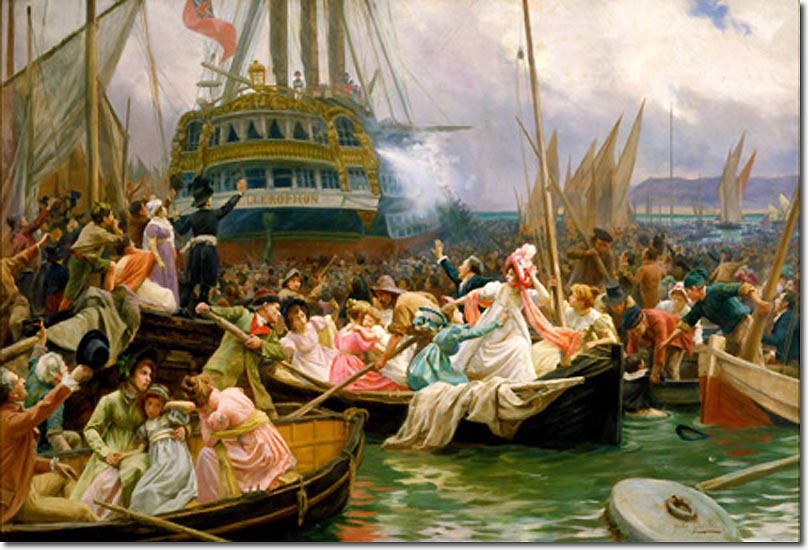
Napoleon’s period in power had seen Britain fighting for its very existence. For two decades the wars against Revolutionary and Imperial France had consumed the nation’s energies, and nowhere was this struggle felt more keenly than in Plymouth, the great naval stronghold of the south‑west. When, in July 1815, the Bellerophon anchored in Plymouth Sound with the defeated Emperor aboard, the people of the three towns were more eager than most to witness the downfall of the man who had so long threatened them.
Napoleon had surrendered to Captain Frederick Maitland in the Basque Roads, hoping that Britain would treat him more fairly than the Royalist French. He imagined himself perhaps a political exile, even a guest, rather than a prisoner. Yet his assumptions were swiftly overturned. Orders from Lord George Keith Elphinstone (Lord Keith) Commander‑in‑Chief of the Channel Fleet, were explicit: Napoleon was not to be allowed ashore. To step upon British soil would have invoked the protections of Magna Carta and habeas corpus, entangling the government in legal complexities and exposing him to the sympathies of juries and public opinion. Anchored off Cawsand, the Bellerophon became his gilded cage, subject to Admiralty law and treated in effect as a prisoner of war.
The public, however, was not denied the sight of him. News of his capture spread quickly, and by the time the ship reached Plymouth Sound on 26 July, crowds were already gathering. The Plymouth and Dock Telegraph reported that on Sunday 29 July as many as “10,000 persons in a thousand small boats circled the Bellerophon.” Boatmen advertised trips—Mr J. Burt of the Barbican offered passage on The Fly for one shilling and sixpence “to see the Bonny Party.” The sailors themselves indulged the curiosity of the masses, chalking messages on a blackboard: “Now talking to the officers,” “Asleep in his cabin,” “Gone to dinner.” Napoleon, amused and perhaps flattered, remarked to Mrs Maitland, the captain’s wife, “This is very hard… Lord Keith is a little too severe, is he not Madam?” He added of her portrait, “I assure you, her portrait is not flattering. She is handsomer than it is.”
The fascination was tinged with danger. One poor soul, John Boynes, a mason from the dockyard, drowned when his craft collided with another vessel in the crush of spectators. His gravestone at Stoke Damerel still records the tragedy. Yet the crowds persisted, some even wearing red carnations as a sign of sympathy. Napoleon himself took hope from these flowers, imagining that a pro‑Bonaparte following might be forming in Britain. Each evening at six o’clock he would walk the deck, and the waters erupted with commotion as boatmen ferried sightseers to glimpse the Emperor. Blank shots were fired to keep them at bay, but the spectacle only grew.
Napoleon was struck by Britain’s engineering prowess. Anchored close to the newly built Breakwater, he admired its scale and remarked that now he understood how France could lose to a country capable of such feats. He also witnessed French prisoners from Waterloo being marched to Dartmoor Prison, a sobering reminder of his fallen fortunes.
Meanwhile, the Admiralty deliberated in secret. At Belair House in Pennycross, Lord Keith, Admiral Sir Thomas Duckworth, and Captain Maitland spread maps across the dining table, guarded by Alexander Elphinstone with drawn sword to prevent intrusion. They weighed the options for their prisoner, conscious of his notoriety and the risk of revolutionary sympathisers. The decision was exile to St Helena, a remote island in the South Atlantic. When Lord Keith finally informed Napoleon, the Emperor protested bitterly, regarding the sentence as a death penalty. His entourage was distraught: Madame Bertrand feigned madness and tried to throw herself overboard; General Gourgaud swore to set fire to the ship; Savary and Lallemand even contemplated killing Napoleon rather than see him disgraced.
There was, briefly, a glimmer of hope. A West Indian lawyer named Mackenrot sought to subpoena Napoleon as a witness in a libel case, believing that if he could be compelled to appear in a British court, he would gain the protection of habeas corpus. As Capell Lofft wrote in the Morning Chronicle, “As an inhabitant or resident of England he shall not be sent prisoner into Scotland or to places beyond the sea.” But Lord Keith evaded the lawyer, and when word reached Maitland that Mackenrot was approaching Plymouth, the Bellerophon was ordered to sail at once. On 4 August, as the ship struggled against tide and wind, a small boat pursued it, a figure in black waving a legal document. It was Mackenrot, too late.
The paranoia of the Admiralty was intense. Remembering Napoleon’s escape from Elba, they not only kept his destination secret but also stationed garrisons on Tristan da Cunha and Ascension Island, thousands of miles from St Helena, lest they be used as bases for rescue. On 7 August Napoleon was transferred to HMS Northumberland off Start Point, and the next day began his long voyage to exile.
The Sherbourne and Yeoville Mercury summed up the episode with dry finality: “Thus terminated a rare show in Plymouth, after yielding a plentiful harvest to the watermen during his stay within the Breakwater at that port; on some days, particularly Sunday night, the numbers of ships which went out to see him at his usual hour of exhibition was about 1,000; on which occasion some fools actually took off their hats, and cheered him, apparently with the view to soothing his fallen fortunes and paying him a popular compliment.”
So ended Plymouth’s encounter with “the Ogre.” For the townsfolk it was a spectacle, a chance to see in the flesh the man who had dominated Europe. For Napoleon it was the liminal moment between empire and exile, between power and oblivion. Plymouth Sound, with its Breakwater, its crowded boats, and its watchful frigates, became the theatre of his downfall—a stage upon which the greatest soldier of his age played his last act on British waters before the long solitude of St Helena.

