

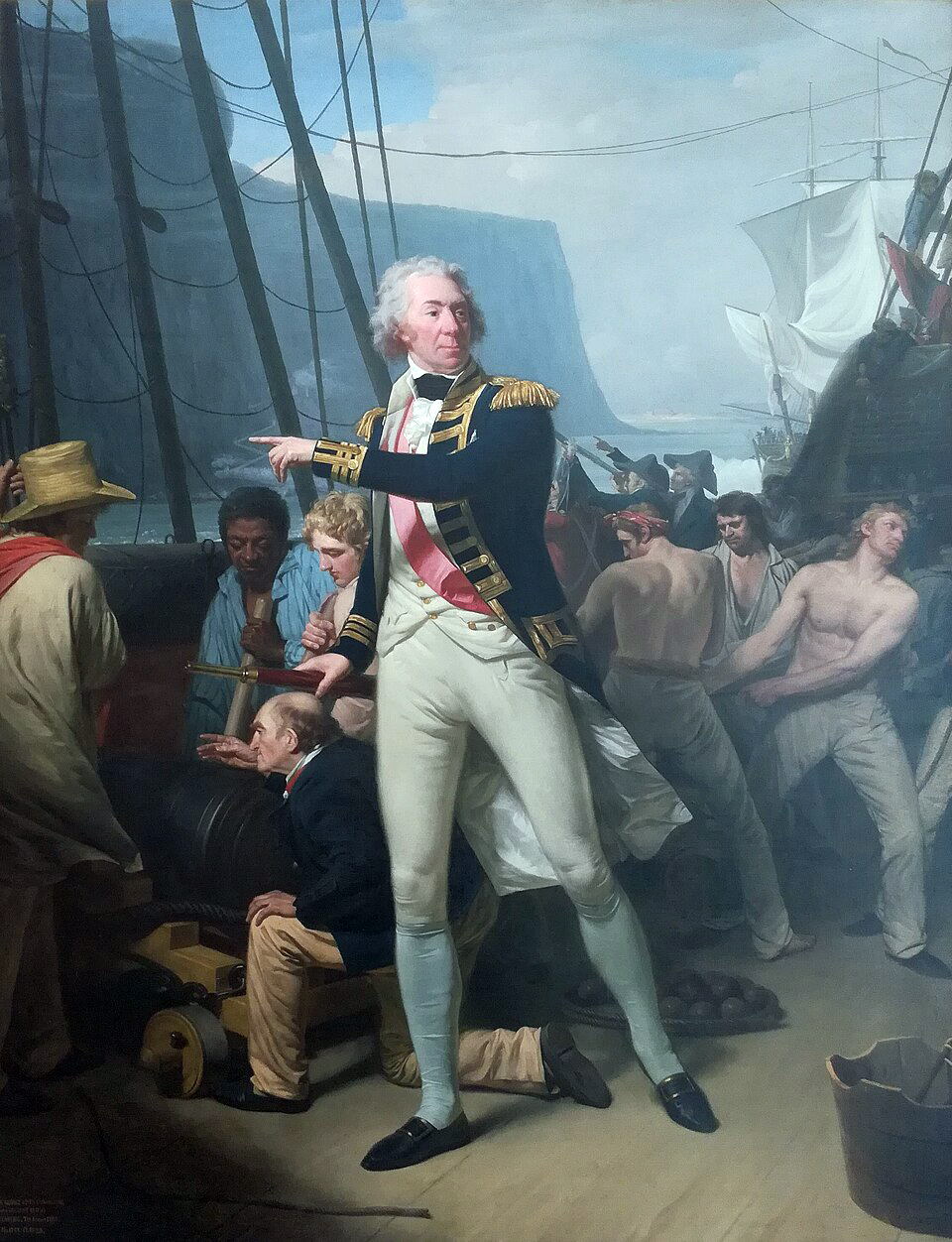
It is one of history’s curious ironies that the fate of an Emperor was settled not in a gilded council chamber but in a quiet dining room in Pennycross, and upon the steady will of a dour Scottish admiral whose genius lay less in flamboyant action than in unblinking administration. Lord George Keith Elphinstone, later Viscount Keith, had spent a lifetime at sea, tempering ambition with caution, and in the summer of 1815 he brought that temperament to Plymouth Sound, where Britain—exhausted by two decades of war—confronted Napoleon Bonaparte with a firmness that was both legal and logistical, both humane and implacable.
Keith’s ties to Plymouth were long-standing. As early as 1803, he had been employed as Commander-in-Chief at Plymouth, flying his flag aboard the Salvador del Mundo. This was a critical appointment, for Plymouth was one of the principal naval bases tasked with resisting the threat of French invasion. His tenure was marked by the organisation of squadrons, the reinstatement of the Sea Fencibles, and the constant vigilance required to guard the Channel approaches. Later, during the Napoleonic Wars, Keith’s responsibilities in Plymouth grew further. In 1812 he was appointed Commander-in-Chief of the Channel Fleet, with his flag aboard the San Josef, and subsequently the Queen Charlotte and Ville de Paris, all stationed at Plymouth. From here he directed detached squadrons off France, Spain, and Portugal, and oversaw the protection of trade routes that were vital to Britain’s survival.
By the time Captain Frederick Maitland’s Bellerophon dropped anchor off Cawsand in July 1815, Napoleon had already gambled his future on British magnanimity. He had surrendered in the Basque Roads with the quiet expectation of civility—perhaps even of hospitality—and for a brief moment the civilities did indeed attend him: respectful conversation, the deference due to fallen greatness, and the mesmerised curiosity of the multitude. Yet Lord Keith understood what the crowds did not: that the threshold of British soil was not merely a line of geography but of jurisprudence. To let the Emperor step ashore would be to invite the full embrace of Magna Carta and habeas corpus, with all their protections, delays, and possibilities of sympathy. Under Admiralty law, afloat, the government’s hand remained sure. Thus Keith held the line: Napoleon would not land.
The scene around the Bellerophon became a theatre in which nation and notoriety met. Up to ten thousand people, it was said, took to a thousand boats to witness the fallen titan. The boatmen traded in inches and glimpses, while sailors on the forecastle chalked the small intimacies of a great man’s routine—“Now talking to the officers,” “Gone to dinner”—as though greatness might be domesticated by the gentle rhythms of shipboard life. At six each evening Napoleon paced the deck to the accompaniment of cheers and commotion; blank-shot, echoing over the water, was required to keep the throngs at bay. In the crush, tragedy struck: John Boynes, a dockyard mason, drowned—his gravestone at Stoke Damerel now a relic of the day Plymouth gazed too closely at history.
For the towns themselves, hardened by years in which Britain had fought for its very existence, the moment was heady. The Breakwater, rising just beyond the anchorage, caught Napoleon’s eye; he admired its ambition, and remarked, with unaccustomed humility, that he could now understand how France had been bested by a country capable of such engineering feats. Nor was the vista abstract. Ships bearing French prisoners from Waterloo entered the Sound and moved their cargo toward Dartmoor Prison, itself a recent monument to the scale of conflict. The emperor saw, in miniature, the machinery of a maritime power: guns, stone, law, and tide—all moving with calculated purpose.
Within Belair House at Pennycross, Lord Keith presided over deliberations that were hush, urgent, and methodical. The dining table—stripped of china—was spread with charts; Alexander Elphinstone stood guard at the door, sword drawn, to secure the silence required for serious thought. Here the Admiralty’s worries were plain: the notoriety of Napoleon, the possibility of revolutionary sympathisers converging upon Plymouth, the peril of delay in a city of ships and whispers. The officers weighed stations across the world, measuring isolation against accessibility, the needs of custody against the reach of rescue. In the end, St Helena offered the perfect algebra of distance and control—remote, wind-swept, defensible. Keith, firm without flourish, resolved upon exile under permanent guard.
When the decision was put to Napoleon, the theatre darkened to tragedy. He argued, pleaded, flared with wounded pride; Lord Keith, for his part, neither baited nor yielded. He confined himself to the single discipline that had governed his career: orders. He would obey them, fully and without deviation, and he would not be led into disputes. If the Emperor had overmastered Europe by the drama of will, Keith would master the moment by the steadiness of duty.
Even duty must move quickly when the law gives chase. Word came that a West Indian lawyer, Mackenrot, armed with a subpoena and the audacity to use it, was nearing Plymouth. The Admiralty understood the danger: one foot ashore, one paper served, and Napoleon might escape into the labyrinth of English procedure. Keith’s response was immediate. The Bellerophon was ordered to slip the Sound, keeping close to shore; a small boat, a figure in black, a document held aloft—they all came, but came too late. Off Start Point the transfer was made to HMS Northumberland, and the course set southward for the Atlantic. So anxious were the British to preclude a second Elba that garrisons were posted even on Tristan da Cunha and Ascension, distant sentinels against a rescue imagined as much as feared.
In the days before sailing, Plymouth’s spectacle acquired its final gloss of commentary. The Sherborne and Yeoville Mercury, with dry asperity, wrote of “a rare show” that enriched the watermen, and of “some fools” who “took off their hats” to cheer the fallen fortunes of the foe. The phrase is more than period curmudgeonliness: it proposes a truth about the scene itself, in which pity pressed against policy, admiration against anxiety. Lord Keith’s task was to ensure that sentiment did not overturn settlement; that pity did not unravel prudence. He succeeded not by innovation but by constancy—by that mixture of caution, organisation, and common sense that his contemporaries, even his rivals, grudgingly respected.
Thus Plymouth became the hinge and Lord Keith the fulcrum. On one side lay the years in which Britain had stood against invasion and revolution, the Channel a moat and a highway; on the other, the silence of St Helena and the slow erosion of legend into memory. Napoleon admired the Breakwater and watched prisoners bound for Dartmoor; he paced the deck and saw his own captivity reflected in a harbour’s order. And above this choreography of boats and crowds, of guns and law, stood the admiral—tough, stern, “steady, persevering and cautious”—who declined to be dazzled by greatness or drawn into its performances. The Emperor’s last act on British waters was shaped not by the theatre of personality but by the discipline of command, and it was Lord Keith, with maps on a cleared table and orders in hand, who ensured that the play ended on time, and in the place selected: a speck of rock, far beyond the horizon, where the sea is a boundary and history keeps its counsel.

