

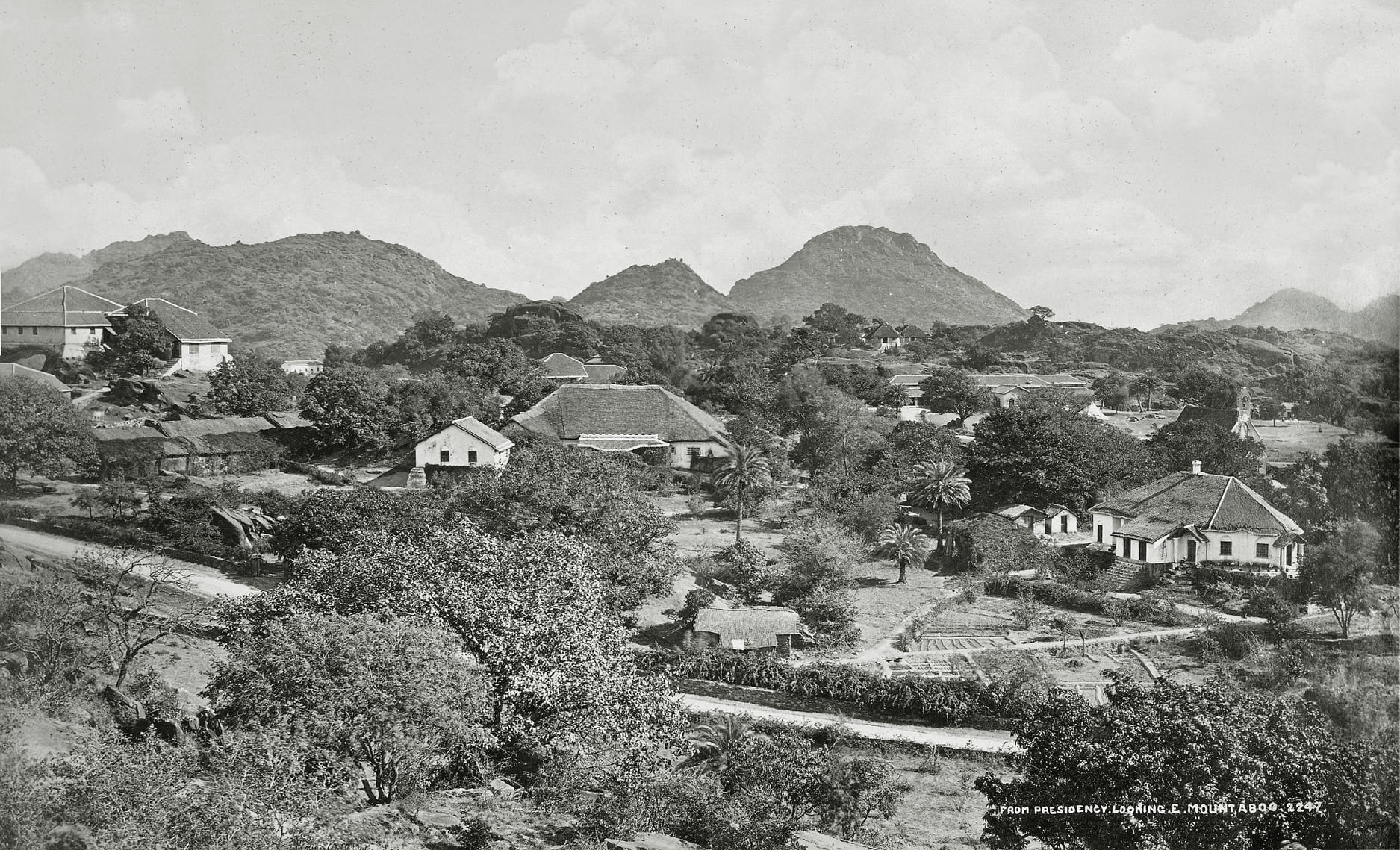
This 1872 photograph by Colin Murray, taken for the firm of Bourne & Shepherd, offers a panoramic view of Mount Abu, a colonial hill station in Rajasthan established in the early nineteenth century. Nestled on an undulating plateau and encircled by rugged hills, Mount Abu served as a seasonal administrative and recreational retreat for British officials seeking respite from the heat of the plains. The image captures the spatial organisation and architectural character of the station, with bungalows, institutional buildings, and natural scenery arranged in harmonious balance.
In the foreground, a series of pitched-roof cottages and bungalows are visible, constructed to suit the elevated terrain and cooler climate. These structures typically featured wide verandahs, high ceilings, and masonry walls, combining local materials with colonial design principles. The bungalow form—adapted across the empire—was especially suited to hill stations, offering both comfort and symbolic continuity with British domestic architecture.
On the extreme left of the image stand the offices of the Agency, the administrative centre for the region. These buildings likely housed the political agent and his staff, serving as the locus of British governance in the princely state of Rajputana. To the right, partially obscured by trees, is the west end and roofline of the small English church, a modest ecclesiastical structure that anchored the spiritual life of the station’s residents. Just beyond the church lies the Lawrence School, an educational institution named after Sir Henry Lawrence, part of a broader network of colonial schools established to educate the children of British officers and administrators.
Between these landmarks—and scattered across the plateau—are several bungalows belonging to officers attached to the Agency. Their placement reflects both practical considerations and social hierarchy, with proximity to the Agency offices often indicating rank or administrative function. The buildings are interspersed with gardens, pathways, and patches of forest, contributing to the station’s reputation as a picturesque and healthful retreat.
The photograph provides more than a visual record; it encapsulates the spatial logic of colonial hill stations, where architecture, landscape, and governance were carefully choreographed. Mount Abu’s elevation, vegetation, and relative isolation made it an ideal site for seasonal administration, and its built environment reveals the interplay between imperial needs and environmental adaptation. The station’s layout—anchored by civic, religious, and residential buildings—mirrored the structure of British towns, yet was shaped by the contours and climate of the Aravalli hills.
Today, Mount Abu remains a popular destination, its colonial-era buildings repurposed or preserved, and its legacy embedded in the architectural and cultural fabric of Rajasthan. Colin Murray’s photograph stands as a valuable historical document, capturing a moment when imperial architecture met Indian topography to produce a distinctive hill station landscape.

