

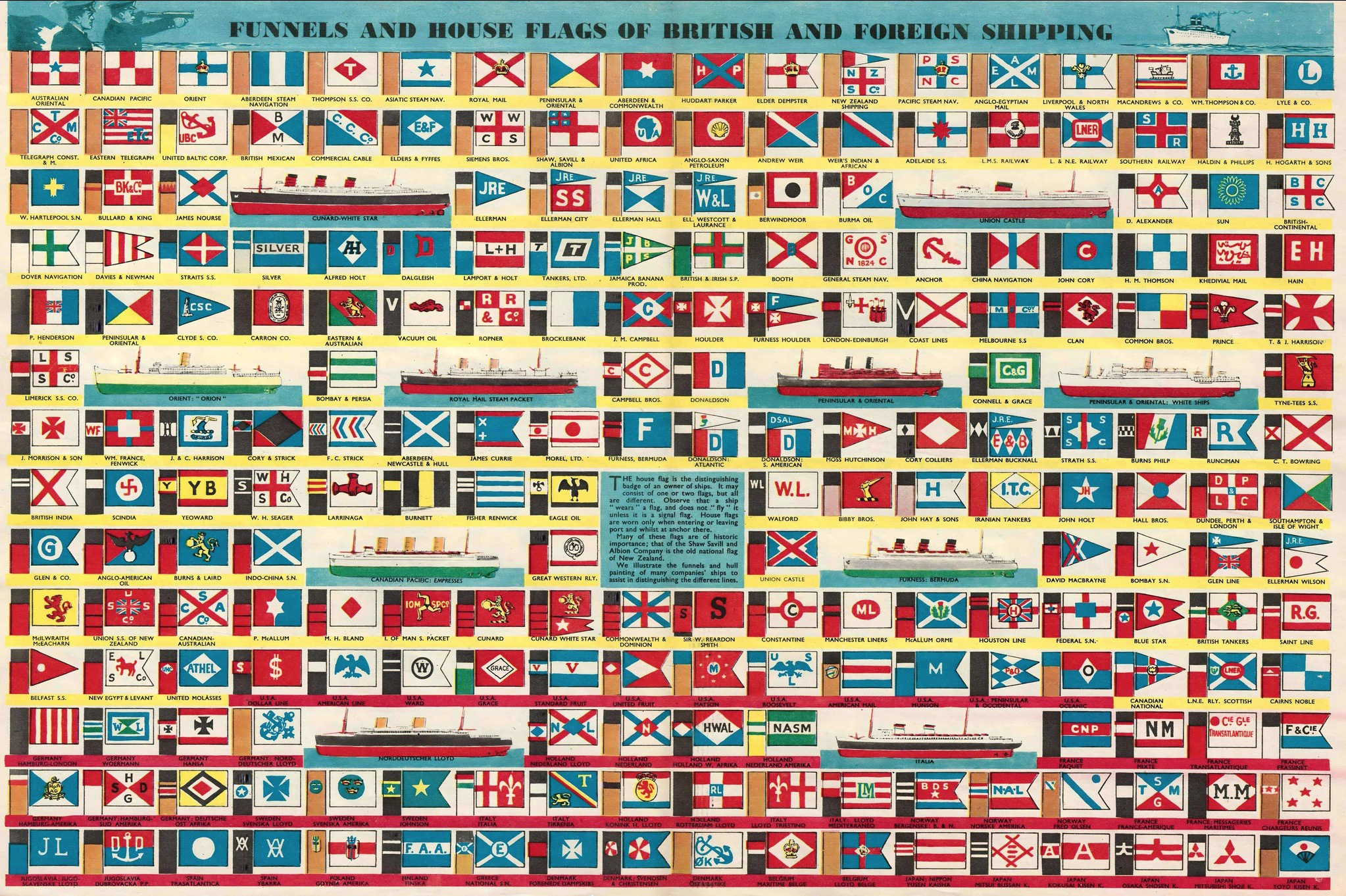
The chart titled Funnels and House Flags of British and Foreign Shipping presents a visual catalogue of maritime insignia used by shipping companies across the globe. Each funnel design and house flag served as a distinctive identifier, allowing vessels to be recognised at sea and in port. These markings were practical tools for navigation, port coordination, and commercial branding, and they played a significant role in the operation of global shipping networks.
Funnels were typically painted with unique colours and patterns on a ship’s smokestack, making them visible from a distance. House flags, flown from the masthead, often displayed company initials or symbols. Together, these elements formed a system of visual identification that facilitated communication between ships, port authorities, and commercial agents. In the context of the British Empire, such insignia helped link colonial ports to metropolitan centres, enabling the movement of goods, personnel, and information across vast distances.
Shipping companies operating within the imperial framework used these markings to signal reliability, contractual authority, and logistical alignment. Firms such as the British India Steam Navigation Company and the Peninsular and Oriental Steam Navigation Company maintained regular routes between Britain and its colonies, and their insignia became familiar symbols in ports from Calcutta to Cape Town. These visual cues assisted in customs processing, cargo handling, and scheduling, contributing to the efficiency of imperial trade.
Foreign shipping companies also employed distinctive insignia, and the chart reflects the competitive nature of maritime commerce. British firms often favoured simple geometric designs or bold initials, while continental companies used national colours or heraldic motifs. These differences in style mirrored broader branding strategies and helped delineate spheres of influence in global shipping lanes.
In addition to their practical functions, funnel and flag designs now serve as historical records. They allow researchers to trace shipping routes, company mergers, and changes in maritime logistics. For example, the Union-Castle Line connected Britain to South Africa, while the British India Line serviced ports throughout the Indian Ocean. These companies played roles in mail delivery, troop transport, and commercial exchange, and their insignia appeared in naval registries, insurance documents, and port archives.
The chart provides insight into the infrastructure of maritime identification and its role in supporting long-distance trade. It illustrates how visual systems were integrated into the broader mechanics of empire, enabling coordination across diverse geographies. The use of funnels and house flags contributed to the standardisation of shipping practices and helped maintain the operational coherence of global maritime networks.

