

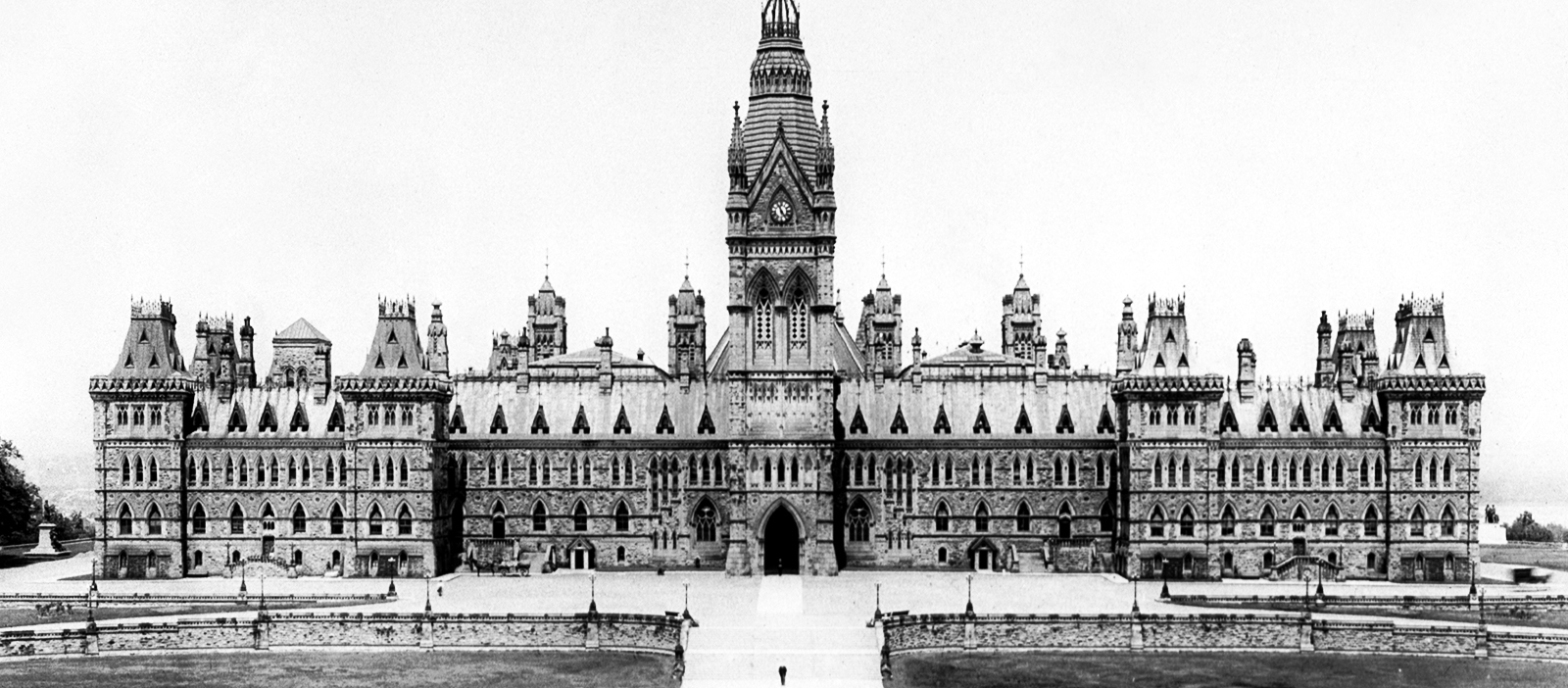
The Centre Block of the Canadian Parliament Buildings in Ottawa, completed in the early twentieth century, stands as a deliberate architectural statement. Designed in the Gothic Revival style, the complex reflects Canada’s desire to assert a distinct national identity—visually and symbolically separate from its southern neighbour, the United States. While American civic architecture had embraced classical forms drawn from Greco-Roman antiquity, Canada turned to medieval European traditions to express continuity, heritage, and institutional gravity.
The Gothic Revival style, characterised by pointed arches, ribbed vaults, and ornate stonework, was chosen not only for its aesthetic appeal but also for its symbolic associations. In Britain, Gothic architecture had long been linked to parliamentary tradition, ecclesiastical authority, and historical depth. By adopting this style, Canadian architects and officials aligned their new federal buildings with the Westminster model, reinforcing ties to British constitutional heritage while avoiding visual conflation with American neoclassicism.
The Centre Block’s most prominent feature is the Peace Tower, a soaring clock tower added after the original structure was destroyed by fire in 1916. Designed by architect John A. Pearson, the rebuilt complex retained its Gothic character, with steeply pitched roofs, lancet windows, and sculptural detailing. The Peace Tower itself serves as both a memorial and a national icon, housing the Books of Remembrance and offering panoramic views of the capital. Its vertical emphasis and intricate stone carvings contrast sharply with the horizontal symmetry and restrained ornamentation of American classical buildings such as the Capitol or the White House.
Beyond stylistic differentiation, the Gothic design also responded to practical and climatic considerations. The steep roofs facilitated snow runoff, while the use of local stone and robust masonry suited the Canadian environment. Internally, vaulted ceilings and stained glass windows created a solemn and dignified atmosphere for legislative proceedings. The building’s layout, with its central chamber flanked by offices and committee rooms, mirrored the functional organisation of Westminster while adapting to the needs of a bilingual and federal polity.
In choosing Gothic Revival, Canada made a conscious architectural decision that reflected both political alignment and cultural aspiration. The Parliament Buildings became more than a seat of government—they were a visual declaration of national distinctiveness, rooted in European tradition but tailored to Canadian context. Today, the Centre Block remains a powerful symbol of Canadian democracy, its spires and stonework continuing to evoke the ideals of continuity, deliberation, and sovereignty.
The top image shows the original construction, below shows it after it was rebuilt.


