

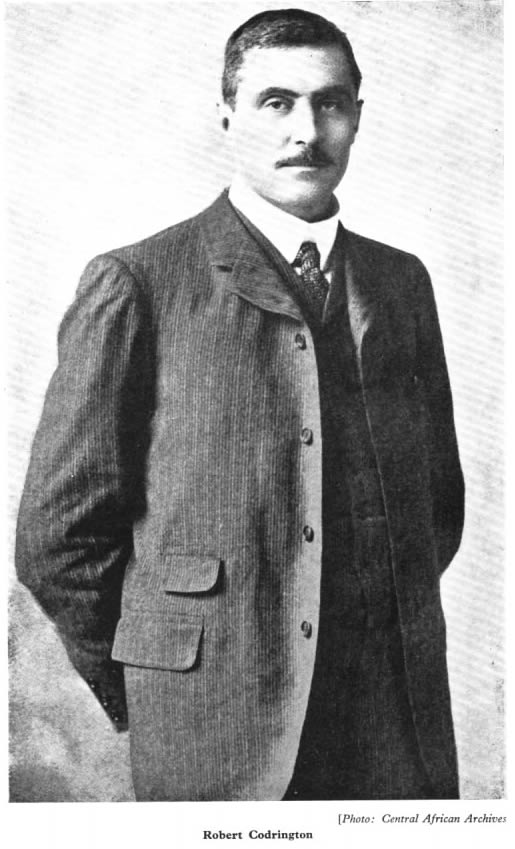
Robert Edward Codrington (6 January 1869 – 16 December 1908) was one of the most important figures in the early colonial history of Central Africa. As Administrator of North‑Eastern Rhodesia from 1898 to 1907, and briefly of North‑Western Rhodesia in 1908, he laid the foundations for the amalgamation of the two territories into Northern Rhodesia in 1911. His career was short, but his influence was decisive in shaping the political and administrative structures of what became modern Zambia and Malawi.
Codrington was born in the United Kingdom into a Gloucestershire family with a background of service in the Royal Navy. In 1890 he went to southern Africa and joined the Bechuanaland Border Police. In 1893 this force took part in the occupation of Matabeleland by white settlers, the overthrow of its ruler Lobengula, and the taking of African land by force, events which continue to have violent consequences in present‑day Zimbabwe. He was appointed Collector of Revenue in the British Central Africa Protectorate and rose rapidly through the colonial ranks. As a result of his military experience he was given the task of conquering the Ngoni and Yao by force and stamping out the last vestiges of the slave trade in the area. On 11 July 1898 he was appointed Administrator of North‑Eastern Rhodesia, based at Fort Jameson (now Chipata).
To solve the shortage of British personnel available to run the administration, Codrington appointed Africans educated by Scottish missionaries in Nyasaland. This policy stood in contrast to Southern Rhodesia, where education and employment of Africans beyond manual labour was strongly opposed. For nearly a decade he oversaw the establishment of BSAC authority, taxation, law enforcement, and the creation of administrative districts. His policies emphasised direct company control, military enforcement, and the suppression of slave trading networks. He was regarded as a firm but pragmatic ruler, balancing frontier realities with the need to build lasting institutions.
In 1907 Codrington was appointed Administrator of North‑Western Rhodesia, based at Livingstone. Though he served only a year before his death in December 1908, he reorganised its administration in the same fashion as North‑Eastern Rhodesia, paving the way for the two territories to be merged in 1911. During his administration he encouraged African education and instigated indirect rule through local chiefs. He opposed rule by white settlers, keeping authority firmly in the hands of trained administrators. These factors helped place Zambia and Malawi on a different path from Southern Rhodesia, enabling them to achieve peaceful independence more than fifteen years before Zimbabwe.
Apart from running the administration, Codrington studied ethnological aspects of Africa and was a collector of cultural artefacts. While some of these had been taken from slave traders whom he had defeated, many valuable pieces, including very old works of Luba origin, were taken from the court of Mwata Kazembe by a British punitive expedition sent by him against Mwata Kazembe X in 1897, and these he kept. In 1920 these items were placed in a museum in Southern Rhodesia. Codrington also wrote a number of articles for the Royal Geographical Society. He died in London in 1908 at the age of 39 due to heart disease, but despite his short life he remains one of the most influential early administrators of Central Africa, bridging the violent frontier era of the 1890s with the more structured colonial governance of the 20th century.
Picture: Robert Edward Codrington, Administrator of North‑Eastern Rhodesia (1898–1907) and North‑Western Rhodesia (1908). Photo: Central African Archives.
