|
The area around the Zambezi became known to Britain through the exploits of David Livingstone, who was the first European to see the Zambezi Falls, which he named Victoria Falls. His journeys in the 1850s were avidly followed, as he embodied qualities that Victorians admired: a devout Christian, an anti-slavery campaigner, inquisitive, and eager to discover the wonders of God’s earth. He represented the “Christianity” of the three C’s of British Imperialism and established a strong Missionary presence in Nyasaland. Soon another Briton, Cecil Rhodes, would bring the other two C’s: Commerce and Civilisation.
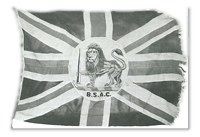
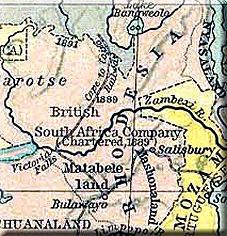
The history of Northern Rhodesia was closely tied to the events in Southern Rhodesia. Cecil Rhodes had formed the British South Africa Company (BSAC) to prospect in lands north of the Transvaal and the Orange Free State. The idea was to determine whether the gold seam extended further north. Rhodes’ representatives signed mining concessions with Chief Lobengula of the Matabele. The Matabele were the dominant tribe between the Limpopo and the Zambezi, but their authority did not extend far beyond the river. The BSAC deliberately left the northern limit of the concession vague, and this became more pressing when it became clear that there was no gold in Matabeleland.
Company prospectors moved further north in search of the elusive gold they expected to find. Those who failed to discover gold in Southern Rhodesia were impressed by the quality of farmland on the plateau, but their mineral rights did not entitle them to seize land. In this context, conflict was contrived against the Matabele, ostensibly in defence of the Mashona, and the use of machine guns and artillery subdued and destroyed Lobengula’s empire. Tensions culminated in the Matabele and Mashona War of 1893–94, beginning with a clash near Victoria in which Captain Charles Lendy’s patrol killed nine Matabele raiders. Jameson declared war on Lobengula, settlers were promised land and cattle, Rhodes supplied funds, and forces gathered at Salisbury, Victoria, and Tuli. Lobengula’s impis, numbering several thousand, attempted to resist but were defeated by cannon and Maxim guns. Bulawayo was abandoned and destroyed by Lobengula himself, and the pursuit northwards ended with the Shangani Patrol, where Major Allan Wilson and his men were surrounded and killed. The war secured Matabeleland for the Company, and its conduct—settler mobilisation, reliance on modern weaponry, and the establishment of administrative control—set a precedent for further expansion. The collapse of Lobengula’s kingdom encouraged the BSAC to extend its authority beyond the Zambezi, laying the foundations for Northern Rhodesia’s later incorporation. The Company continued to search for gold north of the river, obtaining mineral rights from the Lozi in the northwest, while the Ngoni in the northeast resisted until defeated in battle. Although the BSAC sought mineral concessions, its administrative and technological capacity gave it greater influence than the treaties alone provided. The land and climate proved less suitable for European agriculture than in Southern Rhodesia, so white settlement remained limited, and those who did move north were always a small minority of the population.
The charter of the BSAC contained only vague limits on the northern extent of the company’s sphere of activities, and Rhodes sent emissaries Joseph Thomson and Alfred Sharpe to make treaties with chiefs in the area west of Nyasaland. Rhodes also considered Barotseland as a suitable area for Company operations and as a gateway to the copper deposits of Katanga. Lewanika, king of the Lozi people of Barotseland, sought European protection because of internal unrest and the threat of Ndebele raids. With the help of François Coillard of the Paris Evangelical Missionary Society, he drafted a petition seeking a British protectorate in 1889, but the Colonial Office took no immediate action. Rhodes then sent Frank Elliott Lochner to Barotseland to obtain a concession and offered to pay the expenses of a protectorate there. Lochner told Lewanika that BSAC represented the British government, and on 27 June 1890 Lewanika consented to an exclusive mineral concession. This Lochner Concession gave the Company mining rights over the whole area in which Lewanika was paramount ruler in exchange for an annual subsidy and the promise of British protection—a promise Lochner had no authority to give. Nevertheless, the BSAC advised the Foreign Office that the Lozi had accepted British protection. As a result, Barotseland was claimed to be within the British sphere of influence under the Anglo-Portuguese Treaty of 1891, although its boundary with Angola was not fixed until 1905.
In 1889, although Britain recognised the rights of the International Association of the Congo to large sections of the Congo basin, which formed the Congo Free State under King Leopold II of the Belgians, it did not accept its effective occupation of Katanga. Known to contain copper and thought possibly to hold gold, Katanga was targeted by Rhodes, possibly prompted by Harry Johnston. Alfred Sharpe was sent to obtain a treaty from its ruler, Msiri, which would grant the concession and create a British protectorate over his kingdom. King Leopold II was also interested in Katanga, and Rhodes suffered one of his few setbacks when, in April 1891, a Belgian expedition led by Paul Le Marinel obtained Msiri’s agreement to Congo Free State personnel entering his territory. Belgian forces entered in 1892, producing the anomaly later known as the Congo Pedicle.
 |
|
|
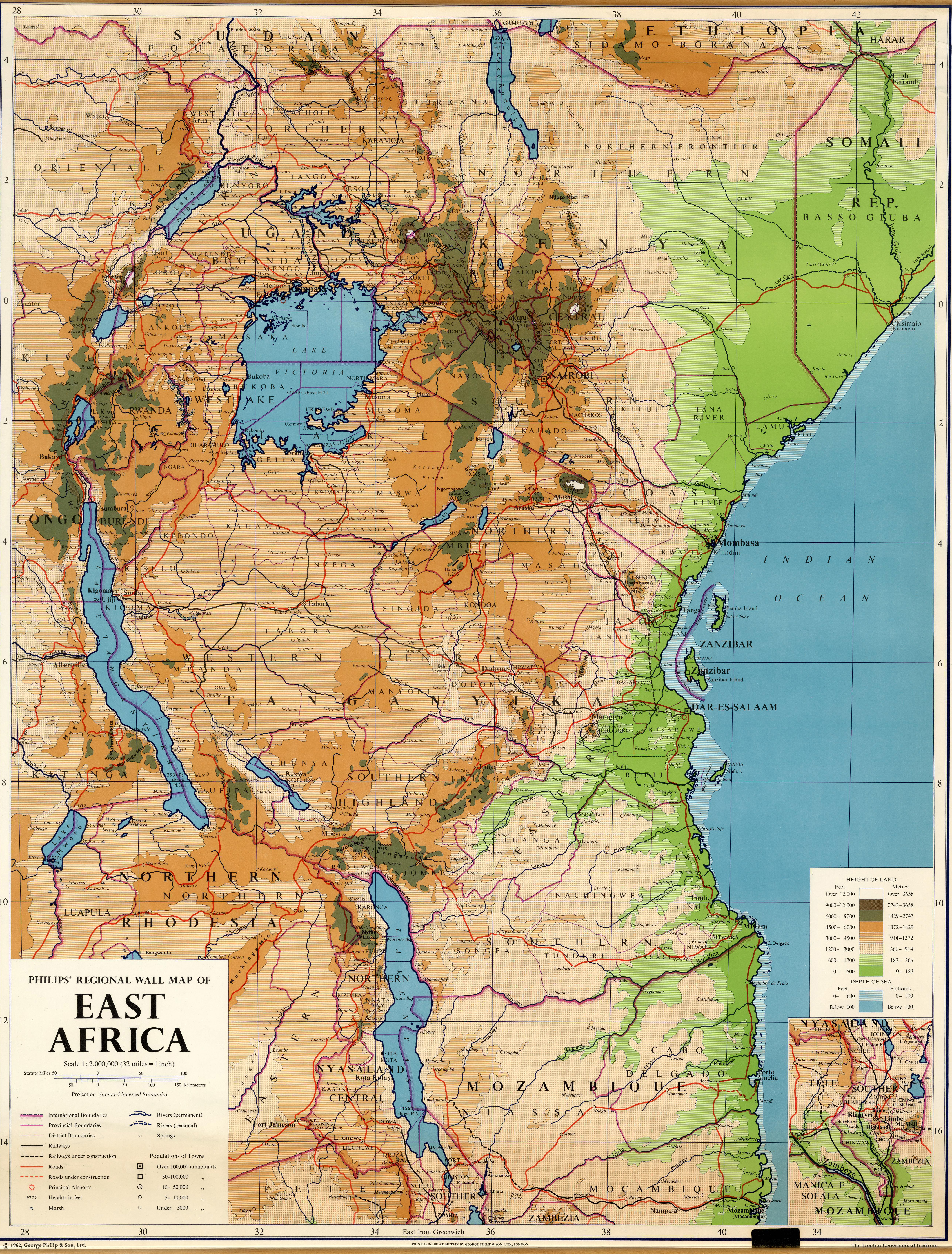
Fixing boundaries became central to the early years of Northern Rhodesia. Following the Congress of Berlin, European powers agreed to secure treaties with local rulers and to negotiate bilateral agreements with each other. Between 1890 and 1910 Lewanika granted concessions covering a poorly defined area of Barotseland–North-Western Rhodesia, while Thomson and Sharpe negotiated further treaties with chiefs in North-Eastern Rhodesia in 1890–91. The Anglo-Portuguese Treaty of 1891, signed in Lisbon, fixed the boundary between BSAC territory in North-Eastern Rhodesia and Portuguese Mozambique, and declared Barotseland within the British sphere. It also defined the frontier between North-Western Rhodesia and Portuguese Angola, though this was not marked on the ground until later.
Other agreements followed. The Anglo-German Convention of 1890 fixed the northern border of North-Eastern Rhodesia with the British Central Africa Protectorate, and also defined the short boundary between North-Western Rhodesia and German South-West Africa (modern Namibia). The frontier with the Congo Free State was settled by treaty in 1894, with minor adjustments continuing into the 1930s. Boundaries with other British territories were fixed by Orders-in-Council: in 1891 the divide between Lake Malawi and the Luangwa River was established as the border between the British Central Africa Protectorate and North-Eastern Rhodesia, while in 1898 the Zambezi River was set as the boundary between North-Western Rhodesia and Southern Rhodesia.
Through these concessions, wars, and boundary agreements, the BSAC laid the foundations of Northern Rhodesia. Its authority rested on mineral rights, military precedent, diplomatic arrangements, and the gradual imposition of administrative structures. By 1911, the Company amalgamated its northern territories into a single unit, formally named Northern Rhodesia, marking the transition from loosely defined spheres of influence to a recognised colonial territory.
Company Administration of Northern Rhodesia
From 1891 onwards, the British South Africa Company exercised administrative authority north of the Zambezi under Orders-in-Council. Barotseland–North-Western Rhodesia and North-Eastern Rhodesia were recognised as protectorates in 1899 and 1900 respectively, with the Colonial Office retaining ultimate responsibility and the High Commissioner for South Africa empowered to approve or reject Company legislation. In 1911 the two territories were amalgamated as Northern Rhodesia.
British common law became the basis of administration in both Southern and Northern Rhodesia, unlike Roman Dutch law which applied in South Africa. The BSAC was authorised to establish a police force and administer justice, with instructions that in cases involving African natives the courts should have regard to the customs and laws of their tribe or nation. An Order-in-Council of 1900 created the High Court of North-Eastern Rhodesia, which assumed control of civil and criminal justice; North-Western Rhodesia received its own High Court in 1906. In 1911 these were amalgamated into the High Court of Northern Rhodesia.
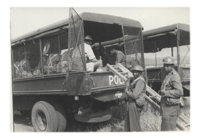
Policing evolved gradually. At first, the British South Africa Police patrolled north of the Zambezi in North-Western Rhodesia, but European troops proved costly and vulnerable to disease. The Company judged the territory more suitable for a largely African police force. In 1902 (some sources date this to 1899 or 1901) the Barotse Native Police was formed, with European officers and NCOs commanding African ranks. This force was later merged with the civil police to form the Northern Rhodesia Police in 1911. In North-Eastern Rhodesia, Harry Johnston in the British Central Africa Protectorate initially oversaw security, deploying Sikh and African troops until 1899. Local magistrates recruited their own constables until 1903, when a North-Eastern Rhodesia Constabulary was created, staffed mainly by African NCOs and troopers under a handful of European officers. In 1912 this was merged into the Northern Rhodesia Police, which then numbered 18 Europeans and 775 Africans in six companies distributed across district headquarters.
Governance under BSAC rule remained limited. The Administrator held powers similar to those of a colonial governor, but decisions affecting Europeans required High Commissioner approval. There was no Executive or Legislative Council; instead, an Advisory Council of senior officials advised the Administrator. After 1917, five nominated members were added to represent the small European minority, but Northern Rhodesia had no elected representation under Company rule.
Economically, hut tax was introduced in North-Eastern Rhodesia in 1901 and extended gradually through North-Western Rhodesia between 1904 and 1913. It was set at rates equivalent to two months’ wages, designed to encourage or compel Africans into wage labour. Before 1920 the tax was generally five shillings a year, but in 1920 it was sharply increased, often doubled, to provide more workers for the mines of Southern Rhodesia, particularly the coal mines of Wankie. The Company regarded Northern Rhodesia primarily as a reservoir of migrant labour for Southern Rhodesia rather than as a centre of settler agriculture or industry.
By 1924, the Company’s revenues were insufficient to sustain long-term administration, and political pressure mounted for change. The British government revoked the BSAC charter in Northern Rhodesia, transferring administration to the Colonial Office. The BSAC retained its mineral rights, but its role in governance ended. The transition marked the close of Company rule, leaving behind the territorial framework, judicial institutions, police forces, and labour systems that shaped Northern Rhodesia’s subsequent development.
Company Infrastructural Development in Northern Rhodesia
In 1911 the British South Africa Company (BSAC) created sufficient infrastructure to combine the northeastern and northwestern territories into a single administrative unit. Despite this consolidation, the hoped-for gold deposits never materialised, and the Company’s debts mounted. By the 1920s its finances were precarious. Meanwhile, white settlers in Southern Rhodesia demonstrated their desire for self-government through elections to the Legislative Council, highlighting the contrast between the more developed south and the Company’s northern dependency.
The BSAC was responsible for building the Rhodesian railway system during the primary period of construction, which ended in 1911 when the main line through Northern Rhodesia crossed the Congo border to reach the Katanga copper mines. Rhodes’s original intention had been to extend a railway across the Zambezi to Lake Tanganyika, but when little gold was found in Mashonaland, he accepted that such a scheme had no economic justification. Railways built by private companies required traffic capable of paying high freight rates, particularly large quantities of minerals. A line from Kimberley reached Bulawayo in 1897, and this was extended to cross the Victoria Falls in 1902. The next section ran through Livingstone to Broken Hill, which the railway reached in 1906. The BSAC had been assured that there would be plentiful traffic from its lead and zinc mines, but this did not materialise due to technical mining problems. The railway could not meet the costs of its construction loans, and the only area likely to generate sufficient mineral traffic to relieve these debts was Katanga. Initially, the Congo Free State concluded that Katanga’s copper deposits were not rich enough to justify the capital cost of building a railway to the coast, but expeditions between 1899 and 1901 proved their value. Copper deposits found in Northern Rhodesia before the First World War proved uneconomic to develop. In 1906 Union Minière du Haut Katanga was formed to exploit the Katanga mines. King Leopold II wanted a railway entirely in Congolese territory, linked to the Congo River, but in 1908 he agreed with the BSAC to continue the Rhodesian railway to Elizabethville and the mines. Between 1912, when full-scale copper production began, and 1928, when a Congolese line was completed, almost all of Katanga’s copper was shipped over the Rhodesian network. The railway’s revenue from Katanga copper enabled it to carry other goods at low rates. Large-scale development of the Copperbelt only began in the late 1920s, when the world market for copper expanded. Transport posed no problem, as only short branches had to be built to connect the Copperbelt to the main line.
Alongside the railway, the BSAC invested in other infrastructure to support administration and communication. Telegraph lines were extended northwards from Bulawayo, crossing the Zambezi at Victoria Falls in 1902 and reaching Livingstone soon after. By 1906 telegraph connections linked Broken Hill with Salisbury and Bulawayo, enabling faster communication between the northern territories and the Company’s headquarters. Telegraph offices were established in district centres, providing a vital link for administrators, police, and mining companies. Postal services were closely tied to these telegraph offices, with mail carried along the railway and distributed through administrative centres such as Livingstone and Broken Hill. This allowed for more regular communication between settlers, officials, and commercial enterprises, though coverage remained limited outside the main towns. Roads were rudimentary, often little more than tracks, but were gradually improved to connect administrative posts and facilitate the movement of goods to railheads. These developments, though modest in scope, provided the framework for integrating Northern Rhodesia into the wider Rhodesian system and laid the foundations for later colonial expansion.
The End of BSAC Rule
In 1923 the BSAC’s charter was revoked across both Northern and Southern Rhodesia in return for a cash settlement. The outcomes, however, were markedly different. Southern Rhodesia, with its larger settler population and stronger political organisation, was granted responsible self-government under settler control. Northern Rhodesia, by contrast, remained a protectorate under direct British administration, with its capital at Livingstone. This divergence reflected the contrasting demographic and political realities of the two territories.
Almost from the start of European settlement, the settlers in Northern Rhodesia were hostile to the BSAC administration and its commercial position. The Company opposed their political aspirations and refused to allow elected representation, limiting them to a few nominated members on the Advisory Council. Following the Privy Council judgement that land in Southern Rhodesia belonged to the Crown rather than the BSAC, opinion among settlers there turned decisively towards responsible government, which was granted in 1923. In Northern Rhodesia, however, the Company insisted its land claims were unchallengeable and persuaded the British government to negotiate directly over future administration.
A settlement was reached by which Northern Rhodesia remained a protectorate but came under the Colonial Office, while the BSAC retained extensive areas of freehold property and mineral rights. It was agreed that half of the proceeds of land sales in the former North-Western Rhodesia would go to the Company. On 1 April 1924 Herbert Stanley was appointed Governor, and Northern Rhodesia became an official Protectorate of the United Kingdom. The capital was later moved from Livingstone to Lusaka in 1935.
Under BSAC administration, the Administrator had powers similar to those of a colonial governor, although certain powers were reserved to the High Commissioner for South Africa. There was neither an Executive Council nor a Legislative Council, only an Advisory Council consisting entirely of nominees. The Northern Rhodesia Order in Council of 1924 transferred to the Governor any power or jurisdiction previously held by the Administrator or vested in the High Commissioner. It also provided for an Executive Council of six ex-officio senior officials and any other members the Governor wished to appoint. At the same time, a Legislative Council was established, consisting of the Governor, up to nine official members, and five unofficial members elected by the small European minority of around 4,000 people. None of the African population had the right to vote.
Mining in Northern Rhodesia
The colony’s economic prospects changed dramatically in 1928 with the discovery of copper in the north. These vast deposits diversified the economy and made Northern Rhodesia one of the world’s largest copper producers. The importance of copper increased further during the Second World War. Conditions for African workers were harsh, following precedents set in the gold and diamond mines further south in South Africa, where companies feared theft. Compounds, poor safety standards, and low wages led to strikes. In 1935 thirteen miners were killed. The large African population meant that striking workers could be replaced or undercut by others seeking employment.
Ancient surface copper workings were known at Bwana Mkubwa, Luanshya, and Kansanshi (near Solwezi), all except the latter on what later became known as the Copperbelt. Exploration in 1895 by the BSAC’s American scout Frederick Russell Burnham confirmed that major copper deposits existed in Central Africa. Along the Kafue River Burnham noted similarities to deposits he had worked in the United States and observed local use of copper ornaments. Later, the BSAC built towns along the river and extended railways to transport copper through Mozambique.
The BSAC claimed mineral rights across Northern Rhodesia under concessions granted between 1890 and 1910 by Lewanika in the northwest and by treaties negotiated by Joseph Thomson and Alfred Sharpe in the northeast. These claims were accepted by the British Government. After the Company’s charter ended, BSAC joined a group of South African and British firms financing the development of Nchanga Mines, seeking royalties while preventing American control.
Commercial exploitation of copper deposits depended on railway access. The Southern Rhodesian line crossed the Zambezi in 1902 and reached the Congo border in 1909, enabling transport to Katanga where rich oxide ores were already being mined. In Northern Rhodesia, surface ores were poorer, and copper was only intermittently worked at Bwana Mkubwa until 1924, when rich sulphide ores were discovered below the surface. Unlike Southern Rhodesia, which attracted numerous independent prospectors, Northern Rhodesia’s mining policy favoured large-scale concessions to major companies.
Large-scale mining on the Copperbelt began after 1924, financed mainly from the United States and South Africa. Chester Beatty and Sir Edmund Davis’s Selection Trust developed the Roan Antelope mine at Luanshya in 1926. Copper’s rising value for electrical and motor industries encouraged investment. In 1927 Beatty sold a one-third interest in Roan Antelope to the American Metal Company (AMC), and in 1928 he formed Rhodesian Selection Trust (RST). By 1930 AMC had taken control, financing the Mufulira mine, which entered partial production in 1930 and full production in 1933. South African capital was led by the Anglo American Corporation, which acquired interests in Bwana Mkubwa in 1924, Mufulira in 1928, and Nkana in 1928, forming Rhodesian Anglo American with BSAC as a shareholder. Roan Antelope and Nkana began commercial production in 1931.
British capital was initially limited. In 1929 fears that Nchanga might fall under American cartel control led the British government to encourage nine companies to finance it, though Rhodesian Anglo American dominated. In 1931 Bwana Mkubwa and Nchanga were amalgamated into the Rhokana Corporation, while RST controlled Roan Antelope and much of Mufulira. Rhokana owned Nkana, Nchanga, Bwana Mkubwa, and the remainder of Mufulira. The shareholding structures of RST and Rhokana were complex, reflecting international finance.
The copper price crash of 1931, caused by global downturn and cartel restrictions, devastated Northern Rhodesia. Thousands of workers were dismissed, ending hopes among settlers of transforming the territory into a white dominion like Southern Rhodesia. Many Europeans returned south, while Africans resumed subsistence farming. Despite this, large firms maintained profits, aided by low labour costs. At a 1932 conference in New York, Rhodesian companies resisted further market intervention, and restrictions lapsed, strengthening their position. In 1933 the BSAC sold its remaining Southern Rhodesian holdings to that government, freeing capital to invest in mines and acquire a major stake in Anglo American. Agreements with Rhodesia Railways secured transport for copper. By the end of the 1930s, Northern Rhodesian copper mining was booming, laying the foundations for the territory’s central role in global copper production.
Protectorate Administration in Northern Rhodesia
When Northern Rhodesia became a Protectorate under the British Empire on 1 April 1924, its administration was reshaped to reflect direct Colonial Office control while retaining many of the structures inherited from the British South Africa Company. A Legislative Council was created, with the Governor presiding ex officio, and initially consisted entirely of nominated members divided between officials holding executive posts and unofficials without administrative responsibilities. In 1926, elections were introduced for a small number of unofficial members, but the franchise was tightly restricted to United Kingdom citizens who met property or income qualifications and could complete their application in English. Africans, as British Protected Persons, were excluded, and the system ensured that political representation remained the preserve of the European minority. Over the following decades, the number of unofficial members was gradually increased, but settler demands for parity with officials and seats on the Executive Council were resisted. By the late 1930s, token representation of African opinion was introduced through nominated European members, and after the Second World War African voices were cautiously incorporated through the African Representative Council, which recommended nominees to sit in the Legislative Council. The reforms of 1953 and 1959 expanded elected representation, introduced African seats, and created separate electoral rolls, but the system remained weighted in favour of Europeans and carefully managed to prevent majority African influence.
From the 1890s, and continuing after the end of Company rule, a policy of direct administration over Africans was pursued, with small numbers of District Officers exercising authority across vast territories. Traditional chiefs were deprived of their judicial powers and troublesome ones were deposed, though many accepted reduced roles as local agents of the administration. By the late 1920s, the idea of indirect rule, articulated by Lord Lugard in The Dual Mandate in British Tropical Africa, gained favour as a theoretical recognition of African interests in colonies where European settlement was limited. In practice, however, the system introduced in Northern Rhodesia in 1930 differed little from direct rule. Chiefs and headmen were nominated as Native Authorities, but their judicial powers were narrow and their financial resources insufficient to build institutions of self-government. District Officers retained most of their authority, using Native Authorities as intermediaries rather than autonomous leaders. The Colonial Secretary Lord Passfield’s Memorandum of 1930 reasserted the paramountcy of African interests and rejected settler aspirations for minority rule, turning European opinion in Northern Rhodesia away from association with East Africa and towards union with Southern Rhodesia. In 1933, a substantial minority in the Legislative Council favoured amalgamation with the south, though most settlers remained cautious about being overshadowed by the larger European population there. From 1943, Provincial Councils were created as advisory bodies above the Native Authorities, and in 1946 an African Representative Council was established for the whole Protectorate, composed of members nominated by the Provincial Councils. These institutions remained consultative, but they provided a framework through which African opinion could be channelled into the colonial administration.
The legal system of Northern Rhodesia was based on English law, with all United Kingdom statutes in force in 1911 applied, together with later legislation specific to the Protectorate. Where Africans were parties before courts, native law and customs were recognised unless deemed repugnant to natural justice or inconsistent with other laws. The High Court of Northern Rhodesia, created in 1911, retained ultimate jurisdiction, while below it Magistrates’ Courts of varying classes exercised limited civil and criminal powers. The Native Courts Ordinance of 1937 allowed the Governor to recognise native courts with jurisdiction over Africans, though their powers were restricted: they could not impose the death penalty and required permission to try witchcraft cases. Appeals lay to the Provincial Commissioner and ultimately to the High Court, ensuring that customary justice remained subordinate to colonial authority.
Land policy was central to governance. The British South Africa Company claimed ownership of all unalienated land in Northern Rhodesia and the right to alienate it, a claim accepted by the British government. Europeans settled along the railway and near towns, but initially there was no shortage of land given the low population density. In 1913, the Company drew up plans for Native Reserves, excluding Africans from ownership outside them, though these were not implemented until 1928 and 1929, when reserves were created in the northern and eastern protectorate. Half the land adjacent to the railway was reserved for European farming, but by 1938 reports noted overcrowding in Native Reserves while much of the European land remained unused. The Privy Council’s rejection of BSAC claims to unalienated land in Southern Rhodesia in 1918 raised questions about Northern Rhodesia, but here the Company’s claims were based on concessions rather than conquest. Although a parliamentary committee in 1921 recommended referral to the Privy Council, the British government preferred to negotiate a settlement. Under the Agreement of 29 September 1923, the Northern Rhodesian government assumed control of lands from 1924, paying the Company half the net rents and proceeds of certain sales, effectively acknowledging its claims while transferring administration to the Protectorate government.
Taken together, these arrangements reveal a system of governance that combined English legal frameworks, limited settler representation, and carefully managed African participation. Direct rule gave way to a nominal indirect rule that left real authority with District Officers, while land and political power remained tightly controlled. The Protectorate administration was shaped by the tension between settler aspirations for self-government, Company claims to property and mineral rights, and the Colonial Office’s insistence on the paramountcy of African interests. This balance defined Northern Rhodesia’s political trajectory until the mid-twentieth century, when the pressures of African nationalism and the realities of copper wealth began to reshape the colony’s future.
African Opposition Groups
Before the end of the Second World War, African opposition in Northern Rhodesia took shape through a combination of religious movements, voluntary associations, and labour unrest. Independent African churches such as the Ethiopian Church in Barotseland, Kitawala, and the Watchtower movement rejected European missionary control and promoted millennialist doctrines that colonial authorities regarded as seditious. These churches were not generally politically active, but their emphasis on spiritual independence challenged missionary dominance. The Watchtower movement was accused of involvement in the 1935 Copperbelt riots, though this was probably incorrect. Alongside these religious currents, Africans educated by missions or abroad sought advancement through voluntary associations, often called Welfare Associations. Their protests were muted until the early 1930s and concentrated on improving African education and agriculture, with political representation a distant aspiration. Nevertheless, several Welfare Associations on the Copperbelt were involved in the disturbances of 1935.
Economic grievances also fuelled opposition. Hut tax was gradually introduced between 1901 and 1913, generally provoking little unrest, though in 1909–10 the Gwembe branch of the Tonga staged a non-violent protest that was harshly suppressed. A sharp increase in 1920 caused further discontent, and the 1935 rise in tax rates on the Copperbelt proved especially incendiary. The Native Tax Amendment Ordinance of May 1935 retrospectively increased rates for African miners while reducing them in rural areas. Miners, already burdened by low pay, poor conditions, and the Pass laws introduced in 1927, responded with a strike from 22 to 25 May at Mufulira, Nkana, and Roan Antelope. British South Africa Police were brought from Southern Rhodesia, and on 29 May violence in Luanshya left six Africans dead. The strike was suspended and a Commission of Inquiry concluded that the retrospective announcement of the tax was the key factor in provoking unrest. One outcome was the establishment of tribal elders’ advisory councils across the Copperbelt, acting as minor courts and intermediaries between Africans and mine management. Native courts, previously confined to rural areas, were introduced into towns from 1938, and by 1940 they operated in Kitwe, Luanshya, Ndola, Chingola, Lusaka, Broken Hill, and Livingstone. At the same time, African Urban Advisory Councils were created in the main Copperbelt towns, though relations between Africans and Europeans remained strained.
Labour unrest continued into the war years. In March 1940, European miners staged successful wildcat strikes demanding higher pay, a war bonus, and protection against the advancement of African miners. Their demands were largely conceded, including measures to prevent permanent “dilution of labour.” When African miners sought proportionate increases, their claims were rejected, prompting strikes despite offers of small bonuses. The government urged mine-owners to raise African wages, but when strikers resisted returning to work, troops of the Northern Rhodesian Regiment were deployed. Violence followed, with 13 Africans killed immediately and four more later. A Commission of Inquiry found that conditions at Nkana and Mufulira had scarcely improved since 1935, and recommended wage increases, better conditions, and eventual African eligibility for jobs previously reserved for Europeans. Although this last recommendation was not implemented immediately, it was gradually introduced after 1943.
By the end of the Second World War, African opposition in Northern Rhodesia had developed through religious independence, voluntary associations, and labour militancy. Churches challenged missionary authority, Welfare Associations sought social and educational advancement, and miners resisted economic exploitation. These movements were fragmented and often suppressed, but they laid the foundations for more organised African political activity in the post-war years.
Northern Rhodesia and the Second World War
During the Second World War, Northern Rhodesia contributed both militarily and economically to the British war effort. Northern Rhodesian military units fought on the side of the United Kingdom, participating in the East African Campaign against Italian forces, the Battle of Madagascar against Vichy France, and later in Burma alongside Allied troops. These deployments reflected the strategic importance of the Protectorate’s manpower, drawn from the Northern Rhodesian Regiment, which was mobilised to serve in theatres far beyond its borders.
The colony’s copper resources proved even more vital. Copper was essential for munitions, communications, and industrial production, and Northern Rhodesia’s mines became a cornerstone of Allied supply. Later in the war, the British Ministry of Supply entered into agreements with Northern Rhodesian and Canadian copper mines to provide all the copper required by the armed forces at fixed prices. This arrangement removed free competition and kept prices down, while subjecting the main producers—British companies—to the Excess Profits Tax. Although profits were limited, the companies benefited from a guaranteed market. In 1943, the Ministry of Supply even paid half the cost of an expansion programme at the Nchanga mine, ensuring that production could meet wartime demand.
The war years also reshaped Northern Rhodesian politics. In 1941, an election was held in which Roy Welensky, a prominent leader of the Rhodesian Railway Workers’ Union first elected in 1938, established the Northern Rhodesian Labour Party. The party favoured amalgamation with Southern Rhodesia, and all five of its candidates were elected. This development attracted attention in London, where Labour MPs worried that amalgamation would diminish the position of Africans in Northern Rhodesia. Welensky himself led a move in the Legislative Council to restrict the mineral rights of the British South Africa Company, a campaign that gained African support. In 1949, the Company agreed to assign 20% of its revenues to the Government, and to transfer all remaining rights in 1986, marking a significant shift in the balance between corporate interests and colonial administration.
Through military service abroad, copper production at home, and political developments within the Protectorate, Northern Rhodesia played a notable role in the Second World War. Its soldiers fought in campaigns across Africa and Asia, its mines supplied the copper that sustained Allied industry, and its politics began to reflect both settler ambitions and African concerns. These contributions underscored the colony’s importance to Britain’s wartime empire and laid foundations for the post-war transformations that followed.
Northern Rhodesia Post-Second World War
At the end of the Second World War, Northern Rhodesia remained a British protectorate. Copper had been central to the Allied war effort, and the mines required renewed investment to restore output. By the late 1940s, new development programmes opened richer seams, and production rose sharply, making Northern Rhodesia one of the world’s leading copper producers in the 1950s.
The expansion of copper mining stimulated urban growth. Towns such as Ndola, Kitwe, and Luanshya developed rapidly as centres of the Copperbelt. Housing estates, hospitals, and schools were built to accommodate the growing workforce. European and African populations increased, though facilities and living standards were differentiated by race. Transport links were improved, with railways extended to carry copper to ports in South Africa and to the coast.
Ex-servicemen returned to the territory. African soldiers had served in various theatres, while European settlers also came back from military service. Their reintegration added to the colony’s post-war social landscape. Educational provision expanded: subsidies replaced school fees for African pupils, while compulsory free education was introduced for Europeans. Technical training schools were established to provide skilled labour for the mines. Trade unions also grew in strength, particularly among African mineworkers, who organised to press for better wages and conditions.
The Federation of Rhodesia and Nyasaland
As early as 1915, the British South Africa Company proposed amalgamating Southern and Northern Rhodesia, but this was rejected by the Southern Rhodesian legislature in 1917, as it might have prevented Southern Rhodesia from obtaining self-government. The idea resurfaced in 1921 and again in 1927, when the Conservative Colonial Secretary Leo Amery gave Southern Rhodesian settlers the impression that he supported their claim to acquire the more productive parts of Northern Rhodesia. At the end of the First World War, the European population of Northern Rhodesia was tiny compared with Southern Rhodesia, but it grew rapidly after the discovery of the Copperbelt in the 1920s. Northern Rhodesian settlers wanted self-government for their minority electorate, but once the British government appeared to reject the idea of further white minority governments in Africa, talk of amalgamation resumed.
In 1927, the Hilton Young Commission was appointed to consider closer union in East and Central Africa. Its majority favoured linking Northern Rhodesia and Nyasaland with East Africa, but a minority argued for economic union with Southern Rhodesia. Discussions between Northern Rhodesian settlers and the Southern Rhodesian government followed, though Northern Rhodesians were only prepared to join if minority rule could be secured. The Copperbelt downturn of the 1930s revived calls for amalgamation, and in 1936 a conference at Victoria Falls resolved in favour of union under a constitution conferring complete self-government. The British government responded by establishing the Bledisloe Commission in 1937 to consider closer association between the two Rhodesias and Nyasaland. Reporting in 1939, it suggested Africans could benefit from European enterprise but ruled out immediate amalgamation, recommending instead closer union between Northern Rhodesia and Nyasaland as a first step. Outbreak of the Second World War changed the situation, as Northern Rhodesian copper became vital to the Allied war effort, and cooperation between the three territories increased through a joint secretariat in 1941 and the Central African Council in 1945.
The 1950s saw a re-evaluation of the role of empire and colonies. Some of the richer, more powerful colonies were granted independence, with Nigeria and Ghana the first significant African territories to achieve this. The British government recognised that granting independence to stronger colonies might leave it with uneconomic territories that could not achieve self-sufficiency. It therefore experimented with federations of colonies, first in East Africa and then in Central Africa, where Northern and Southern Rhodesia were combined with Nyasaland to form the Central African Federation in 1953. Post-war governments saw federation as a way to cut costs and manage development, while Southern Rhodesia pressed for full amalgamation. The Labour Colonial Secretary Arthur Creech Jones resisted such plans, but his successors James Griffiths and Oliver Lyttelton advanced the idea of federation, with Lyttelton removing the requirement to consult African opinion in 1951. Despite strong African opposition, agreement was reached, and following a referendum in Southern Rhodesia, the Federation was created.
Roy Welensky, originally a railway worker and trade union leader in Northern Rhodesia, rose to prominence during this period. He became a leading advocate of federation, believing that the economic strength of Northern Rhodesia’s copper industry could be harnessed alongside the agricultural base of Southern Rhodesia. Welensky served first as Deputy Prime Minister and then, from 1956 to 1963, as Prime Minister of the Federation of Rhodesia and Nyasaland. His government sought to maintain European political dominance while managing growing African nationalist movements. Welensky’s policies and leadership were central to the Federation’s operation, and his resistance to rapid constitutional change shaped the political climate in Northern Rhodesia until the Federation’s collapse.
 |
|
|
Opposition to Federation was strong among Africans. In 1946, the Federation of African Welfare Societies was formed, later renamed the Northern Rhodesia Congress under Godwin Mbikusita Lewanika. By 1951, Harry Nkumbula had replaced Lewanika as leader, adopting a more radical stance against Federation. Nkumbula, joined by Kenneth Kaunda, argued that Federation entrenched white minority rule and extended racial discrimination. Despite strikes, boycotts, and protests, Federation was imposed in 1953 and accepted with sullen resignation by most Africans. Congress increasingly demanded self-government under majority rule, targeting grievances such as the colour bar and poor working conditions. Both Nkumbula and Kaunda were imprisoned in 1955, but their activism intensified thereafter, laying the foundations for the nationalist movements that would eventually dismantle the Federation.
The Federation of Rhodesia and Nyasaland was conceived as an experiment in colonial administration, combining economic resources and settler political power across three territories. It reflected Britain’s attempt to balance the retreat from empire with the need to sustain uneconomic colonies. Yet its imposition against African opposition, and its reliance on copper wealth and settler dominance, ensured that it was unstable. By the early 1960s, African nationalism and international pressure made its continuation impossible, and in 1963 the Federation was dissolved, leaving Northern Rhodesia on the path to independence as Zambia.
End of Federation and Independence
The Federation of Rhodesia and Nyasaland was an unhappy union from the outset. Africans in Northern Rhodesia demanded the same rights as Europeans in Southern Rhodesia, while the Southern Rhodesian government resented using its wealth to subsidise infrastructure in the poorer northern territories. Nyasaland was too impoverished to contribute significantly, and Africans increasingly suspected that the Federation was designed to preserve white and colonial domination. In a period of rising nationalism across Africa, the Federation was destined to collapse, and by 1963 it was formally dissolved.
Events elsewhere accelerated this process. The withdrawal of South Africa from the Commonwealth in 1961, coupled with its imposition of harsh racial laws, embarrassed the British government, which reassured African leaders that such policies would not be repeated. Representation of Africans became a priority, and Legislative Councils were adjusted to reflect this. In Northern Rhodesia, a two-stage election held in October and December 1962 produced, for the first time, an African majority. This council pressed for more democratic representation and self-government. Britain, already struggling to claw back rights conceded to the white government of Southern Rhodesia, recognised that denying self-government to a black Legislative Council would alarm other colonies with similar aspirations. It therefore preferred to grant independence peacefully, and on 24 October 1964 Northern Rhodesia became the Republic of Zambia.
The road to independence was turbulent. After Kenneth Kaunda and other radicals defected from the Northern Rhodesian African National Congress, its leader Harry Nkumbula chose to contest the Legislative Council elections under the 1959 Order-in-Council, entering into pacts with white liberals. Kaunda’s Zambia African National Congress boycotted the elections, denouncing the racially biased franchise. Before the vote, however, states of emergency were declared in both Nyasaland and Northern Rhodesia, leading to mass arrests. Kaunda was imprisoned for 19 months, and his party banned. These measures marked the end of nationalist attempts to work within the colonial system and the beginning of a push for immediate independence.
Nkumbula’s Congress won several seats in 1959 but failed to capitalise on Kaunda’s absence. Disillusioned members joined former Zambia African National Congress activists to form the United National Independence Party (UNIP) in October 1959, with Kaunda assuming leadership upon his release in January 1960. Nkumbula retained support among the Ila and plateau Tonga peoples in the south, but UNIP became dominant elsewhere. Meanwhile, Federal Prime Minister Sir Roy Welensky continued to advocate gradual African advancement, convincing Colonial Secretary Alan Lennox-Boyd to support Federation. This position held until the states of emergency, when Harold Macmillan’s government established the Monckton Commission in 1960. The Commission concluded that Federation could not survive without force or radical change, recommending African majorities in the legislatures of Nyasaland and Northern Rhodesia and giving them the option to leave the Federation after five years.
Iain Macleod, who replaced Lennox-Boyd in 1959, released Hastings Banda in Nyasaland and negotiated a constitution for responsible government there. He was more cautious in Northern Rhodesia, where Welensky opposed rapid change. Macleod accepted a compromise: a Legislative Council of 45 members divided between African and European rolls, with complex requirements in “national” constituencies. The October 1962 elections under this system gave UNIP 14 seats with 60% of the vote, the Federal party 16 seats with only 17% of the vote, and Congress 7 seats, holding the balance of power. Nkumbula agreed to a coalition with Kaunda, who became Prime Minister. The two parties cooperated until the pre-independence elections of 1964, when a wider franchise delivered UNIP a decisive victory, winning 55 of 75 seats.
The Federation of Rhodesia and Nyasaland was formally dissolved on 31 December 1963. Less than a year later, on 24 October 1964, Northern Rhodesia achieved independence as the Republic of Zambia, with Kenneth Kaunda as its first President. The collapse of Federation reflected the contradictions of colonial rule: settler aspirations for dominance, African demands for equality, and Britain’s desire to manage decolonisation peacefully. Zambia’s entry into the Commonwealth symbolised that there was a desire to continue a strong relationship between the newly independent nation and that of its former colonial master.
|