

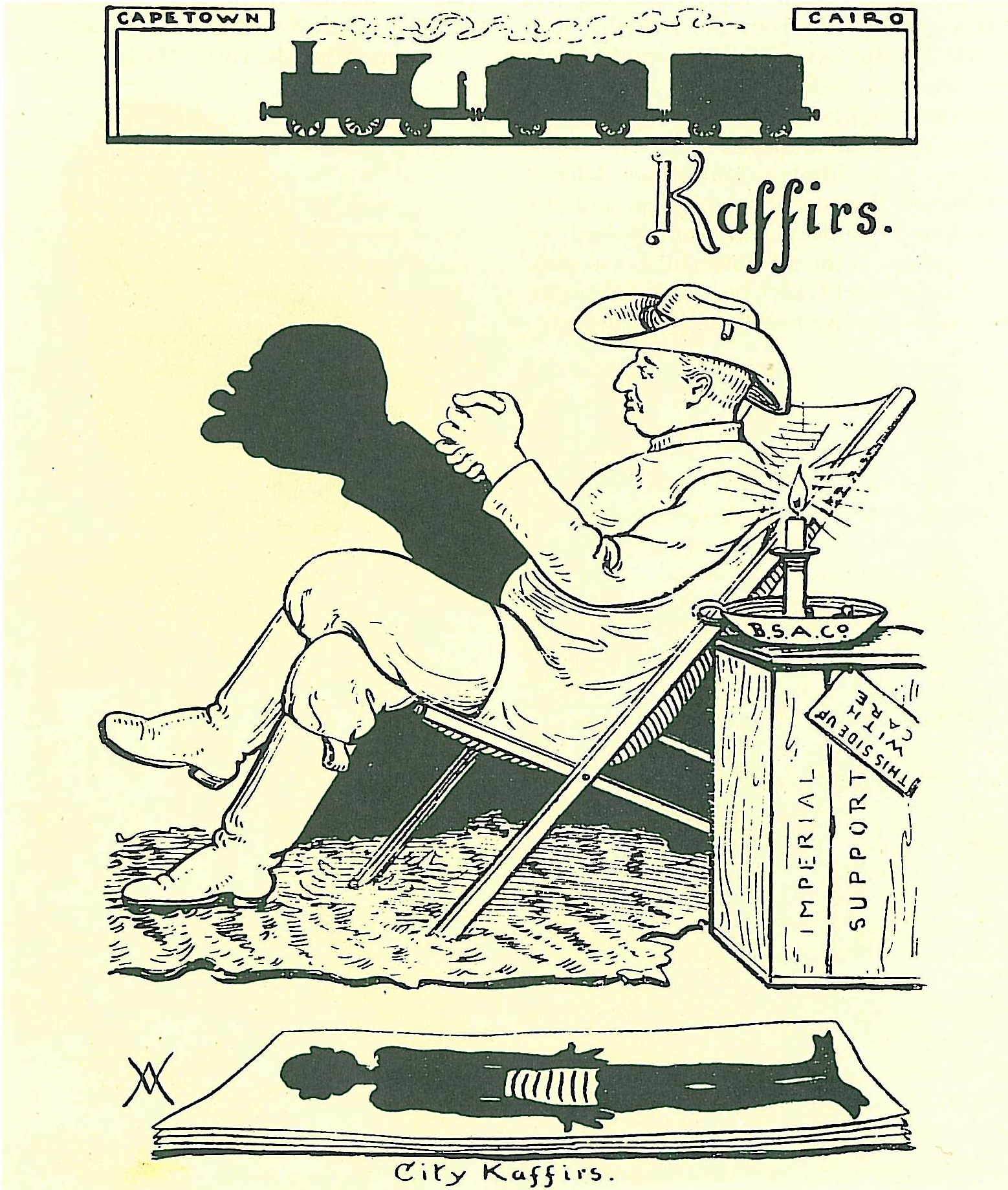
Cecil John Rhodes was a central figure in the expansion of British influence in southern and central Africa during the late nineteenth century. A financier, imperial strategist, and founder of the British South Africa Company (BSAC), Rhodes pursued a vision of territorial acquisition that extended from the Cape to Cairo. His strategy combined commercial ambition with political negotiation, and his agents were tasked with securing mineral rights, land concessions, and administrative control across vast regions.
In a contemporary cartoon, Rhodes is depicted dreaming of linking Africa from end to end by manipulating “Kaffirs”—a term used in European circles both for African labourers and for South African mining shares. The word itself originated in Arabic, where kāfir referred to a non-believer. Arab traders applied the term broadly to non-Muslims, and over time it became associated with Black Africans. European settlers adopted the term during the colonial period, and in racially divided South Africa it evolved into a pejorative slur. Simultaneously, “Kaffir” became a shorthand in financial circles for shares in South African mining companies, particularly those operating in the goldfields around Johannesburg. “Kaffir shares” were speculative instruments traded on London markets, and their volatility mirrored the uncertainties of colonial extraction. The cartoon’s double meaning—labour and capital—reflected Rhodes’s dual interest in controlling both African bodies and imperial finance.
Rhodes’s interest in the territory north of the Zambezi was initially driven by the hope that the gold seams of Southern Rhodesia extended further north. His representatives signed mining concessions with chiefs such as Lewanika of Barotseland, and the BSAC gradually expanded its influence through treaties and limited military action. The collapse of Lobengula’s kingdom in the Matabele and Mashona War of 1893–94 encouraged further expansion. Rhodes’s agents applied similar methods in the north, securing mineral rights and establishing administrative posts.
By 1911, the BSAC had amalgamated its northern territories into a single unit named Northern Rhodesia. Though Rhodes himself had died in 1902, the Company he founded continued to operate under the framework he had established. Northern Rhodesia was administered by BSAC officials until 1924, when the British government revoked the Company’s charter and assumed direct control. The territory became a protectorate, but its boundaries, infrastructure, and legal codes had been shaped by Rhodes’s vision and the Company’s operations.
Rhodes’s legacy in Northern Rhodesia was not confined to ideology or personality. It was embedded in the mechanisms of chartered rule: concessionary governance, extractive economics, and the fusion of private capital with imperial authority. The image of Rhodes manipulating “Kaffirs”—whether as labourers or as stock—captures the essence of his project: a system in which African territory was subordinated to metropolitan finance, and where the instruments of empire were as likely to be railway lines and share certificates as they were rifles and treaties.

