

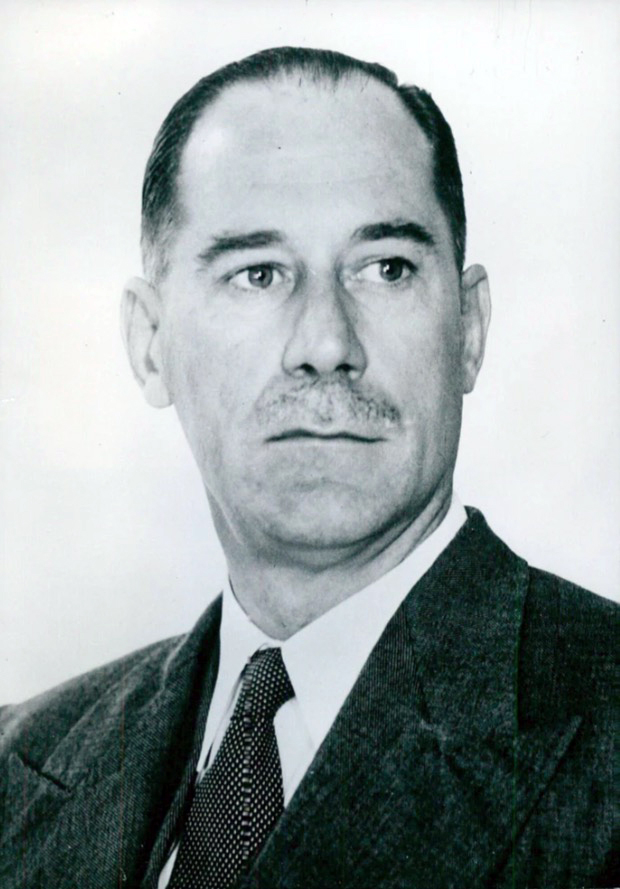
Sir Arthur Edward Trevor Benson, a career colonial administrator with prior service in Nigeria and the Central African Council, was appointed Governor of Northern Rhodesia in May 1954. His tenure lasted until April 1959, a period marked by mounting nationalist agitation, constitutional uncertainty, and growing tensions within the Federation of Rhodesia and Nyasaland. Benson’s governorship was defined by his cautious approach to reform, his resistance to external political pressure, and his efforts to maintain colonial authority amid escalating unrest.
During Benson’s administration, Northern Rhodesia was drawn deeper into the political orbit of the Federation, dominated by settler interests and the assertive leadership of Sir Roy Welensky. Benson frequently found himself at odds with Federal authorities, particularly over the use of military force and the pace of constitutional change. His correspondence and public statements reveal a growing frustration with London’s deference to Salisbury, and a belief that African discontent was being fuelled not by radicalism, but by the perceived abdication of British responsibility.
In 1959, Benson faced the most serious crisis of his governorship. Widespread riots and disturbances erupted across Northern Rhodesia and neighbouring Nyasaland, where a plot to assassinate the Governor and senior officials was uncovered. Troops and police from Southern Rhodesia were dispatched to restore order, but their presence provoked further unrest. Benson banned the African National Congress (ANC) in Northern Rhodesia, citing security concerns and the need to prevent coordinated insurrection. His decision was controversial, and reflected the broader colonial strategy of containment rather than engagement.
In a widely quoted statement, Benson warned that Africans “…will reject any North Rhodesian Constitution which does not give them the casting vote on the question of secession.” He argued that the British Government was increasingly blamed for failing to stand up to Federal pressure, and that this failure was driving support for nationalist leaders. “Britain has abdicated: we won't be ruled by Salisbury,” he declared, capturing the mood of alienation among African communities. Benson’s remarks were echoed by Kenneth Kaunda, who rejected the notion that Federal troops had a calming influence, insisting that their presence only deepened the sense of occupation and resistance.
Throughout the crisis, Benson maintained that Federal authorities had acted unilaterally, calling up Territorial troops without his consent and undermining the constitutional role of the Governor. His correspondence with the Colonial Office reveals deep mistrust of Federal intentions and a belief that only direct British intervention could restore legitimacy. Benson’s governorship thus ended in a climate of suspicion and unrest, with the colony poised on the edge of political transformation.
By the time Benson left office in April 1959, Northern Rhodesia was entering a new phase of nationalist mobilisation. His successor, Sir Evelyn Hone, would inherit a colony in flux, where the structures of colonial rule were being challenged by increasingly organised African political movements. Benson’s legacy was one of principled caution, marked by his refusal to yield to settler pressure and his insistence on constitutional propriety, even as the ground shifted beneath him.
Picture: Sir Arthur Benson, Governor of Northern Rhodesia, 1954–1959.

