

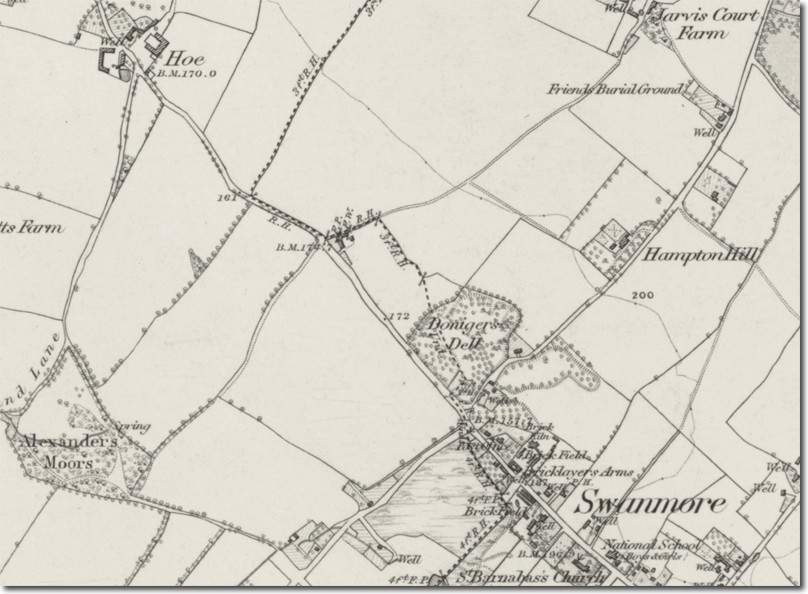
Swanmore lies on the western side of the Meon Valley. Its origins go back to the early medieval period. In the sixth century a Jutish population from Denmark settled in this part of Hampshire. One of their groups, known as the Meon, gave their name to the river and probably established the first settlement on the site of the modern village.
The name Swanmore derives from the Old English mere, meaning a pond. It refers to a swan pond, possibly one maintained by the Bishop of Winchester. In the Middle Ages swans were reserved for high-status households and were eaten alongside peacocks, herons and cormorants.
At the time of Domesday in 1086 Swanmore was too small to appear as a separate entry and was included under Droxford. It remained part of Droxford for administrative purposes until 1894. The surrounding landscape formed part of the Forest of Bere, which stretched from the Sussex border to Winchester.
Throughout the Middle Ages Swanmore formed part of the Bishop of Winchester’s estates. The land was organised into tithings and small manorial holdings. Much of the area consisted of woodland, rough grazing and small clearings. Settlement was dispersed, with farmsteads and cottages grouped loosely around tracks rather than a single nucleated centre.
The earliest houses were simple structures of timber framing with wattle-and-daub infill and thatched roofs. Windows had wooden shutters rather than glass. In the late sixteenth and seventeenth centuries living standards improved and many dwellings were rebuilt in brick with chimneys and glazed windows.
A hearth tax survey of the 1660s recorded forty-six houses in Swanmore, indicating a population of about two hundred and twenty. Only one householder had eight hearths. A small number had between four and five. Most had one or two and sixteen were exempt from the tax through poverty. The figures show a typical seventeenth-century rural community with a substantial proportion of poor households.
A Quaker burial ground was established at Hampton Hill in the late seventeenth century. The first burial took place in 1667 and the last in 1703. Twenty-seven people were interred there. Holywell House was built in the late eighteenth century.
By the eighteenth century Swanmore consisted of scattered farms and cottages along what are now Church Road, New Road and Hampton Hill. The Rising Sun served as a coaching inn on the route between London and Southampton. The landscape was dominated by small fields, orchards and woodland.
In the nineteenth century the population increased steadily. Brickmaking became an important local industry, using the clay deposits around the village. Several small brickworks operated during the century and into the early twentieth century. The industry declined in the 1930s. Market-gardening and orchards were also significant local activities.
Until the mid-nineteenth century Swanmore had only a chapel and remained too small to form a parish. St Barnabas Church was built in 1845–46 and a south aisle and tower were added in 1876–77. A Methodist chapel was erected in 1863 and a Baptist presence developed later in the century. The new church encouraged the growth of a more recognisable village centre along Church Road.
Swanmore House was built for Charles Myers but he died before its completion in 1880. Stephen Butler Leacock, later known as a writer and economist, was born in the village in 1869. A National School was built in 1864 and enlarged in the 1880s. Additional classrooms were added in 1964 and further rebuilding took place between 1969 and 1971. A secondary school opened in 1961 and became a comprehensive in 1973.
In the early twentieth century Swanmore remained a largely self-sufficient rural settlement. Gas and electricity did not arrive until the 1930s. A memorial cross to those who died in the First World War was erected in 1921. The Bishop’s Waltham branch railway, opened in the nineteenth century, provided access to the wider area until its closure in the mid-twentieth century.
From the 1960s the population grew rapidly. In 1961 it stood at about twelve hundred and by 1974 had reached two thousand. Housing estates were built on former farmland and orchards. A new village hall was constructed in 1980. The Paterson Centre followed in 1989, named after Ron Paterson, vicar of Swanmore from 1962 to 1985. In 1993 the village was twinned with Maneglise in Normandy.
Modern Swanmore is a residential community with a general shop, post office, hairdresser and three public houses. Many residents commute to Portsmouth or Southampton. The present population is around three thousand.

