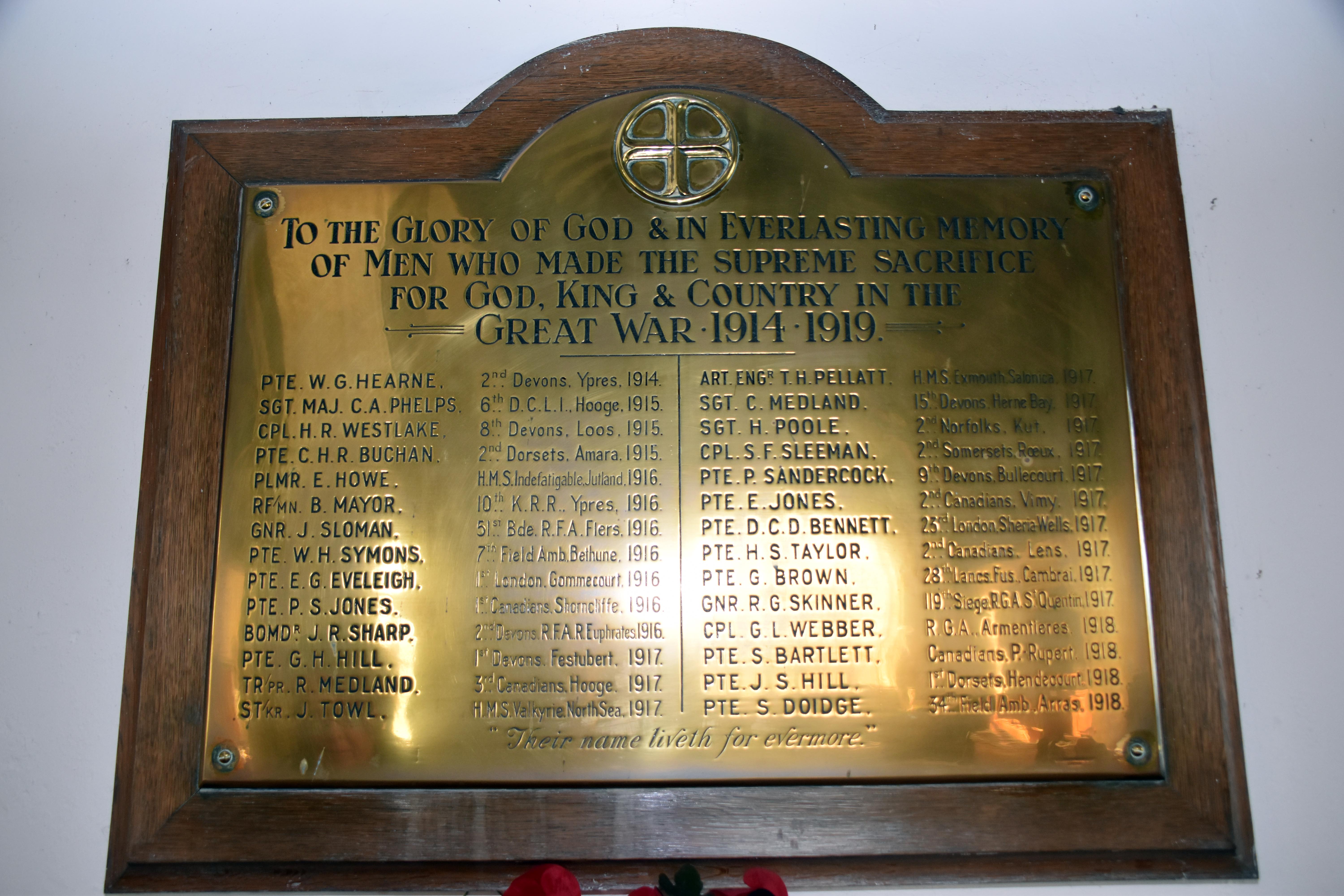
One of the more unusual features of the war memorial in St Thomas Church is that it does not simply record the names of the men who never returned from the First World War. It also records where they died. As a result, what initially appears to be a straightforward roll of honour becomes a miniature history of the war itself. Reading down the list you move from the desperate fighting around Ypres in 1914 through Hooge, Loos, Amara, Jutland, Flers, Gommecourt, the Euphrates, Vimy, Bullecourt, Cambrai and Arras before eventually reaching the final casualties of 1918. The memorial also reveals something rather unexpected about Newport. Although this is a Cornish parish, only one of the men appears to have served in the Duke of Cornwall's Light Infantry. The Devonshire Regiment dominates the list instead, whilst others served with the Dorsets, Somersets, Norfolks, Lancashire Fusiliers, Royal Field Artillery, Royal Garrison Artillery, London Regiment, Canadian forces and Royal Navy. Looking at the variety of regiments and locations, it becomes obvious that this small community beside the Kensey contributed men to almost every major theatre of the conflict.
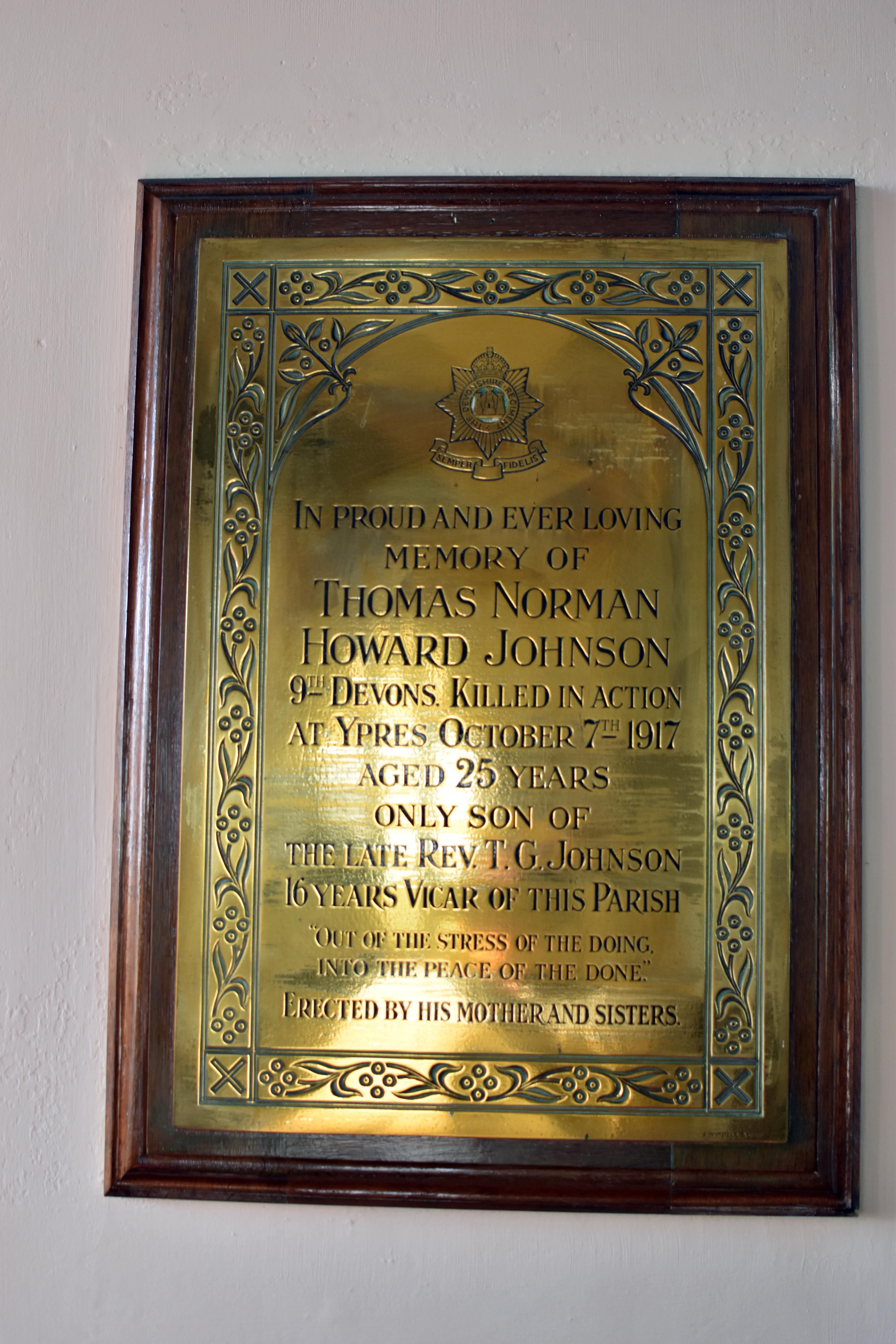
The church also contains a separate memorial to Thomas Norman Howard Johnson of the 9th Devonshire Regiment who was killed at Ypres on 7 October 1917 at the age of twenty-five. The plaque records that he was the only son of the Reverend T.G. Johnson, who had served as vicar of the parish for sixteen years. Whilst the main memorial inevitably turns the dead into a list of names, this smaller plaque reminds us that each name represented an individual tragedy. Johnson's family felt his loss so keenly that they erected an individual memorial beside the larger parish tribute, ensuring that more than a century later visitors to the church still stop to read his story.
What particularly struck me was the geographical range represented on a single memorial. Men from Newport died in Belgium, France, Mesopotamia, Palestine, Greece and the North Sea. One sailor was lost aboard HMS Indefatigable at Jutland. Another died aboard HMS Valkyrie in the North Sea. Others fell at some of the most famous battlefields of the war including Loos, Vimy Ridge, Bullecourt, Cambrai and Arras. It is easy to forget that places such as Newport were connected to events taking place thousands of miles away. The memorial is a stark reminder that a conflict fought across continents was felt just as deeply in the streets surrounding St Thomas Church.
Names recorded on the Great War Memorial
W.G. Hearne, 2nd Devonshire Regiment, Ypres, 1914.
C.A. Phelps, 6th Duke of Cornwall's Light Infantry, Hooge, 1915.
H.R. Westlake, 8th Devonshire Regiment, Loos, 1915.
C.H.R. Buchan, 2nd Dorsetshire Regiment, Amara, 1915.
E. Howe, HMS Indefatigable, Jutland, 1916.
B. Mayor, 10th King's Royal Rifles, Ypres, 1916.
J. Sloman, 51st Brigade Royal Field Artillery, Flers, 1916.
W.H. Symons, 7th Field Ambulance, Béthune, 1916.
E.G. Eveleigh, 1st London Regiment, Gommecourt, 1916.
P.S. Jones, 1st Canadians, Shorncliffe, 1916.
J.R. Sharp, 2nd Devons attached Royal Field Artillery, Euphrates, 1916.
G.H. Hill, 1st Devonshire Regiment, Festubert, 1917.
R. Medland, 3rd Canadians, Hooge, 1917.
J. Towl, HMS Valkyrie, North Sea, 1917.
T.H. Pellatt, HMS Exmouth, Salonica, 1917.
C. Medland, 15th Devonshire Regiment, Herne Bay, 1917.
H. Poole, 2nd Norfolk Regiment, Kut, 1917.
S.F. Sleeman, 2nd Somerset Light Infantry, Roeux, 1917.
P. Sandercock, 9th Devonshire Regiment, Bullecourt, 1917.
E. Jones, 2nd Canadians, Vimy, 1917.
D.C.D. Bennett, 23rd London Regiment, Sheria Wells, 1917.
H.S. Taylor, 2nd Canadians, Lens, 1917.
G. Brown, 28th Lancashire Fusiliers, Cambrai, 1917.
R.G. Skinner, 119th Siege Battery Royal Garrison Artillery, St Quentin, 1917.
G.L. Webber, Royal Garrison Artillery, Armentières, 1918.
S. Bartlett, Canadians, 1918.
J.S. Hill, 1st Dorsetshire Regiment, Hendecourt, 1918.
S. Doidge, 34th Field Ambulance, Arras, 1918.
Separate Memorial
Thomas Norman Howard Johnson, 9th Devonshire Regiment, Ypres, 7 October 1917.