

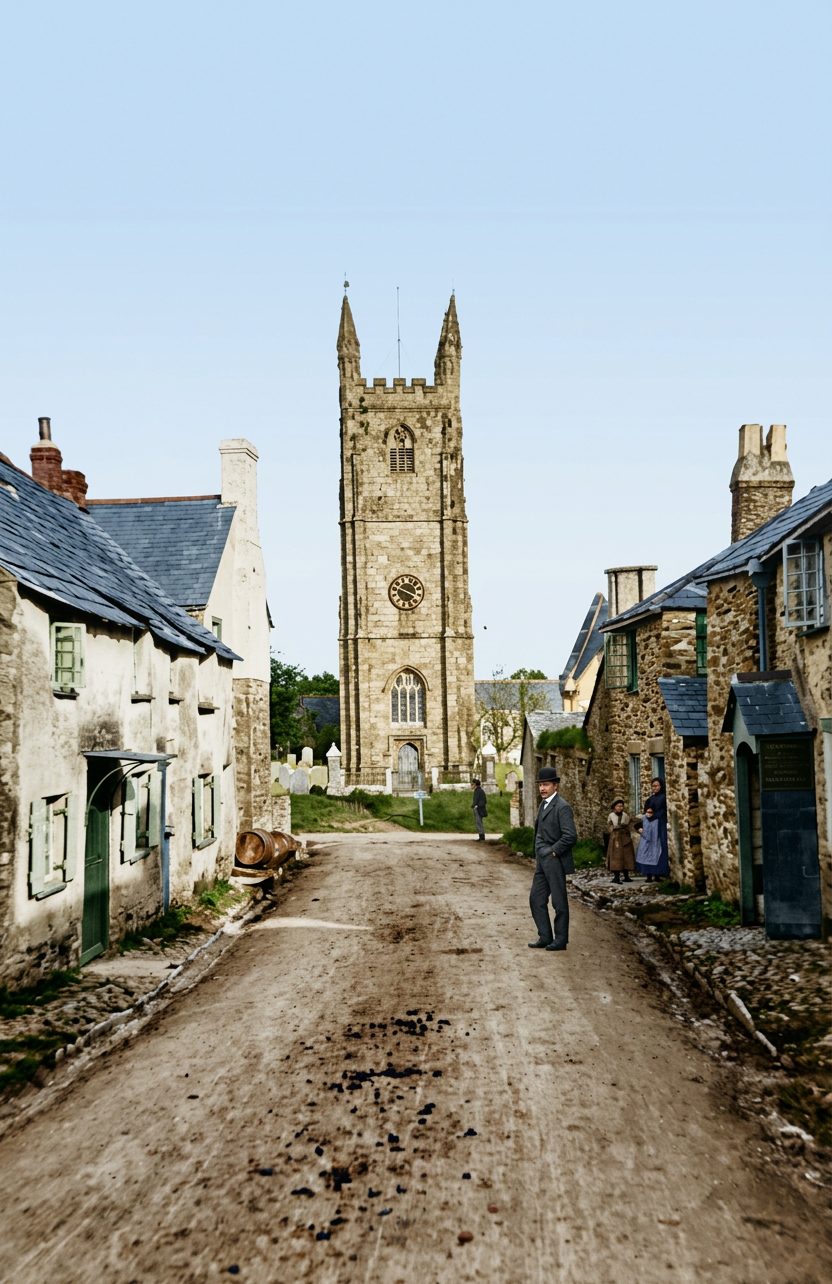
When Lanson was a fuzzy down, St Stephens was a market town. The old rhyme carries the truth of the place, for long before the Norman fortress rose on the opposite hill, St Stephens was the centre of commerce and religion, the Saxon burh and mint of Cornwall. A church dedicated to St Stephen has stood on this height since the tenth century, its presence shaping the settlement that gathered around it.
The present church was built in the early thirteenth century, though its foundations reach deeper into the early medieval past. Around 1100 the collegiate house of St Stephen was converted into a foundation of regular canons. Some forty years later it stood amid the turbulence of King Stephen’s reign, when the tower was destroyed by the Earl of Cornwall after being used as a currency store. The canons withdrew to the valley of the Kensey and built their new priory beside the river in 1155. The hill church was re‑consecrated in 1259, and its tower rebuilt in the early sixteenth century through the legacy of forty marks left by Dame Thomasine Percival, Lady Mayoress of London, once Thomasine Bonaventure of Week St Mary. Legend insists that she required the pinnacles to be large enough to be seen from her birthplace twelve miles away at Swannacott Farm.
The church itself is a characteristic Cornish structure, built of local stone with a battlemented tower rising above the surrounding village. The late‑medieval rebuilding left its mark in the crenellated parapet, the traceried windows and the sturdy granite walls that define the nave and aisles. The south porch retains its moulded timbers and studded doors, while the interior holds a mixture of medieval and later work: the carved stone font, the surviving fragments of the rood screen, and memorials to parish families whose names recur across centuries. The churchyard spreads around the building, containing slate headstones, Celtic crosses and eighteenth‑century memorials that speak of the long continuity of worship on the site.
The church remained the heart of its community. The village gathers around and below it, its cottages and farmhouses pressed close to the slope. Formerly under the Duke of Northumberland’s estates, many of the dwellings are more than two centuries old. Northumberland House was once an inn; Duke Street and North Street still carry the pattern of Cornish stone cottages that grew from the medieval settlement.
By Act of Parliament in 1540, the privilege of sanctuary was restricted to eight places in England, and St Stephens was one. A fugitive who reached its doors was legally protected unless charged with sacrilege or treason. Life‑long protection could be granted if the refugee undertook to leave the realm within forty days. The law endured until the early seventeenth century, and the church’s shadow was a literal refuge for the desperate.
In 1883 a vault was uncovered beneath the choir floor, containing members of the Morth family of Dutson Farm. Two coffins measured nine feet in length, giving rise to the local question of whether giants had once lived at St Stephens. A slate slab now covers the site, carved with a great cross and the letters IHS, the date still legible.
The road that leads to the Holy Well was once called Holy Road, now Gallows Hill. The name recalls the rising ground where the well stands and where felons were hanged. The reason for executions here—so far from the county gaol at the castle—is uncertain, yet records confirm that several punishments were carried out on this slope. The well, formerly known as Shalder’s Well, was enclosed and roofed in 1825, its water still clear beneath the stone.
Thus St Stephens endures: a Saxon foundation reshaped by Norman power, rebuilt by Tudor charity, and surrounded by the quiet persistence of its village. The rhyme remains its truth, echoing across the valley—when Lanson was a fuzzy down, St Stephens was a market town.

