St Sampson was one of the great missionary saints of the early Celtic church, remembered for his travels between Wales, Cornwall and Brittany in the sixth century. His name is still found across the western seaboard — in churches, chapels and holy wells — but few places preserve his memory as clearly as Golant, where the parish church stands on the hillside above the Fowey estuary. The building is dedicated to him, and the holy well beside the porch is said to mark the spot where he first settled, erecting a temporary shelter and beginning his ministry in the valley below.
According to tradition, Sampson arrived in Cornwall after studying in Ireland and spending time in Wales. He followed the route now known as the Saints’ Way — a pilgrimage path that runs from Padstow to Fowey, avoiding the dangerous seas around Land’s End. Golant lies near the end of that route, and would have been a natural stopping point for missionaries heading to Brittany. The story goes that Sampson killed a serpent by the river here, and a cave near the water is still pointed out as the place where it lived. Whether or not the tale is literal, it reflects the kind of symbolic victories often attributed to early saints — triumphs over paganism, danger, or spiritual darkness.
The church at Golant is one of the few in Cornwall where a holy well is built directly into the structure. The architects clearly considered it important: the well is accessed through a narrow walkway in the porch, and its presence suggests that Christian worship on this site began with the spring itself. In the early medieval period, wells were often the first sacred places, and churches were built around them as communities grew. Sampson’s association with the well gives Golant a strong claim to being one of the oldest continuous places of worship in the region.
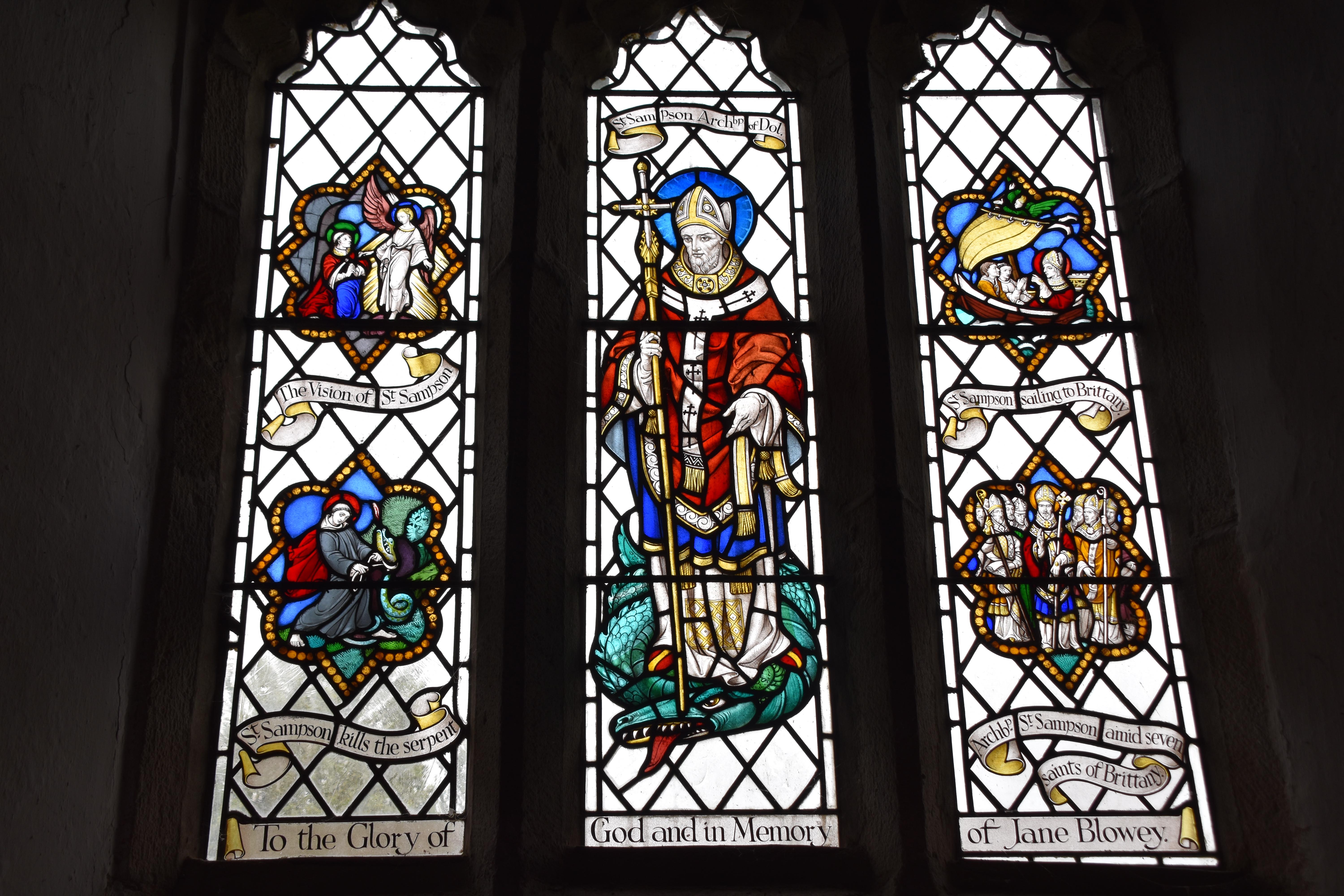
Inside the church, the connection to Sampson is made visible in the stained glass window behind the organ case. It shows him learning the call to preach, killing the serpent, sailing to Brittany to convert the people, and blessing the seven saints of Brittany. The central panel depicts him as Archbishop of Dol, the role he held in later life. These scenes link Golant not just to Cornwall’s Christian past, but to the wider network of Celtic saints who moved between Britain and Armorica in the sixth century. Sampson was one of the most prominent among them, and his legacy in Golant reflects that status.
When the Benedictines arrived in Golant, the church became a ‘church of alien monastic authority’, tied to the Priory at Tywardreath. But after a long dispute over money, Bishop Oldham intervened and in 1509 consecrated the church to St Sampson, making it independent. That act formalised a dedication that had likely existed for centuries, and it preserved the link between the building and the saint whose name it bears. Today, the church remains a quiet but enduring reminder of Sampson’s presence in the valley — a place where the stories of early Christianity still shape the landscape.
For visitors walking the Saints’ Way, or simply exploring the Fowey valley, Golant offers a rare chance to stand in a place where legend, history and geography meet. The church, the well, and the river below all speak to a time when saints travelled by foot, carrying their message from one coast to another. St Sampson’s story may be old, but in Golant it still feels close to the ground.