

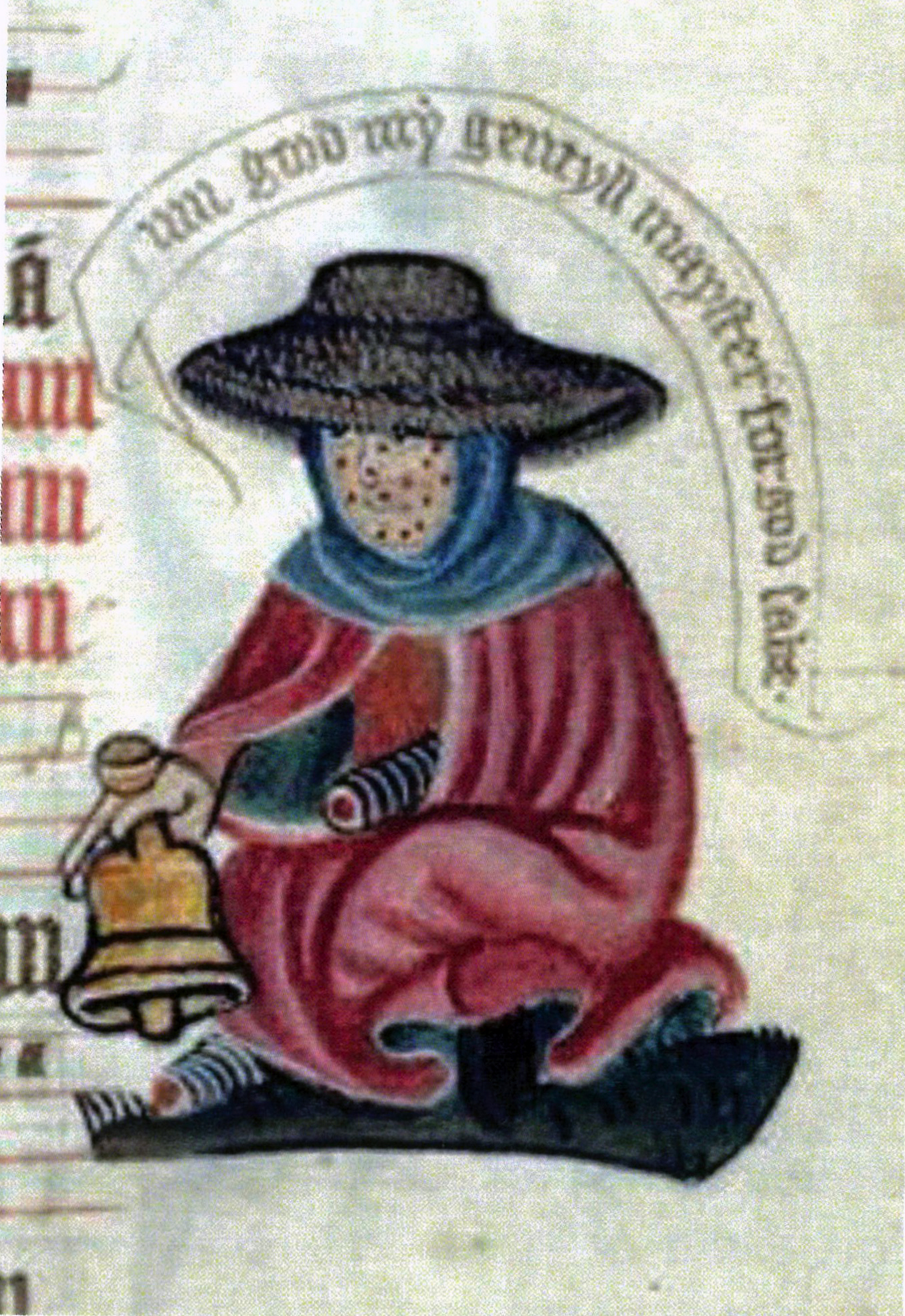
The story of St Leonard's Leper Hospital cannot really be separated from either St Thomas Church or St Stephen's Priory. Leprosy, or Hansen's Disease as it is now known, was one of the most feared diseases of the medieval world. Although medieval people had little understanding of how it spread, its visible symptoms made it particularly alarming. Yet Christianity placed a special obligation upon society to care for lepers. Christ's interactions with lepers in the Gospels ensured that, whilst sufferers might be segregated, they could not simply be abandoned. The result was a network of leper hospitals across England that attempted to provide both physical care and spiritual support for those afflicted by the disease.
The Kensey Valley appears to have had connections with leprosy long before the establishment of St Leonard's itself. There is evidence that lepers may originally have been accommodated somewhere in Newport and it has often been suggested that the curious low window in the west tower of St Thomas Church served as a leper window through which sufferers could observe Mass without entering the church itself. Whether that interpretation is correct remains a matter of debate amongst historians, but there is little doubt that St Thomas and the nearby priory played an important role in ministering to lepers. The discovery of the early sixteenth-century wall painting of St Roche within the church is also suggestive. St Roche was widely associated with plague and disease and was often invoked by those suffering from contagious illnesses. His presence within St Thomas hints at a long-standing local awareness of such afflictions.
During the later twelfth century attitudes towards leprosy were hardening throughout Europe. Church councils increasingly favoured the separation of lepers from the general population whilst still insisting that they should be cared for and supported. It appears that Robert Fissacre, Prior of St Stephen's, was instrumental in establishing a purpose-built leper hospital dedicated to St Leonard at the eastern end of the Kensey Valley. The location was carefully chosen. It lay outside the main settlement but remained close enough for spiritual oversight and practical assistance from both the priory and the church at St Thomas. Significantly, it was also positioned near the approach to Polson Bridge, one of the principal crossing points between Cornwall and Devon.
Although often referred to as a hospital, St Leonard's would not have resembled a modern medical institution. Medieval medicine offered little in the way of effective treatment for leprosy. Instead the hospital functioned as a religious and charitable community providing accommodation, food, spiritual care and a measure of security for its residents. Documentary evidence suggests that it possessed its own chapel and cemetery. Unfortunately, exactly what the buildings looked like remains uncertain. Whether the residents occupied individual houses or lived communally is not known. The probable site was largely destroyed during nineteenth-century development and no detailed archaeological investigation was undertaken at the time.
The hospital was supported through a combination of charitable donations, grants and endowments. The Duchy of Cornwall appears to have provided support during its early history, whilst later records show involvement by Launceston after the town received borough status in 1383. Families would also contribute towards the upkeep of relatives living there where they were able. Contrary to popular belief, lepers were not prisoners. Residents could leave the hospital and often did so. Indeed, one of the principal means by which hospitals such as St Leonard's supplemented their income was through begging. Medieval Christians considered the giving of alms to be both a charitable act and a means of improving their own spiritual standing. The location of St Leonard's close to Polson Bridge therefore made considerable sense. Travellers moving into and out of Cornwall provided a steady stream of potential donors.
The image of lepers as complete outcasts is therefore somewhat misleading. Whilst they certainly faced fear and discrimination, they continued to maintain connections with wider society. Relatives visited them, religious services were conducted for them and charitable gifts were regularly provided for their support. The warning bell traditionally associated with lepers was as much a means of drawing attention to their presence as it was of encouraging people to keep their distance. Society regarded them with a mixture of fear, pity and religious duty rather than simple rejection.
St Leonard's continued operating for centuries after its foundation. This longevity is perhaps its most remarkable feature. Whilst many medieval institutions disappeared during periods of economic hardship or political upheaval, St Leonard's persisted. By the seventeenth century, however, leprosy itself was becoming increasingly rare in England. Improved living conditions, better diets and changing patterns of disease gradually reduced the number of sufferers. As the need diminished, so too did the purpose of the hospital. By the end of the seventeenth century St Leonard's had effectively ceased to function. Unlike the dramatic closure of a monastery during the Reformation, its disappearance appears to have been a gradual process reflecting the decline of the disease it had been created to combat.
Today almost nothing remains visible of the hospital itself. Ironically, one of the few reminders is the name of the modern St Leonard's water treatment works that occupies part of the area. Yet the influence of the institution survives through the documentary record, through archaeological discoveries and through its links with St Thomas Church. The priory that helped establish it has disappeared and the hospital itself has long vanished, but together they reveal an aspect of medieval society that is often overlooked. The existence of St Leonard's demonstrates that even those suffering from one of the most feared diseases of the age were not simply abandoned. Instead a substantial institution was maintained for their care for roughly five centuries, making it one of the more enduring examples of medieval charity in Cornwall.

