

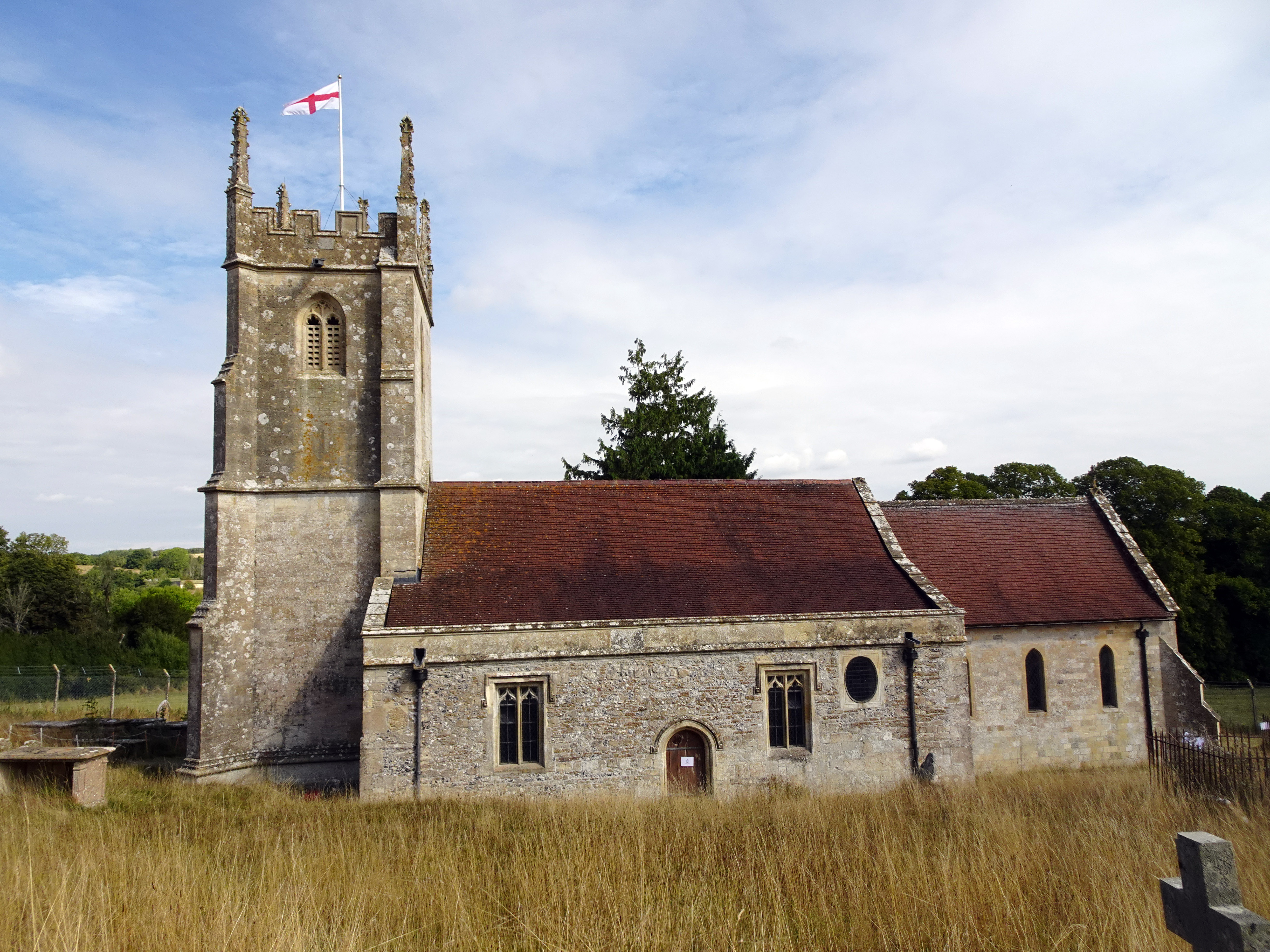
Walking into Imber, the ghost village on Salisbury Plain, one building still draws you in: St Giles Church. Dressed limestone and flint catch the changing light, while a tiled roof with coped verges and cross finials frames the skyline. The north porch is your welcome — a gabled, battlemented entry with a moulded pointed doorway and diagonal buttresses rising to crocketed corner pinnacles. Sit on the fixed stone benches and run a hand along the heavily moulded Tudor‑arched inner doorway; its hoodmould ends in lozenge terminals, a shield to the left and a quatrefoiled rosette to the right. To the right, the cusped stoup once held holy water; above and around, faint traces of historic graffiti suggest the hands of 17th‑century villagers who stood where you’re standing now.
Inside, the nave opens in three bays beneath a late‑medieval arch‑braced collar rafter roof, its tie‑beams and carved bosses once hidden under plaster. The late‑13th‑century north and south arcades carry double‑chamfered pointed arches on cylindrical piers with moulded capitals; look closely for the red‑tinted traces of medieval paint on the arches and wall above. The tower arch is tall and confident, and a depressed doorway leads to stone newel stairs climbing the two‑stage Perpendicular tower outside — a Corsham‑stone statement of c.1400, with heavy plinth, diagonal buttresses, Tudor‑arched west doorway, battlemented parapet, and corner pinnacles. On the north, a stair turret pricks the sky with crocketed pinnacles and tiny chamfered arrow loops, more castle than church in mood.
The aisles whisper their own stories. In the south aisle, a trefoil‑headed piscina marks the ritual heart of communion; a blocked doorway with an inverted arch suggests centuries of rearrangement. In the north aisle, the treasure is visual: late‑medieval wall paintings — St Giles, Avarice from the Seven Deadly Sins, and the weighing of souls — brought back to view when the limewash was stripped in 1849, with traces of the Lord’s Prayer and a decorative border lingering like breath on stone. Nearby, reset medieval heads of a king and bishop peer over the vestry window; the chancel, rebuilt in 1849, carries a polychrome tiled floor and a braced rafter roof with diagonal ribs, culminating in a three‑light east window of interlaced tracery whose hoodmould ends in king and queen masks. Even the bell‑ringers speak across time: a painted mural on the tower’s north wall, dated 1692, its gabled panels and red figures a rare post‑Reformation survival, though partly erased.
The monuments and floor slabs keep names in the room: the unfinished tablet to Thomas Ayliff with its absent lettering; the white‑marble memorials to Elizabeth Ballard (1786), John Wadman (1745) with urn and cartouche, and Johannis Offer (1822), signed by Reeves of Bath; ledger stones for Sarah Harris (1663) and John Wadman (1688). Yet the church is also shaped by loss. After the village’s evacuation in 1943 to train American troops for D‑Day, the fittings were dispersed: the Norman font to Brixton Deverill, the pulpit to Winterbourne Stoke, seating, bell, and two effigies to Edington. In 2005, declared redundant and vested in the Churches Conservation Trust, St Giles underwent careful repairs — masonry, roofs, drainage, windows, wall paintings — a conservation lullaby for a building that once held a parish and now holds memory.
Step back outside and the building settles into its landscape: a north aisle with square‑headed two‑light windows and cusped lights flanking the porch; a lean‑to vestry with shouldered doorway; a chancel with north lancet and three south lancets; a south aisle with blocked moulded doorway, ogee‑cusped two‑light windows, an 18th‑century oeil‑de‑boeuf, and a fine Perpendicular three‑light to the east, the west end partly rebuilt in brick in the 18th century. For most of the year, the church sits closed, sentinel over empty lanes and training ranges. Then, a few days a year and again at Christmas, doors open, light pours through tracery, and voices return — brief, resonant, enough to remind you that St Giles is more than fabric. It’s a place where devotion, displacement, and endurance share the same stone.
St Giles is not usually open to the public. Access is tied to the Ministry of Defence’s control of Imber village, and the church can only be visited during limited open days when the ranges are made safe. These rare occasions — an annual September service and a Christmas carol concert — transform the locked and silent building into a living place of worship once more, drawing visitors who come to honour both its history and its survival.

