In a quiet corner of the church hangs a modest brass plaque commemorating Lieutenant Ronald “Roy” Gundry Carnall of the Machine Gun Corps. It is a simple memorial — a plain rectangular plate mounted on a wooden backboard, the family crest tucked neatly into the corner — but behind its economy of words lies a story that stretches from the banks of the Fowey to the battlefields of the Somme. Carnall was born in Golant on 7 November 1895 and grew up at Lescrow House, a 109‑acre estate overlooking the estuary. He would have known this valley intimately: the lanes, the river paths, the sound of the tide turning below Fowey. It is striking to think that the young officer remembered here once walked the same ground as any visitor to the parish today.
Roy Carnall was the younger son of Archibald and Mary Trevenen Carnall, a family well rooted in the life of the town. Like many young men of his generation, he entered the army early in the First World War and was commissioned into the Machine Gun Corps — a unit that quickly earned the grim nickname “the Suicide Club” because its crews were so often exposed to enemy fire. Carnall served with the 143rd Machine Gun Company, attached to the 48th (South Midland) Division, and spent the whole of 1916 moving through some of the hardest‑fought sectors of the Somme.
The Division’s route through that year reads like a map of the campaign’s most punishing ground: Serre in early July; the Ovillers–Pozieres sector later that month; the Leipzig Salient and Constance Trench in August; Hebuterne in October; and finally, in November, the shattered landscape around Le Sars. It was here, in the final weeks of the Somme offensive, that Carnall was wounded. The main battle had officially ended on 18 November, but the fighting had not. Units were still engaged in bitter local actions as winter closed in, and the Machine Gun Corps bore a heavy share of the strain. Carnall died of his wounds on 29 November 1916, aged just twenty‑one.
He is buried at Dernancourt Communal Cemetery Extension, south of Albert, where many of the men who died in the casualty clearing stations behind the front were laid to rest. The cemetery contains more than two thousand Commonwealth graves from the Somme, and Carnall lies among those who survived long enough to be brought back from the line but not long enough to return home. The inscription on his memorial in the church makes no attempt at embellishment. It simply records his name, his regiment, his parents, the date of his death, and the place where he lies. That plainness is part of its poignancy.
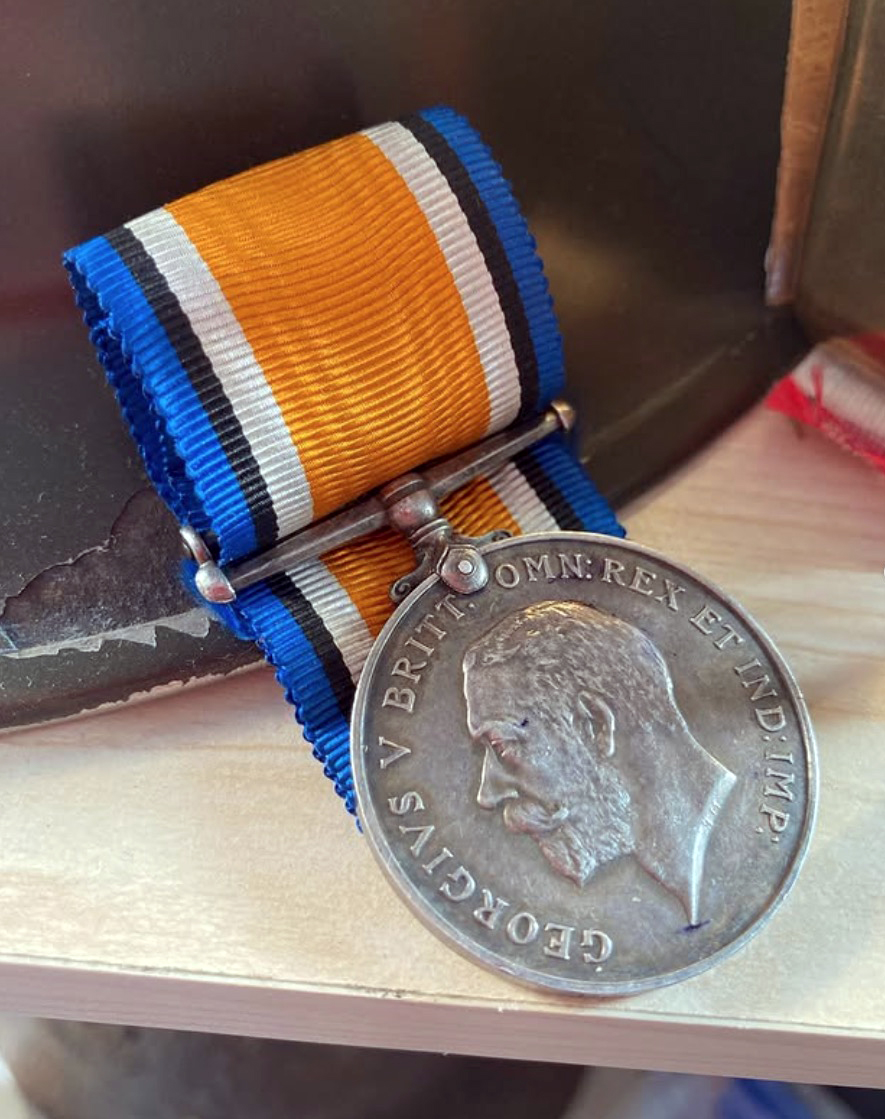
Below there is a photograph of Carnall’s British War Medal from powellmedalsandmilitaria— a simple, handsome piece of silver bearing the profile of King George V. It is the medal issued to all who served overseas during the war, but seeing Carnall’s medal brings the story much closer to home. This was the medal awarded to a young man from Fowey, born in Golant, who grew up at Lescrow House and later found himself in the exposed positions of the Machine Gun Corps.
In the stillness of the church, the Carnall memorial sits among centuries of local history — medieval stonework, Victorian fittings, and the older stories of the Fowey valley. It is a reminder that the First World War reached into every corner of Britain, even into small rural parishes far from the Western Front. Ronald Gundry Carnall’s life was short, but the plaque, the medal, and the landscape he grew up in ensure that his name remains part of the story of the Fowey valley.