

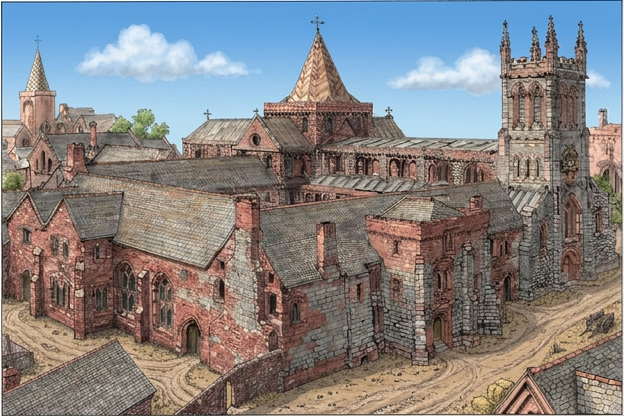
St Nicholas’ Priory is the oldest surviving building in Exeter still in regular public use. It was founded shortly after the Norman Conquest, when William the Conqueror granted the confiscated estates of Gytha, Countess of Wessex, to Benedictine monks from Rouen. The priory was established around 1087 and became one of the most important monastic houses in the city. Its position in the West Quarter placed it close to Fore Street and the medieval commercial district, and its influence extended across the surrounding neighbourhood. The priory church, cloister and domestic ranges formed a substantial complex, much of which has been lost, but the surviving west range preserves significant Norman fabric.
The priory’s early architecture reflects its origins. The surviving Norman walls, round‑arched openings and heavy masonry are characteristic of late eleventh‑century monastic construction. The west range contained the prior’s lodging and guest accommodation, and its layout demonstrates the status of the house within the Benedictine network. The priory was closely associated with St Olave’s Church, which stood in the alley behind and remained under monastic control throughout the medieval period. The monks administered the surrounding estates and maintained a strong presence in the West Quarter.
During the later Middle Ages the priory expanded and adapted to changing circumstances. Additional ranges were built, and the domestic quarters were improved. The priory’s wealth derived from its lands, rents and ecclesiastical income, and it remained a stable institution until the sixteenth century. The Dissolution of the Monasteries brought an abrupt end to its religious life. In 1536 the priory was suppressed, its church demolished, and its buildings converted for secular use. The west range became a private residence, and later alterations transformed it into a substantial Tudor townhouse. Much of the medieval complex was lost, but the surviving structure retained its Norman core.
The building underwent further changes in the seventeenth century. New fireplaces, plasterwork and domestic fittings were added, and the house reflected the tastes of its owners. The surrounding area also changed, with Fore Street remaining a busy commercial thoroughfare. The priory’s name persisted in local usage, and the alley beside the building retained its association with the former monastic precinct. In the nineteenth century the house was divided and adapted for multiple occupants, and parts of the structure fell into disrepair. Despite these changes, the Norman walls and Tudor alterations survived.
In the twentieth century the building was recognised for its historical importance. Restoration work revealed the extent of the surviving Norman fabric and the later Tudor modifications. The west range was opened to the public as a historic house, and archaeological investigation clarified the layout of the original priory. Although the church and cloister have vanished, the surviving structure provides valuable evidence of monastic life in Norman Exeter. The building’s position in the West Quarter, close to the medieval commercial streets, reflects the integration of religious and urban life in the city.
St Nicholas’ Priory remains a significant survival from Exeter’s early Norman period. Its heavy masonry, original openings and later domestic adaptations illustrate the long history of the site. The building stands beside the alley leading to St Olave’s Church, preserving the connection between the two foundations established after the Conquest. Although much of the priory has disappeared, the west range continues to convey the scale and importance of the monastic house that once dominated this part of the city.

