

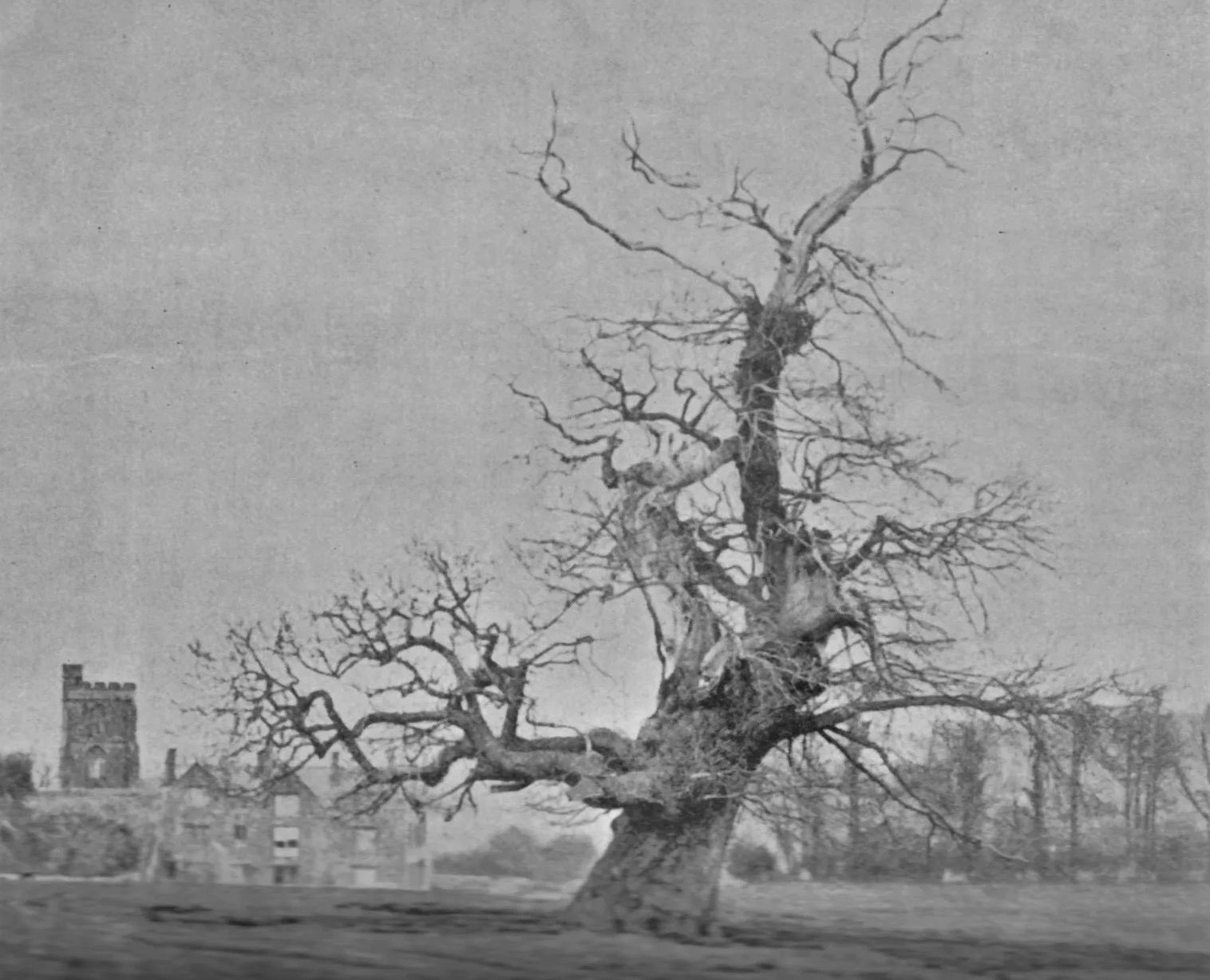
In the field above Whitelackington Manor, with the church tower watching from the background, lie the remains of the great Spanish chestnut known as the Monmouth Tree. Once it stood 49 feet tall, with a girth of 25 feet at mid‑trunk, and—if Hugh Norris is to be believed—may have been planted before the Norman Conquest. It was a landmark in its own right: the sort of tree that gathers stories and people beneath it, a living witness to centuries of quiet village life and sudden drama.
Its fame was sealed in 1680, when James Scott, Duke of Monmouth—illegitimate son of Charles II—visited Whitelackington Manor as the guest of George Speke. A great lunch was held under the spreading shade of the chestnut, and word drew an excited crowd of around 2,000. In the crush, more than 100 metres of palings were pushed down, though the tree itself stood firm. Five years later, after Charles II’s death and the succession of his Catholic brother James II, Monmouth returned to Somerset as a rebel. Loyal to the Protestant cause, George Speke’s eldest son John raised a troop of horse and served as a Colonel. The rebellion failed, and the price the Spekes paid was not a fine but a life: unable to find John, Judge Jeffreys ordered the execution of his younger, politically disinterested brother for the simple crime of having shaken Monmouth’s hand. “This family owes a life,” he said.
The Monmouth Tree survived those turbulent years, only to be brought down two centuries later by a storm that locals long remembered. In the March 1897 issue of Somerset and Dorset Notes and Queries, Hugh Norris recorded that the “grand old Spanish chestnut” was destroyed in a gale on Ash Wednesday, 3 March 1897. The storm began around midnight, rose to hurricane force by 4 a.m., eased briefly, and then returned with full fury by 8 a.m. The decisive blast came at about 9 o’clock in the morning, when the wind from the south‑east levelled many noble trees across South Somerset. It was in that moment that the Monmouth Tree finally fell, ending more than eight centuries of life.
Even in its fallen state, the chestnut’s presence endures. The remains are still visible in the field above the house, lying now on private land, a gnarled relic that binds village to the era of Protestant fervour and rebellion. Though access is restricted, the Monmouth Tree is still remembered in parish histories and local heritage accounts as one of Somerset’s most celebrated landmarks. The manor, the church, and the field form a quiet archive; the Monmouth Tree, even now, links this village to a fascinating page in English history.

