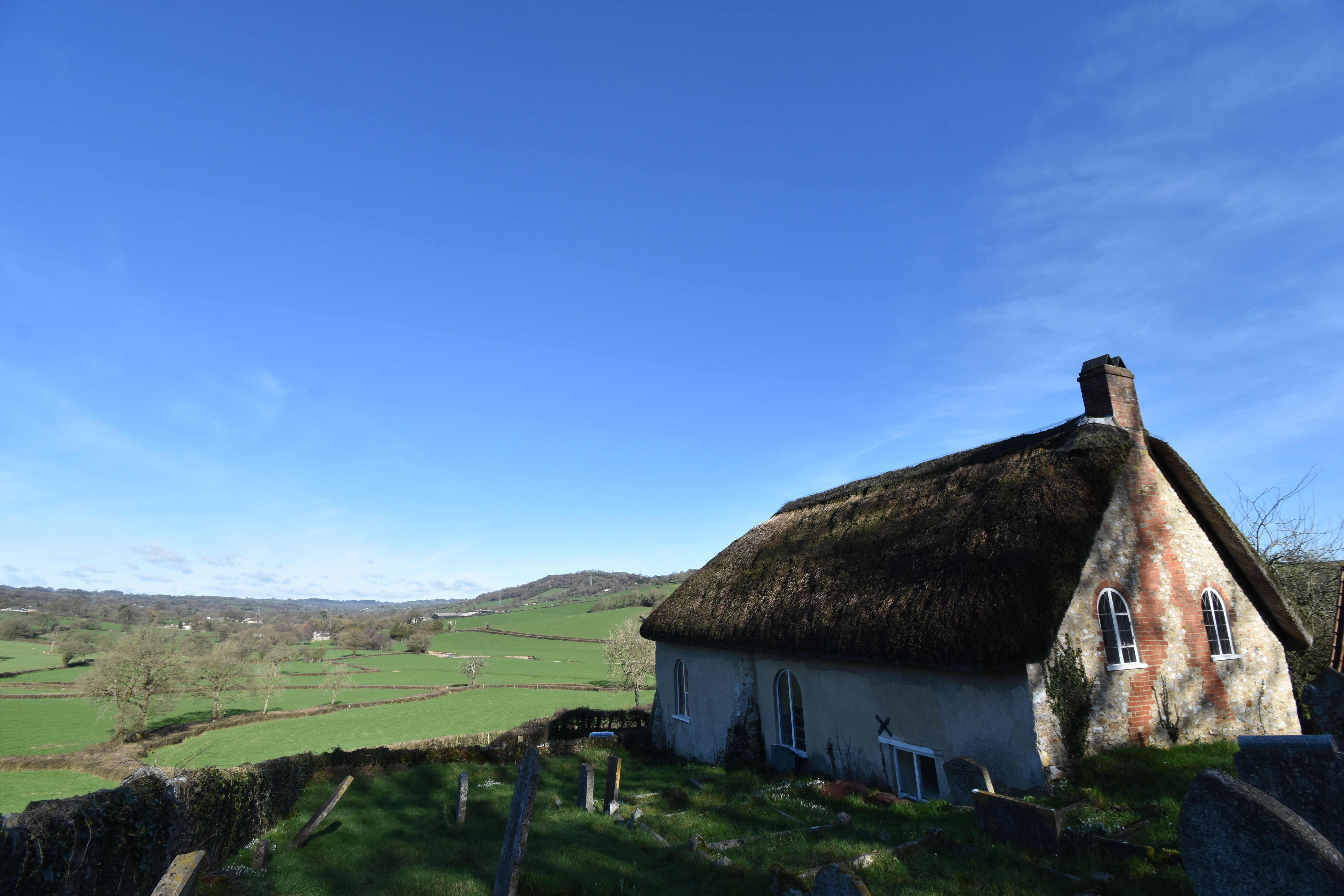
Loughwood Baptist Chapel stands in a steep, wooded combe above the Axe valley, a deliberately secluded site chosen in the mid‑seventeenth century by Baptists from nearby Kilmington who needed somewhere out of sight to worship. The first known record of the congregation dates from 1653, but the meeting house almost certainly grew out of earlier gatherings in cottages or barns on the same holding. In an age when the Church of England was the only legal form of worship, the decision to build a dedicated chapel in such a hidden location was both practical and political: the landscape itself became part of the congregation’s defence against the state.
The building is architecturally modest but conceptually radical. Externally it reads more as a small farmhouse than a church, with its low profile, thatched roof and simple openings tucked into the hillside. This plainness is not accidental. For seventeenth‑century Baptists, the word of God, preached and read, was central; architecture was a container for that activity rather than a vehicle for symbolism. The chapel’s isolation, reached by narrow lanes and footpaths, made it easier to post lookouts who could warn of approaching soldiers or informers. Stories survive of worshippers arriving to find an armed soldier at the door with orders to attack the first person entering, or a huntsman blowing a horn while hounds nosed around the pews, reminders that attendance here once carried real risk.
The legal context sharpened those risks. Before the Toleration Act of 1688, Baptist meeting houses were illegal, and those who gathered in them could be ostracised, fined, imprisoned, transported or, in extreme cases, executed. Opponents labelled English Baptists “Anabaptists”, linking them polemically to the violent continental radicals of the previous century. Pamphleteers accused them of heresy for rebaptising adults, of political conspiracy for meeting in secret, of murder for immersing believers in cold rivers, and of sexual licence for baptising men and women together. The surviving evidence from Loughwood suggests something very different: a disciplined congregation of artisans, farmers and minor gentry, determined to follow their consciences in unsettled times.
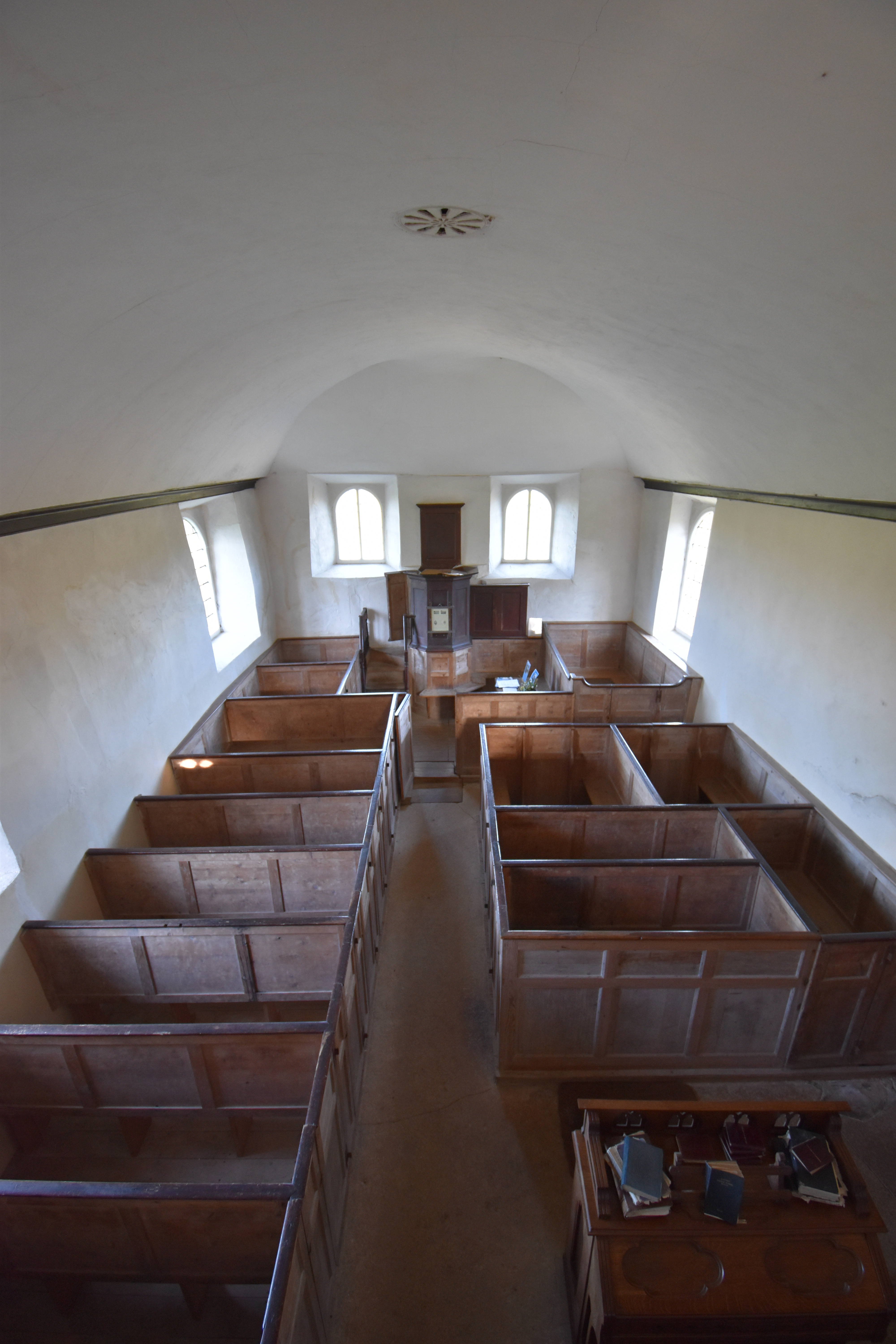
Inside, the chapel is a study in functional nonconformist space. Unvarnished pine pews, arranged in simple ranks, face a high‑set pulpit that dominates the room. The pulpit, with its Bible rest and commanding position, embodies the priority of preaching over sacrament or ceremony. Under the gallery are two rest rooms with fireplaces and basic cooking facilities, used by those who had travelled long distances—some as far as sixty‑five miles from Shebbear in north Devon—to spend whole Sundays in worship and fellowship. Above, the gallery itself retains music rests and a hole cut in the bookrest to accommodate a bass violin, evidence that unaccompanied psalm‑singing was not the only musical practice here.
Beneath the floor, directly in front of the pulpit, lies the baptismal pool, fed by a nearby stream and reached by three stone steps. Its position at the centre of the interior makes theological sense: believers’ baptism was the defining practice of the congregation, marking a conscious, adult commitment to faith. Candidates descended into the water in full view of the gathered church, an act that both affirmed their membership and, in the eyes of critics, confirmed their radicalism. The pool’s integration into the fabric underlines how closely architecture and doctrine were aligned in this place.
One of the few memorials inside the building is the wall tablet to the minister Isaac Hann, whose interment within the chapel is highly unusual for a nonconformist setting. His tablet, effectively an indoor gravestone, signals the depth of pastoral attachment between minister and people. Another figure associated with Loughwood, Deborah Huish (1628–1662), illustrates the intellectual and emotional intensity of this religious culture. Her conversion narrative, published in London in 1658 as The Captive Taken from the Strong, describes a period of profound spiritual despair, shaped by Calvinist anxieties about election and blasphemous thoughts, followed by a painstaking engagement with scripture that led her to embrace believers’ baptism. The elders of Loughwood endorsed her testimony, and its publication was intended not only to edify readers but to strengthen links between Baptist congregations in Ireland and Devon.
The chapel was also a node in a wider network of political and religious radicalism. Elders such as William Allen and John Vernon moved between Devon and Ireland with Cromwellian regiments, recruiting to the Baptist cause and engaging with the Fifth Monarchist movement, which anticipated the imminent rule of Christ on earth. Thurloe’s state papers show that their activities were closely watched by government spies, and that meetings of Baptists and Fifth Monarchists in places like Dorchester were read as potential threats to the post‑regicide settlement. In 1659 Allen, Vernon and others signed the broadside An Essay Toward Settlement, calling for the abolition of kingship and the House of Lords and for a godly commonwealth governed according to scripture. Orders for their imprisonment and banishment followed in 1661, though they seem to have evaded enforcement.
Loughwood’s origins are also tied to continental Protestantism. Huguenot refugees, notably the De Phippen family who settled in nearby Seaton, played a role in establishing the chapel; it is likely that Jean de Phippen provided the land on which it stands. Over time the family adopted the surname “French”, a name that recurs in the burial ground and among the deacons, a quiet trace of the chapel’s transnational roots. The graveyard itself, with its modest stones and former stables, speaks of a community prepared to invest in infrastructure—places to tether horses, rooms to rest and eat—to sustain long‑distance attendance at worship.
By the nineteenth century, as attitudes to Baptists softened, Loughwood shifted from clandestine refuge to “mother church”, seeding new congregations in the region. A daughter church was openly founded in Kilmington in 1832, and the pattern of worship gradually moved there as the old meeting house deteriorated. By 1969 services had ceased at Loughwood, the thatch had been replaced by slate, and the building was in serious decay. Its transfer to the National Trust and subsequent restoration, including the reinstatement of the thatched roof, secured the survival of a rare physical witness to seventeenth‑century nonconformity. Today the interior still presents the same stripped‑back arrangement of pews, pulpit, gallery and pool that once drew in worshippers from across Devon, and the chapel continues to function as a material record of how a small rural community negotiated questions of authority, conscience and belonging in a period of intense religious and political experiment.