

Most people walking along the Kensey today notice it as an attractive little river winding its way through a pleasant valley towards the Tamar. For most of its history, however, people looked at the Kensey rather differently. To previous generations it represented power, industry and profit. The river's flow was harnessed repeatedly through the construction of leats, artificial channels designed to divert water away from its natural course and put it to work. As a result, the valley became lined with mills, tanneries and other commercial enterprises that depended upon a reliable supply of running water.
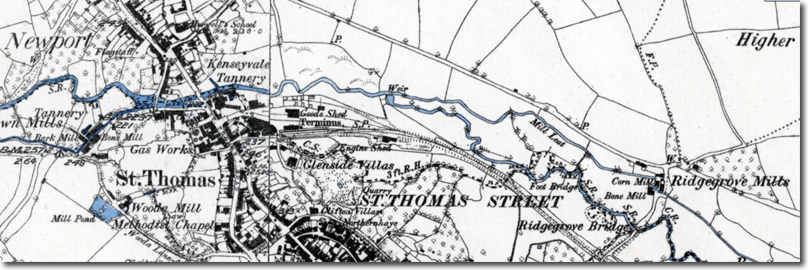
The importance of the Kensey can still be traced through the landscape. Near Newport a substantial leat can be seen branching from the river close to East Bridge. This supplied water to local industry, including the tanneries that once operated nearby. Tanneries were notoriously thirsty businesses. Large quantities of water were required at various stages of the tanning process and access to a dependable river was often essential to their success. Whilst the smell associated with tanning was rarely appreciated by those living nearby, it created employment and formed an important part of the local economy for centuries.
Water power was equally important. Long before steam engines arrived in Cornwall, river valleys provided one of the most reliable sources of industrial energy available. Various mills operated along the Kensey, grinding grain, processing agricultural products and supporting local commerce. The remains of some of these enterprises have disappeared beneath later development, but the course of the old leats often survives to reveal where water was once being directed. Even when a mill building has vanished entirely, the engineering required to feed it frequently remains surprisingly visible.
One of the best examples further down the valley was the system supplying the Ridgegrove Corn and Bone Mills. Here yet another leat was cut from the Kensey to divert water towards the mill complex. Corn mills were an essential part of rural life, converting locally grown grain into flour, whilst bone mills processed animal bones into fertiliser and other products. Both relied upon a dependable source of power and the Kensey provided it. The willingness of successive generations to invest time and money constructing artificial channels illustrates just how valuable the river was regarded.
The Kensey therefore functioned as far more than a simple natural watercourse. It was effectively the engine that drove much of the valley's economy. Every leat represented a deliberate attempt to capture some of that energy and redirect it towards human purposes. Looking at modern maps, the repeated diversions of the river can appear almost excessive, but to earlier communities every cubic foot of flowing water represented potential income. The landscape that survives today is therefore not entirely natural but the product of centuries of engineering designed to extract the maximum benefit from the river.
Ironically, many of the industries that once depended upon the Kensey have disappeared whilst the evidence of the water management systems survives. The tanneries have gone, many of the mills have gone, and the workers who maintained the leats have long since passed into history. Yet the channels they dug can still be followed through fields, woodlands and the edges of modern developments. For those willing to look carefully, the Kensey tells the story of a valley whose fortunes were shaped not simply by the river itself but by the ingenuity of the people who repeatedly found new ways to harness its flow.

