

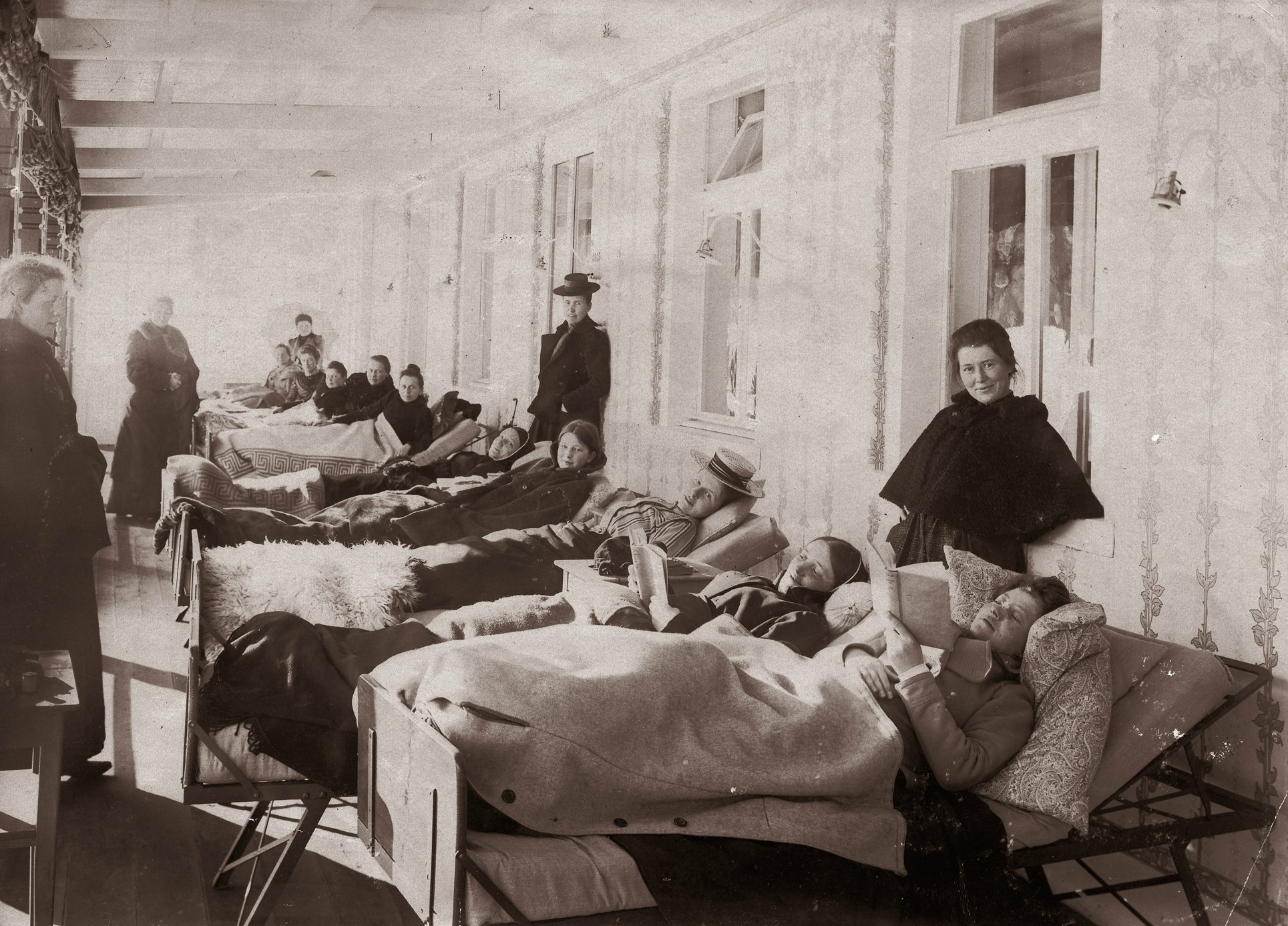
The Boucher family of Eaglemont House appears frequently in the parish records. Charles Boucher lost two daughters within a short period: one died at Rugg’s Farm at the age of thirty, and the other, Helen Boucher, died at twenty‑eight in Davos, Switzerland, on 27 November 1904. Her memorial plaque in the church identifies her as the wife of Captain R. H. Boucher, D.S.O., and the elder daughter of Charles Boucher of Eaglemont. The location of her death is notable. Davos was one of the principal European centres for the treatment of tuberculosis, and her presence there strongly suggests that she was suffering from the disease.
Tuberculosis was a leading cause of death in the nineteenth and early twentieth centuries. Before the development of antibiotics, treatment focused on managing symptoms rather than curing the illness. Physicians believed that high altitude, dry air and prolonged rest could slow the progress of the disease. Davos, situated at over 1,500 metres, offered these conditions and became a major destination for patients from across Europe. From the 1860s onwards the town saw rapid growth in sanatoriums, many of them purpose‑built to house long‑term patients who required months or years of supervised rest.
The development of Davos as a tuberculosis centre was driven by the work of Dr Alexander Spengler and his son Carl, who promoted the idea that the Alpine climate could relieve pressure on the lungs. Their approach attracted patients from Britain and elsewhere, and by the early twentieth century Davos had become a recognised centre for pulmonary treatment. Sanatoriums such as the Schatzalp, opened in 1900, offered regimented routines of rest, controlled exposure to the climate and strict daily schedules. Although the medical basis for these treatments was limited, families often saw Davos as offering the best available care.
Helen Boucher’s presence in Davos fits this wider pattern. Families who could afford it frequently sent relatives to Alpine sanatoriums when tuberculosis was suspected or diagnosed. The fact that her sister died only four years later, also at a young age, may indicate that the disease had entered the household. Tuberculosis was highly infectious, and once present in a family it could spread slowly, sometimes taking years to claim its victims. The Boucher family’s losses therefore reflect the medical limitations of the period and the realities of a disease that affected all classes. The photograph above shows Lung disease patients resting in the sun lounge in Davos in the early 1900s - at the same time that Helen was possibly present. Is she in the photograph even?
Helen’s death in Davos places the Bouchers within a broader European context. The town’s sanatoriums drew patients from across the continent and became a symbol of the struggle against tuberculosis long before effective treatment existed. Her memorial in the parish church, combined with the record of her death in Switzerland, provides a clear link between local family history and the wider history of tuberculosis treatment in the early twentieth century.


