The memorial to Thomas Prockter Ching in St Mary Magdalene Church records the death of a Launceston man involved in the loss of the barque Charles Eaton in 1834. Ching was twenty‑two when he died following the wreck, an event that became widely known at the time because of the small number of survivors and the detailed accounts later published.
The Charles Eaton was a wooden barque launched at Coringa, near Madras, in January 1833. Built of teak and coppered to the wales, she was regarded as a well‑constructed merchant vessel. After arriving in London with a valuable cargo of indigo, she was purchased by Gledstanes & Co. for general trading and passenger service. Her first major voyage took her from London to the Australian colonies, carrying emigrants, pauper children from the Children’s Friend Society, and general cargo.
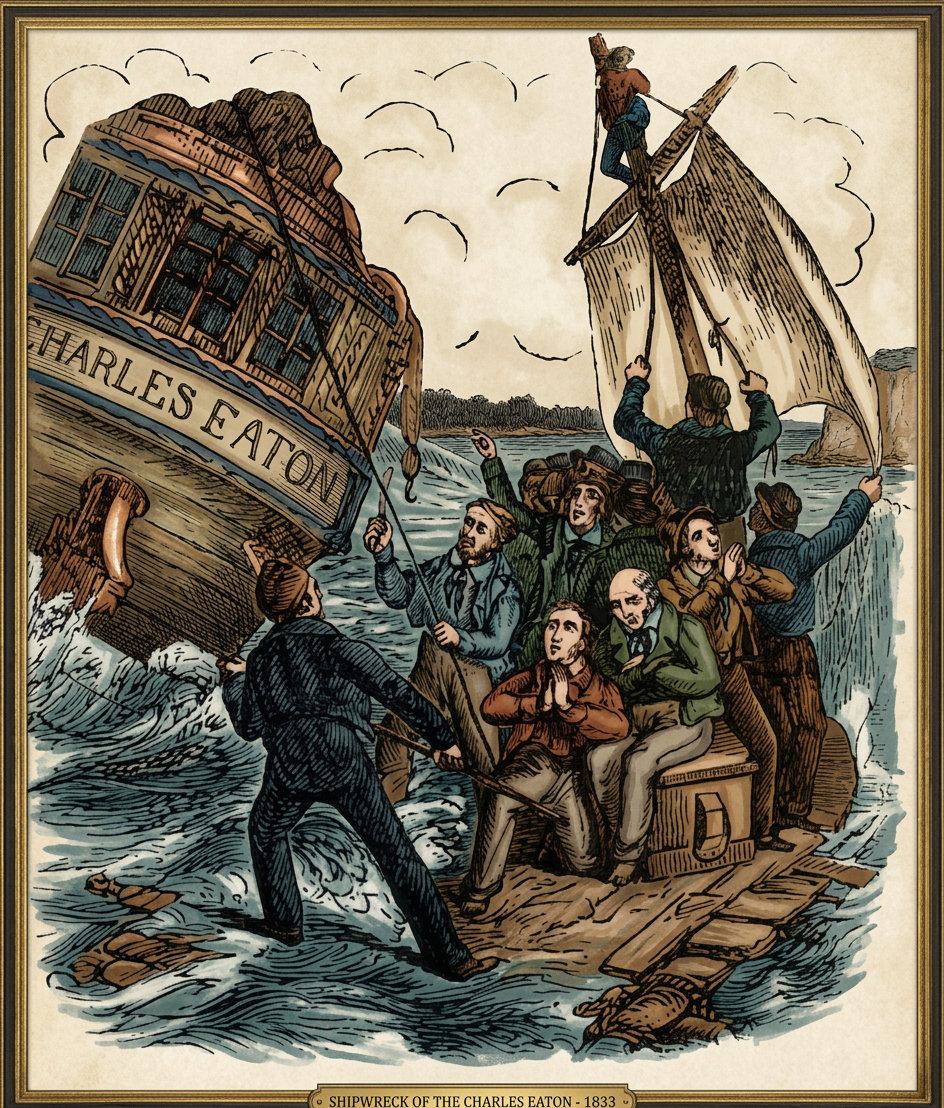
In July 1834 the ship left Sydney bound for Singapore via the Torres Strait. She struck the Great Barrier Reef near the Sir Charles Hardy Islands on 15 August 1834. What followed was a sequence of events reconstructed from the testimony of the only surviving crew member, the ship’s boy John Ireland, and from later rescue reports.
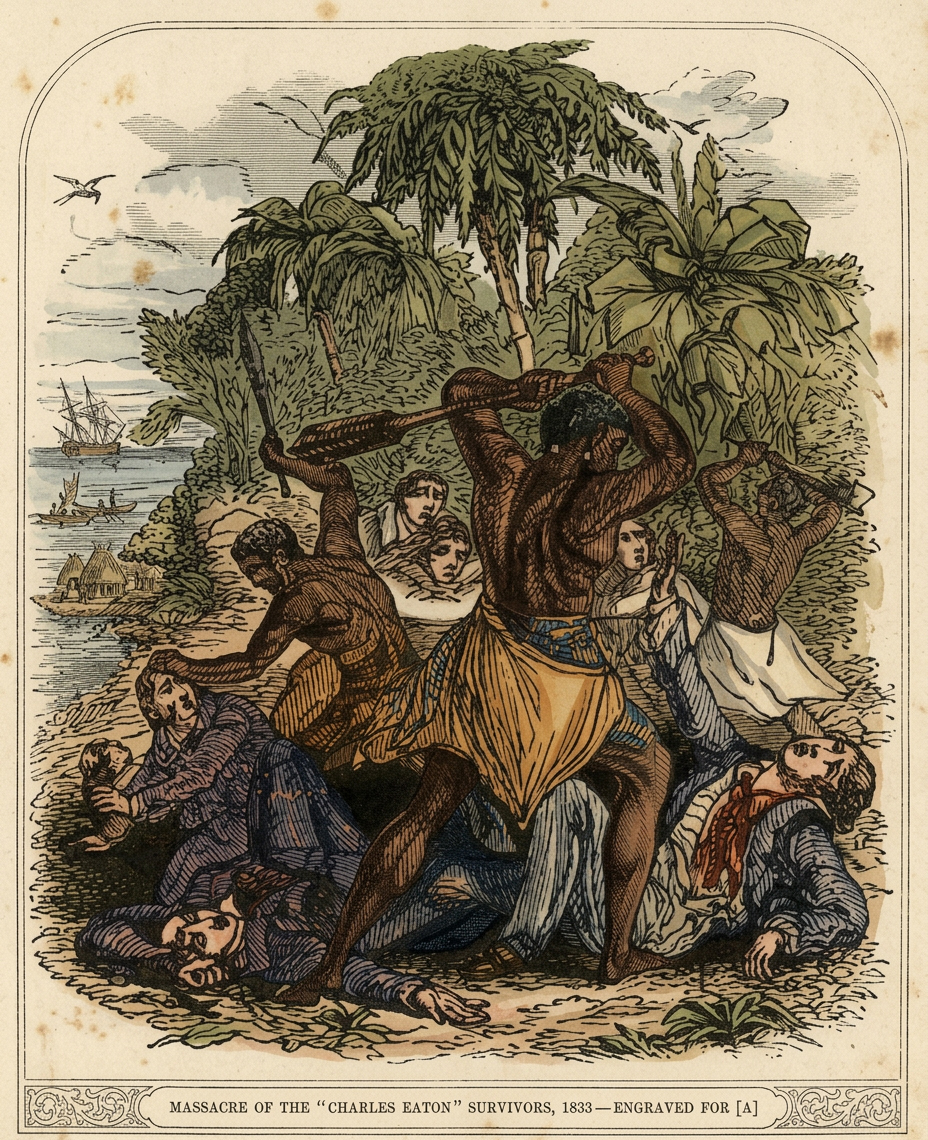
Two rafts were launched from the wreck. The first carried the passengers and several crew, including Captain Moore and surgeon Grant. They reached a small cay, Boydang, where visiting Torres Strait Islanders killed the adults and retained their skulls. The second raft, carrying the remaining crew, met the same fate. Of the twenty‑six or twenty‑seven people left at the wreck site, only four boys initially survived: John Ireland, John Sexton, and the two D’Oyly children, George and William. Sexton and George D’Oyly died soon afterwards.
Ireland and William D’Oyly lived with Torres Strait Islanders for nearly two years, first with the group who had taken them from the wreck and later with Murray Islanders, who treated them comparatively well. They were renamed Wak and Uass and remained on Mer until June 1836.
The colonial schooner Isabella, commanded by Captain Charles Lewis, was sent from Sydney to recover any survivors. Lewis retrieved Ireland and D’Oyly from Mer and, acting on information from neighbouring islands, located a skull house on Aureed containing European skulls and a large turtle‑shell mask. These remains were taken to Sydney and buried in a mass grave in November 1836.
Ching’s memorial in Launceston is one of the few physical reminders in Britain of the Charles Eaton disaster. It reflects the global reach of Cornish families in the early nineteenth century, when young men frequently travelled as sailors, clerks, or traders across the empire. The tablet is typical of its period: plain marble, concise wording, and a focus on the essential facts of his death.
For Launceston, the event is remembered chiefly through this memorial. It links the town to a well‑documented maritime loss and to the wider world of colonial trade, long‑distance travel, and the hazards of navigating the Torres Strait in the age of sail.