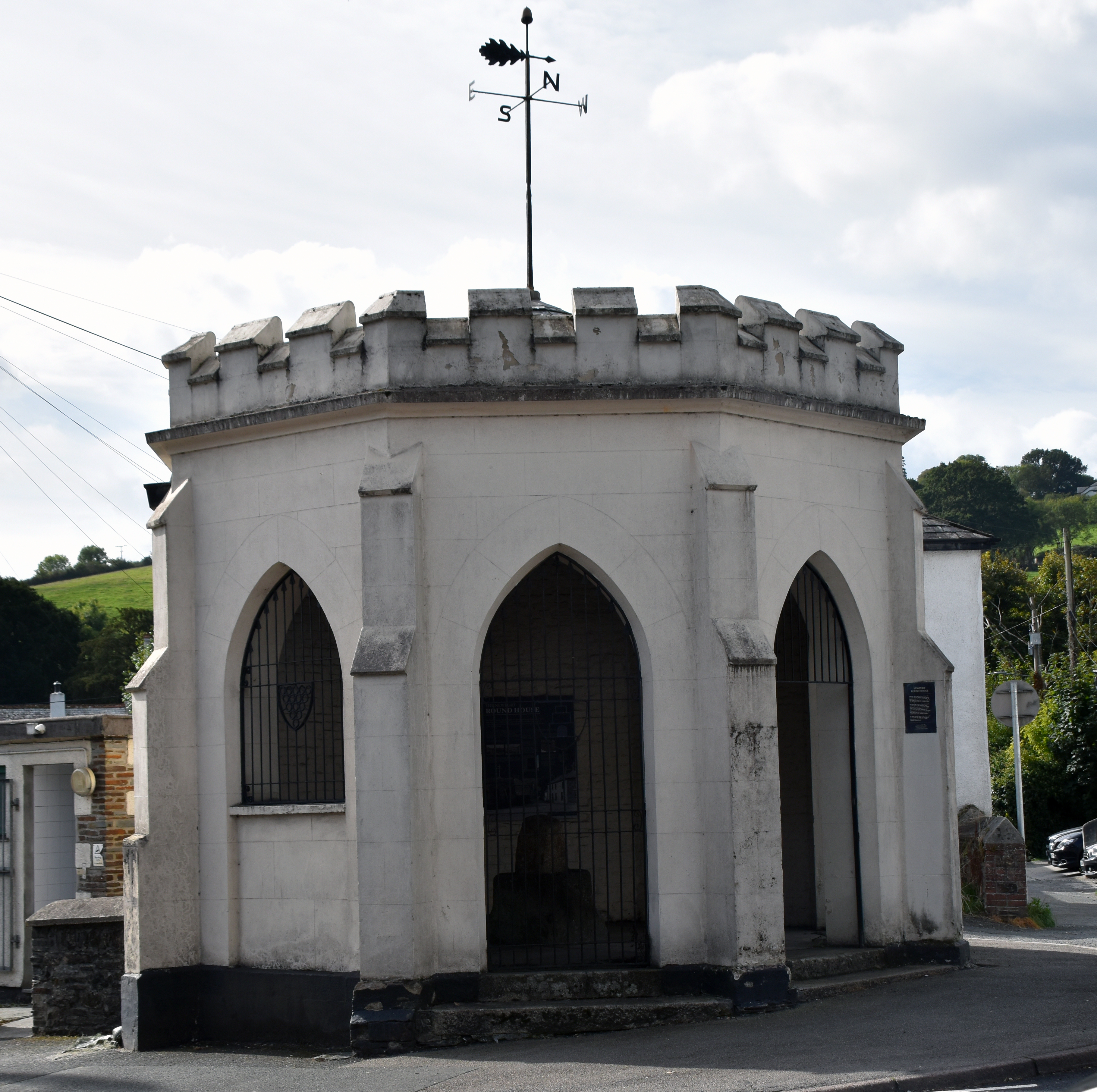
Just beyond East Bridge stands one of Newport's more curious buildings. Known as the Round House, despite being octagonal rather than round, it was built in 1829 by Hugh Percy, 3rd Duke of Northumberland. He modelled it on the ancient Tower of the Winds in Athens, hence its other nickname, the Temple of the Winds. It was built around the remains of Newport's medieval market cross and served as both a market house and a place where election results were announced. Whilst it may look like little more than an eccentric folly today, it was actually one of the final architectural flourishes of a political system that was already on its deathbed.
Newport had enjoyed the right to return two Members of Parliament since Tudor times. When first granted this privilege it was a respectable enough settlement but over the centuries it failed to grow in the way that larger towns and cities did. Despite this, it retained exactly the same parliamentary representation. By the nineteenth century Newport had a population of only a few hundred people but still elected two MPs. Even more remarkably, only a tiny number of people actually had the right to vote. Ownership of particular properties known as burgages determined who could vote and by 1831 there were only around a dozen eligible electors. This made it very easy indeed for a wealthy landowner to control the result.
That landowner was the Duke of Northumberland. The Percy family owned extensive property in and around Newport and effectively controlled the borough. Hugh Percy himself had previously sat as MP for nearby Launceston before inheriting the dukedom and moving to the House of Lords. Elections were still held and votes were still cast but everybody knew where power really lay. Newport was therefore one of the classic Cornish Rotten Boroughs. The Duke did not need to stand for election himself. Instead he could largely determine who Newport sent to Westminster.
The timing of the Round House makes it particularly fascinating. Percy built it in 1829, only three years before the Great Reform Act swept Newport's parliamentary representation away altogether. The building was intended to serve as the centre of Newport's political life yet almost as soon as it was completed the political system it represented ceased to exist. The borough was abolished in 1832 and incorporated into an enlarged Launceston constituency. A structure built to celebrate Newport's ancient privileges suddenly found itself commemorating something that had already become history.
It would be wrong, however, to portray Hugh Percy simply as a villain defending a corrupt system. Like many nineteenth-century aristocrats he combined self-interest with a genuine sense of local responsibility. The Round House was built at his own expense and nearly two centuries later remains one of Newport's most distinctive landmarks. Yet it is impossible to separate the building from the borough that created it. Every gust of wind that whistles through its arches seems to echo with the voices of candidates, voters and political patrons from a vanished age. Few buildings capture the strange world of the Rotten Borough quite so effectively as this little octagonal shelter beside the road.