

Coulson’s Park in Lostwithiel is one of those riverside spaces where history, memory and landscape fold quietly into one another. At first glance it appears simply as a green sweep beside the River Fowey, a place for dog walkers, families and those seeking a moment of calm. Yet the park’s existence, its early character and even the way it looks in old illustrations are all tied to the extraordinary life of Nathaniel “Tommy” Coulson, a man who began in poverty in Cornwall and ended his days as a wealthy benefactor in San Francisco.
The land that became Coulson’s Park was once the town’s common, a practical space used for grazing and access to the river. In August 1906 it was formally opened as a public park, funded by a £100 gift from Nathaniel Coulson, a sum equivalent to around £10,000 today. His intention was to give Lostwithiel a place of peace and recreation, a riverside retreat with a bandstand and a children’s play area. For many years after its opening, cattle still grazed the grass, a reminder that this was a working town and that leisure and agriculture often overlapped.
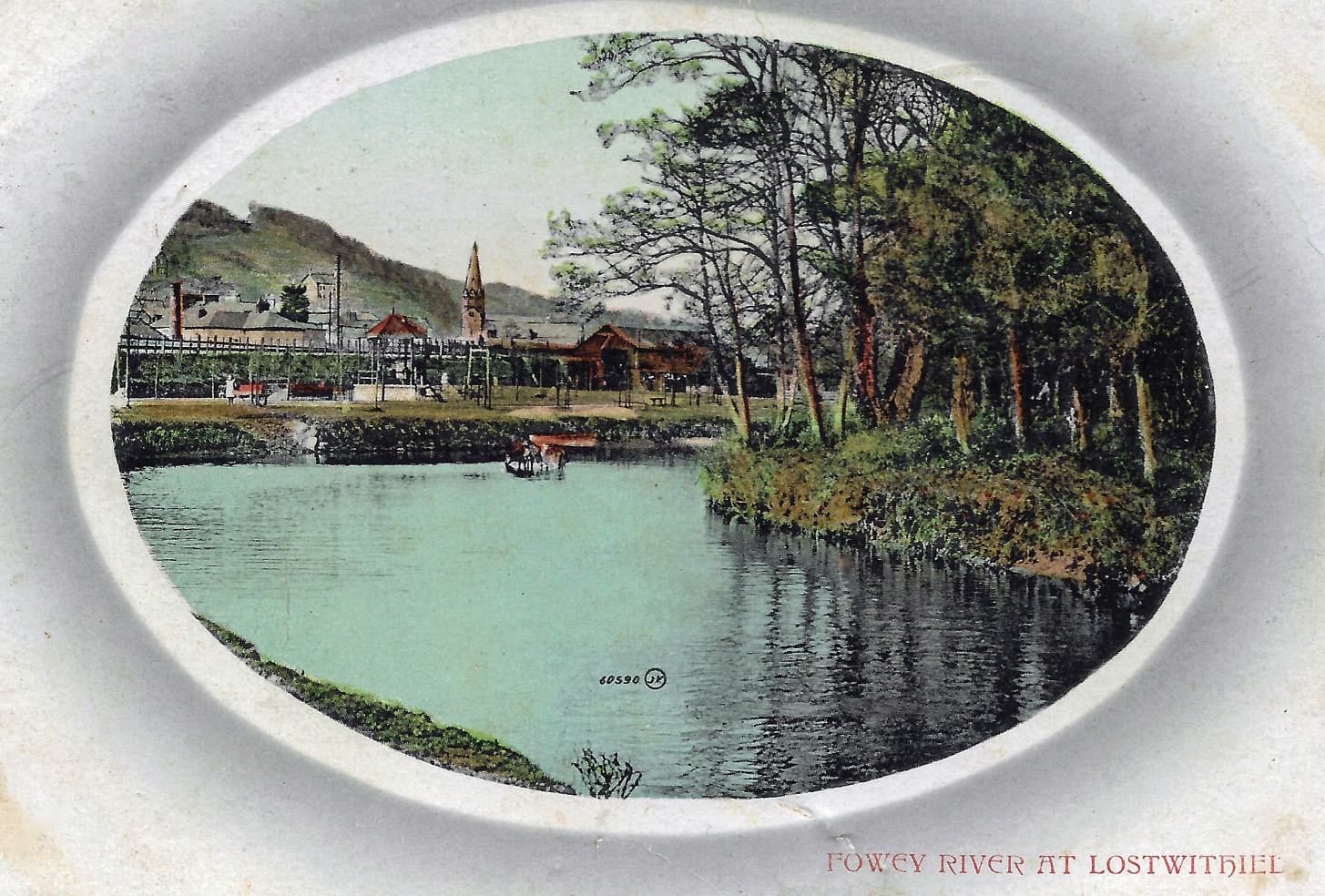
Early images of the park show it in its Edwardian prime. One vintage postcard, captioned “Fowey River at Lostwithiel,” captures the scene with remarkable clarity: the calm river in the foreground, the fenced park with benches along the bank, the bandstand rising among the trees, and the church spire anchoring the skyline behind. A small boat glides across the water, and the whole composition is framed in an oval, as if inviting the viewer to step into a gentler era. It is one of the best surviving depictions of Coulson’s Park as it looked in the years after its creation, when the bandstand was still new and the park felt like a proud civic achievement.
The bandstand itself was a wooden structure surrounded by seating, offering a place to listen to music while steam trains passed behind on their way to and from Fowey. On summer afternoons, families could sit and watch the river while the sound of brass instruments mingled with the rhythmic clatter of the railway. By the 1960s, however, the bandstand had deteriorated beyond repair and was dismantled, leaving only its memory in photographs and postcards.
Another structure once stood nearby: a shelter built in 1936 to commemorate the Silver Jubilee of King George V and Queen Mary. For decades it provided a quiet place to sit, sheltered from the rain, looking out over the river. In 2011 it suffered severe damage and had to be removed. Today, benches take its place, offering simple but welcome spots to rest and watch the Fowey’s changing tides. A modern children’s play area now stands near the entrance from Pill Cottages and Dark Lane, continuing the park’s long tradition of providing space for younger generations.
The park road, which begins as a gentle riverside lane, eventually becomes the only access route for large vehicles heading to the Lostwithiel Wastewater Treatment Plant. It is not suitable for private cars beyond the park itself, and this limitation helps preserve the quiet character of the riverside. When the road was strengthened in 1992, the Environment Agency required that the width of the river be maintained. Cutting back the opposite bank unexpectedly revealed the remains of a 19th-century wooden barge, a relic from the days when vessels carried goods between Lostwithiel and Fowey. The barge was recorded and then reburied to protect it, but its discovery added another layer to the park’s story, linking the modern landscape to the town’s mercantile past.
Behind all of this lies the remarkable biography of Nathaniel Thomas Coulson. Born in Penzance on 8 August 1853, he lost his mother before his first birthday. At six years old his father abandoned him to the Bodmin workhouse, a harsh beginning for any child in Victorian Cornwall. At ten he was apprenticed to Thomas Hoar at Penquite Farm near Lostwithiel, where he worked long days and found solace in the Methodist Church. The navy offered him a way out, and he travelled widely before eventually settling in San Francisco. There he trained as a dentist, invested shrewdly in property and became a wealthy man, far removed from the circumstances of his childhood.
Despite the distance, Coulson never forgot Lostwithiel. His donation to create Coulson’s Park was an act of gratitude to the town that had shaped him. But his philanthropy extended far beyond Cornwall. In 1939 he funded a 44-bell carillon for Grace Cathedral in San Francisco, a major cultural gift to his adopted city. The Photograph below from the time shows him present as the six-ton Bourdon bell was unloaded. The carillon was temporarily installed in the Tower of the Sun at the Golden Gate International Exposition on Treasure Island, where its bells rang out over the fairgrounds. Coulson personally chose a name and Bible verse for each bell. The Peace Bell bore the inscription from Isaiah, “Nation shall not lift up sword against nation,” a message of hope in the time of international tensions in the lead up to the Second World War just a few months later.
Nathaniel Coulson died on 18 December 1945 at the age of ninety-two and was laid to rest in the columbarium of Grace Cathedral. His life had spanned continents and extremes of fortune, from the Bodmin workhouse to the cultural institutions of San Francisco. Yet in Lostwithiel his legacy is quieter and more intimate. It is found in the shade of trees grown tall since 1906, in the laughter from the play area, in the benches overlooking the river and in the knowledge that this peaceful space exists because a man who once had nothing chose to give something lasting back.
To walk through Coulson’s Park today is to see how these different layers of its history still sit quietly alongside one another. The paths follow the lines of the old common, the river continues to shape the land as it always has, and the site of the bandstand is now simply open grass. The church spire remains a familiar landmark, just as it appears in the postcard, and trains still pass along the edge of the park. It is a modest, well‑used green space, shaped by the town’s needs and by the generosity of a man whose early life was tied to Lostwithiel. That connection endures in the park that carries his name.


