

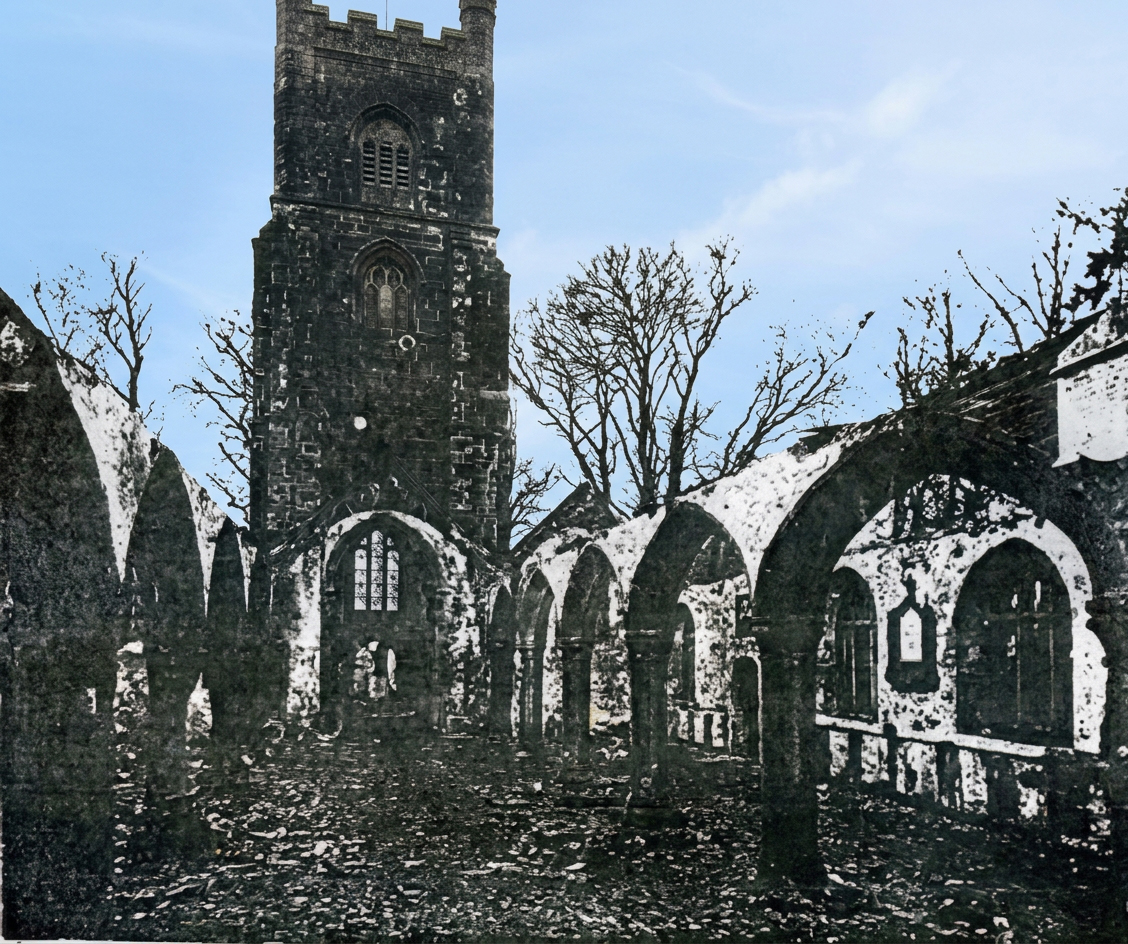
In January 1890 Lewannick’s parish church was destroyed by a fire that originated from a stove lit by the Sexton to heat the building for the following day’s service. During the night the stove ignited adjacent timber, and the fire spread through the interior unchecked. By the time the outbreak was discovered the structure was already compromised and could not be saved.
The church contained medieval and later fabric, including fifteenth‑century roof timbers, pews, screens and carved bench ends. All internal woodwork was lost. The bells were melted and the majority of fittings were destroyed. Surviving elements included the granite Norman font, a pre‑Norman cresset stone, several marble memorial tablets, the two porches and the vestry, all of which withstood the collapse.
The cresset stone, consisting of a granite block with lamp hollows, is considered to be of late Saxon origin. Its survival, along with the Norman font, provided usable liturgical items for the subsequent reconstruction. The memorial tablets also remained structurally intact and were retained.
Following the fire the parish initiated rebuilding plans. Work began later in 1890, using the surviving stonework as the basis for a new structure. The replacement church followed the footprint of the earlier building but employed Victorian construction methods and materials. The restored church incorporated the surviving font, cresset stone and memorials.
The 1890 fire marked the end of Lewannick’s medieval church. The present building dates from the reconstruction undertaken immediately afterwards and contains the limited number of original items that remained intact.

