


Vivian Norman Smith was born on 27 October 1881 in Hampshire, the only son of Norman and Flora Smith. Educated at Connaught House Preparatory School and Sherborne, he showed early artistic promise and went on to study at Calderon’s School of Animal Painting in Baker Street, later continuing at St. John’s Wood Art School and Burlington House. He became known among contemporaries as a gifted painter of horses, admired for his ability to capture movement and character with unusual sympathy. He exhibited several times at the Royal Academy, though he modestly insisted that he painted for pleasure rather than commercial success.
In September 1907 Smith joined Gresham’s School, Holt, as art master. He quickly became a central figure in school life, lodging at Hanworth House with other unmarried staff and hosting informal gatherings where boys were invited to look through his sketches and paintings. His drawing lessons were remembered as both demanding and inspiring, and he threw himself into school sport, playing rugby, hockey and cricket for the masters’ teams. He contributed scenery for school plays, lectured to the Camera Club, and subscribed to the fund for the new cricket pavilion in 1909. By the outbreak of war in 1914 he was a well‑loved and influential member of staff.
When war came, Smith applied to the War Office but, seeing little prospect of a commission, enlisted in September 1914 with the 12th (Public Schools) Battalion of the Middlesex Regiment. Within three weeks he received a commission as Second Lieutenant in the 6th Battalion, Wiltshire Regiment. After training at Perham Downs he was promoted Captain in March 1915 and went to France that July. He was wounded on 4 October 1915 and returned to England to recover. His commanding officer, Lieutenant‑Colonel Shepherd, later wrote of the strain that trench warfare placed on a man of Smith’s temperament, praising his efforts to teach men to sketch in the trenches and his ability to maintain morale despite the “sordid scenes of ruin” that he found deeply distressing.
Smith returned to France in 1916 and took part in several major actions. Two of his paintings, Under the Hawthorn Tree and The Evening’s Return, were exhibited at the Royal Academy that year. His death came on 13 November 1916 during the final phase of the Battle of the Ancre, the last major British attack of the Somme campaign. He was killed by shellfire in Regina Trench, north of Miraumont, while tending to a wounded man. His men carried his body from the line and buried him at Aveluy Communal Cemetery Extension, on a hillside overlooking the Ancre valley.
The Battle of the Ancre, fought from 13 to 18 November 1916, was intended to secure the northern flank of the Somme front before winter. The attack targeted the German positions around Beaumont‑Hamel, Beaucourt and the fortified Regina Trench system. The ground was waterlogged, the weather bitter, and the German defences among the strongest on the Western Front. Although the British captured Beaumont‑Hamel and made gains along the Ancre, the battle marked the end of the Somme offensive. Smith’s battalion was committed to the assault on Regina Trench on the opening day, and it was in this action that he lost his life whilst tending a wounded soldier. His death therefore forms part of the final, costly effort to break the German line before the onset of winter.
Smith was Mentioned in Despatches for “gallant and distinguished service in the Field” on the day he died. He is commemorated at Sherborne, on the Holt War Memorial, and on the memorial of the Royal Academy. His grave at Aveluy and the tributes that survive reflect both sides of his character: the romantic artist who painted travellers, gypsies and working horses, and the practical, courageous officer who led his men with determination in some of the hardest fighting of the war.
Probate records confirm that Smith was living at ‘Beechcroft’, Kilmington, at the time of his death, establishing a direct connection with the parish. His father later resided at ‘Littlehome’, Seaton, and it was to this address that the War Office sent his medals and effects. These details place the family within the Kilmington–Seaton area in the years immediately before and after the war and explain why his name appears on local memorials despite his burial in France.
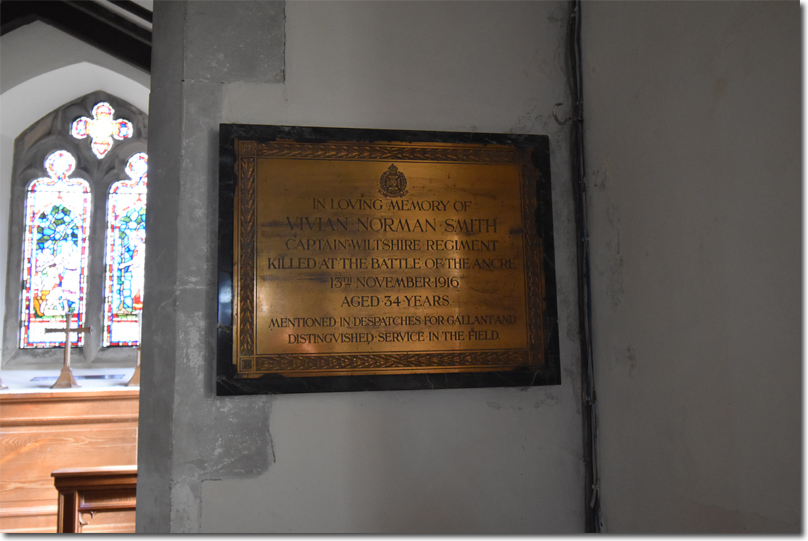
VIVIAN NORMAN SMITH was born on October 27th, 1881. He was educated at Sherborne, and on leaving School he studied art at Calderon's School of animal painting in Baker Street, at the St. John's Wood Art School and at Burlington House. His pictures were exhibited at the Royal Academy on several occasions as well as at other exhibitions. He came to Gresham's School as Drawing Master in September, 1907, and from that time until July, 1914, he took a very active part in all the varied interests of the School.
When war broke out he applied at the War Office, but, as there did not seem much chance of getting a commission, he enlisted in the Middlesex Regiment in September, 1914. Three weeks later he received a commission as 2nd Lieutenant in the Wiltshire Regiment. He was promoted to Captain in March, 1915, and went out to France in July of the same year. He was wounded on October 4th, and was sent to a hospital in England. He returned to France in February, 1916, and took part with his regiment in many engagements. He was killed by a shell in the “Regina trench” in front of Miraumont on November 13th.
The Colonel of his battalion wrote: “May I be allowed to add my sympathy to those of the rest of the brother officers of your son, on the death of your son and our much-beloved companion in arms. I can assure you his loss is regretted by no one more than myself. He was a remarkably brave man, an extremely good soldier and a natural leader of men. Personally, he was of the greatest assistance to me, always cheery, thoroughly to be relied upon on all occasions, no matter how trying they were, making light of difficulties, taking great care of his men, and never sparing himself to look after them. I deplore his loss more than I can say. He was killed, as you probably know, when binding up another man's wound. We carried his body and buried him in the cemetery back behind the lines. His grave is marked. I can only once more offer you my deepest sympathy.”
A fellow-officer wrote: “I am very sorry indeed to have to tell you that Captain Smith was killed by a shell on the afternoon of the 13th. He was killed in our most advanced trench, ‘Regina trench,’ in front of Miraumont. He went out to tie up a wounded man, and a shell landed in the trench, and he was killed instantly. We got him out yesterday and buried him in the cemetery at Aveluy. A wooden cross is being put up on the grave. I went to the funeral service last night. The cemetery is on the side of a slight hill below the village. We buried him with the ruined church and the sunset as a background and the roll of guns his requiem. I cannot say how sorry I feel. The regiment has lost a good soldier, the company an able and popular commander, and I a friend.”
An Old Boy writes: “I have heard of the death, in action, of Captain V. N. Smith. May I express, through you, my sympathy with those who, like myself, have lost, by his death, a sincere friend. He was a man from whom I had learned much. As an artist he was in the foremost ranks of the animal painters of his day. He portrayed horses with a sympathy and understanding that few could equal. His more serious work was not widely known. As he himself said of it ‘It is not the sort of stuff the public want to buy. I do it because I like it.’ It was a true self-expression. While he loved the romantic and imaginative thoughts of mediaevalism, he loved more the lives of those who wander—the lives of gypsies, of travellers, tinkers and circus folk, of poachers and pedlars. He loved great gloomy stables and the vastness of cathedrals in the evening time. Yet his work showed a knowledge of earthly strife, of the necessity of toil and the labour of the poor. He was not concerned with the actual progress of work, but with the rest that comes after work. Such pictures as ‘The Day’s Work Done’ and ‘Under the Hawthorn Tree’ will explain what I mean. Through the tranquillity of the scenes we are forced to recognise the toil of the day that preceded the rest of the evening. It was his expression of the yearning for that peace in life which he was destined to attain only in death.”
A present member of the School writes: “We can never forget Mr. Vivian Smith; he was and is too much an integral part of the school. His boys, past and present, must always remember that wonderful personality which is still so potent here that every new boy seems to know him. We can never forget his merry tea-parties at Hanworth House. It was especially our delight to look through his sketches and paintings, as we sat by the fire in the well-known room. How much our teams, and especially our scrums, have missed his energetic example and inspiriting coaching! The drawing lesson, too—why even we non-artists looked forward to it with pleasure, though not without some trepidation, for, quite honestly, while we loved him with all our heart, we also feared his tremendous will.”

