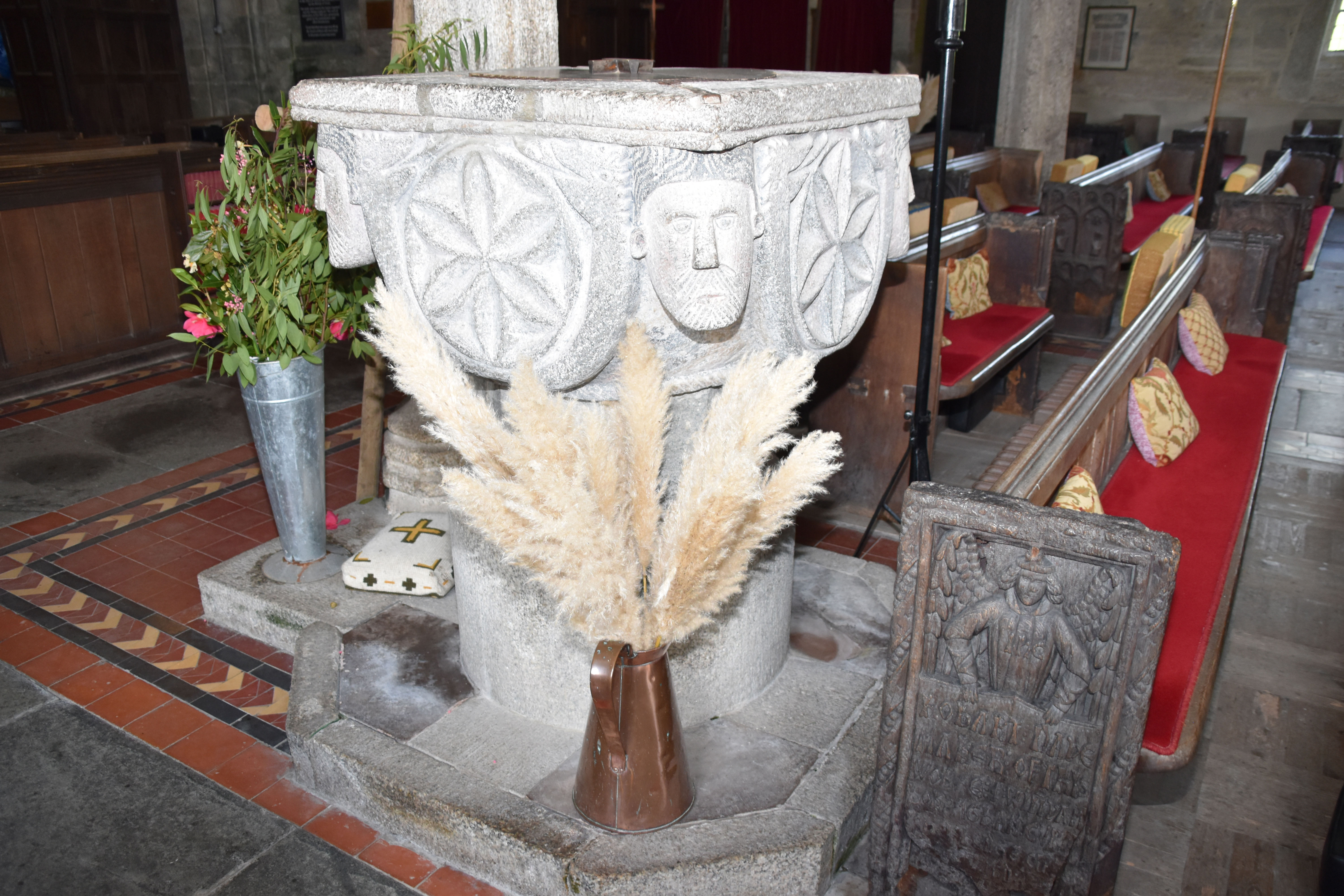
The Norman font at Altarnun is one of the largest in Cornwall and one of the most striking. It stands near the south door of St Nonna’s, a massive square bowl on a later shaft, carved in a style that is as uncompromising as the moorland around it. This is not refined Gothic work but something much earlier and more primitive in feeling, dating from the early twelfth century.
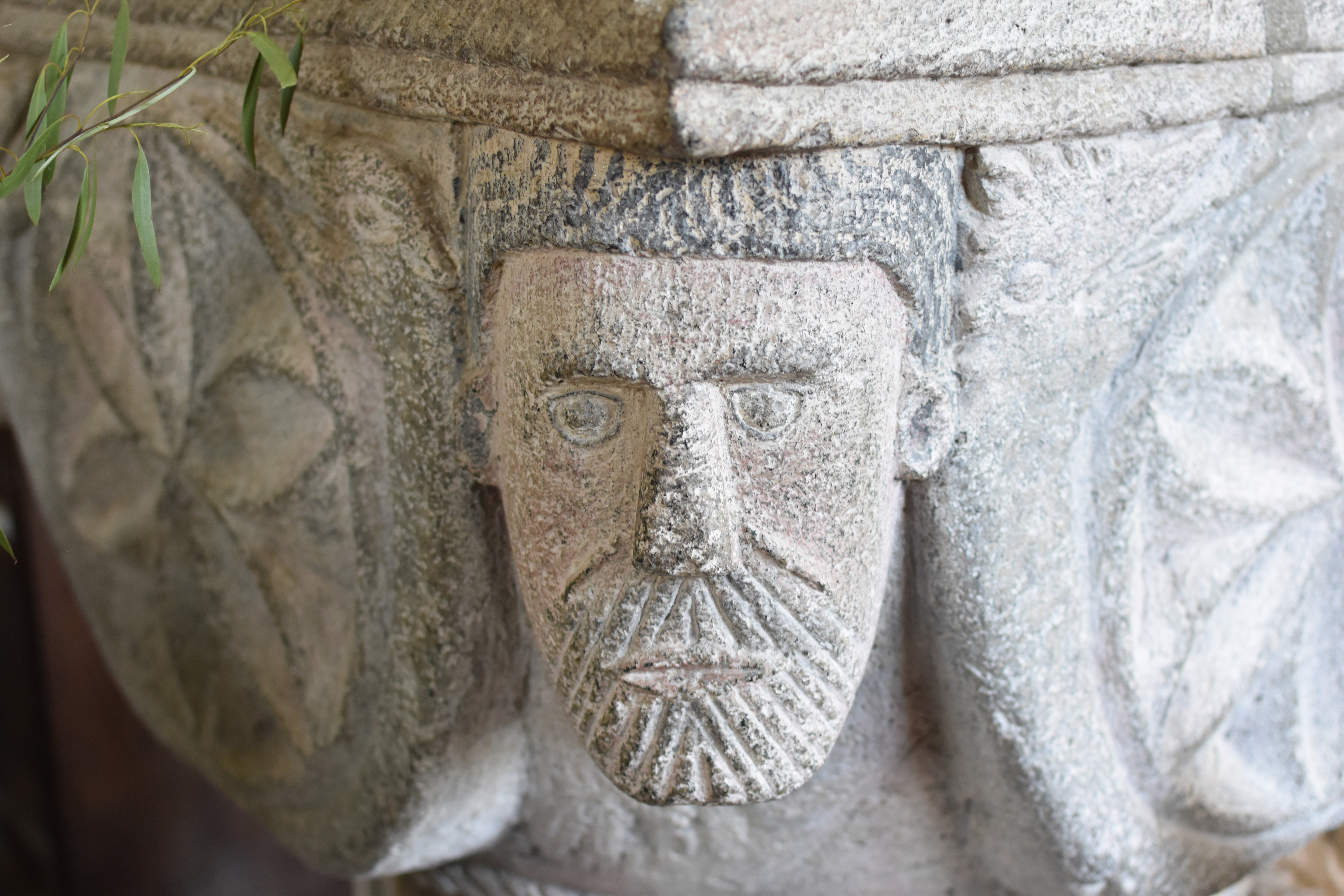
Each corner of the bowl carries a bearded head, roughly carved and faintly grotesque. Traces of original paint still cling to the stone, a reminder that these heads were once vividly coloured. On each face of the bowl a large radial motif or “flower” is carved, and around each of these a serpent coils, its body looping around the petals. At the base of the bowl runs a heavy cable moulding. The whole composition is forceful, functional and, to modern eyes, almost pagan in its imagery.
There is no delicacy here. A crude face leers at you from each corner; the sides are dominated by a single bold motif, repeated on all four faces, with serpents entwined around it. The design is entirely consistent, as if the mason had one idea and pursued it relentlessly. The result is a font that looks as if it belongs to an older religious world, where baptismal water and carved serpents could coexist without embarrassment.
This distinctive combination of features — square bowl, bearded corner heads, radial motifs and coiled serpents, with a cable moulding below — has given its name to a whole group of similar Norman fonts in the region. Architectural historians refer to them collectively as “Altarnun Fonts”, taking their title from this, the largest and best-known example.
Other churches with fonts of the Altarnun type include:
Beyond Cornwall, related fonts with similar square bowls, corner heads and heavy Norman mouldings are found in some border parishes of Devon, reflecting the reach of the same workshop tradition. Taken together, these fonts form a recognisable family: massive, square, with heads at the corners and bold, repetitive carving on the faces.
Altarnun’s font is the archetype because it preserves the scheme in such a complete and legible form. The bearded heads, the serpents, the radial “flowers” and the cable moulding are all present and still clearly visible, despite centuries of use. The survival of paint traces is particularly important, reminding us that these objects were once brightly coloured and far less austere than they now appear.
In a church otherwise dominated by late medieval Perpendicular work, the Norman font anchors St Nonna’s in an earlier phase of Christian Cornwall. It is a piece of sculpture that has outlived the building that first housed it, and it has lent its name to a whole group of fonts across the north of the county. To understand the “Altarnun Fonts”, you begin here, at the south door of the “Cathedral of the Moors”, with a square block of stone, four bearded faces and a ring of serpents.