

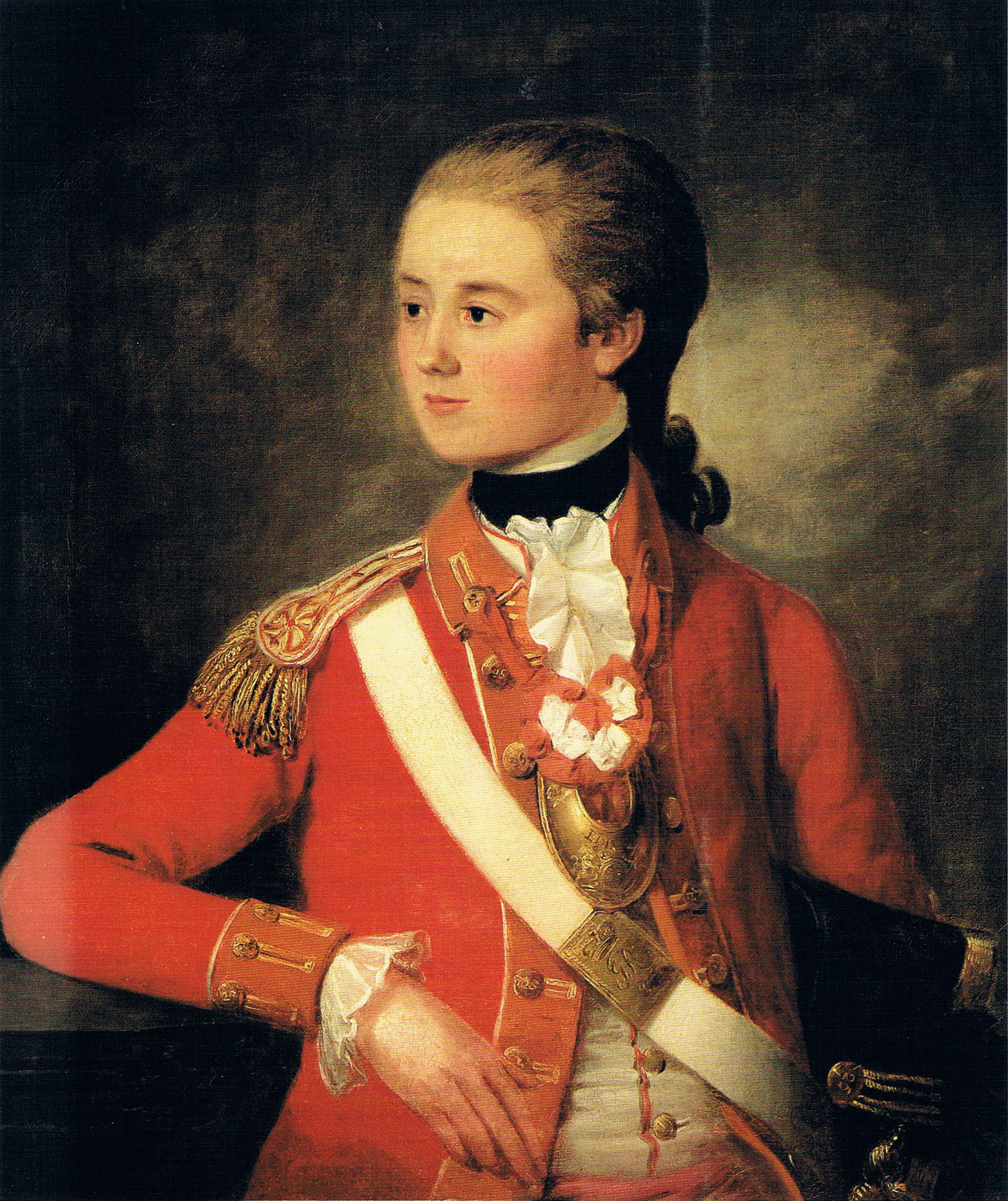
The portrait is of John Stewart of East Craigs who joined the 25th Edinburgh Regiment on 19 Aug 1780. The uniform conforms to the changes made in the Clothing Warrant of 19 Dec 1768. The lapels were 3 inches wide from neck to waist, having gilt buttons evenly spaced on both lapels, and gold lace button-holes. The collar was turned down, called a cape, and had a button on either side with a gold lace button-hole; and the cuffs were to be small and round with four buttons and button-holes. The colour of the collar, lapels and cuffs is depicted as dull orange. This differs from the deep yellow shown in the paintings made in Minorca, known as the Ponsonby paintings. There is also a white piping edge to them.
The single epaulette on his right shoulder is embroidered with a gold pattern and has a fringe made from a mixture of fine and twisted bullion. The single epaulette was worn by all officers except for flank company officers and did not signify rank at this stage. The Minorca paintings show officers wearing white waist-belts to support their swords, but at some stage in the 1770s the shoulder-belt was adopted, although this was not officially made regulation until 1788. So the gilt belt plate is the first pattern. The gorget is hung quite low on the neck, suspended with orange ribbons from the collar buttons. The rosette formed from the ribbon, mixed with white, is unusual and suggests the custom of the Minden regiments of celebrating the anniversary of the battle with red and white roses. The gorget is engraved with the Royal Arms and the word ‘Edinburgh’. The regiment was still known as the Edinburgh Regiment until 1782 when they were inappropriately ‘territorialised’ as the Sussex Regiment.
The gilt belt plate depicted here is therefore the earliest pattern associated with the regiment’s adoption of the shoulder-belt in the late 1770s.

